
Comparison DeWALT DCG416VSN vs DeWALT DCG418X2
Add to comparison | 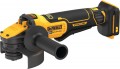 | 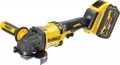 |
|---|---|---|
| DeWALT DCG416VSN | DeWALT DCG418X2 | |
from $354.00 | Compare prices 1 | |
| TOP sellers | ||
Model DCG416VSN is shipped without battery and charger. | Includes XR VLEXVOLT system batteries capable of delivering 54V (3Ah) or 18V (9Ah). | |
| Type | angle grinder | angle grinder |
| Power source | battery | battery |
Specs | ||
| Rotation speed | 9000 rpm | 9000 rpm |
| Max. disc diameter | 125 mm | 125 mm |
Protective functions | ||
| Soft start |  |  |
| Safety lock-off | | |
| Electronic motor protection | | |
| Motor brake | | |
| Kickback protection | mechanical | mechanical |
Additional features | ||
| Features | speed controller brushless motor | brushless motor |
| In box | additional handle without charger | additional handle charger DCB118 case (bag) |
Battery | ||
| Battery in set | is absent | 2 |
| Battery platform | 18V XR | DeWALT 54V XR FLEXVOLT |
| Battery voltage | 18 В | 54 В |
| Battery capacity | 3 Ah | |
| Battery type | DCB547 | |
| Compatible batteries | DCB183G, DCB183, DCB184G, DCB184 | DCB546, DCB547, DCB548 |
| Charging time | 75 min | |
General | ||
| Noise level | 95 dB | |
| Weight | 1.95 kg | 3.64 kg |
| Added to E-Catalog | march 2023 | september 2021 |


Compare DeWALT DCG416VSN and DCG418X2
Price comparison
You may be interested in
DeWALT DCG416VSN often compared


Glossary
Soft start
Soft start ensures a smooth motor acceleration of the grinder with relatively low acceleration. This is achieved by limiting the start-up current. Soft start performs two functions: it prevents sudden jerks of the tool, reducing the risk of dropping it, and also decreases the load on the electrical network, helping to avoid significant voltage spikes.
Features
— Speed Controller. The ability to limit the engine's maximum speed. Essentially, this function is a smooth speed adjustment; it's convenient when full speed isn't required — for example, in delicate tasks where precision is more important than performance. Note that this feature is found in all types of sanders — including those with a vibrational or belt operation (see "Type"): even in these machines, the vibration frequency or belt speed is determined by the engine's rotations.
— Speed Maintenance. The ability to maintain a set number of rotations regardless of the load on the working attachment. This function is implemented through automation, which adjusts the engine's power accordingly — increasing it under more load and decreasing it under lighter load. Constant rotation speed positively affects both the quality of processing and the lifespan of the working attachments and the tool itself.
— Brushless Motor. The presence of a brushless motor in an electric sander (see "Power Source"). These motors are considered more advanced than traditional brushed motors: they are more energy-efficient, quieter, and do not spark, which can be crucial in fire-hazardous environments. The main downside of brushless motors is their high cost.
— Lighting. This feature is undoubtedly desirable when working in lo...w-light conditions. However, it can also be useful in bright external light: the work area often ends up in shadow (e.g., from the tool itself), making it difficult to work without special lighting.
— Display. A built-in display that can show various information about the device's operation and status. Such a screen provides additional convenience and clarity, but overall, it is quite a specific feature that is rarely found in modern power tools.
— Smartphone Synchronization. The ability to connect the tool to a smartphone or other gadget (like a tablet) via Wi-Fi or Bluetooth. Such a connection is usually used for adjusting work parameters; it's often more convenient to do this through a mobile app than through the controls on the tool itself.
— Rotating Main Handle. The ability to rotate the main handle of the sander around the longitudinal axis. This feature is mainly found in angle models (see "Type") — it provides extra convenience, allowing you to adjust the handle's position according to the situation. This is important for working in unusual positions and hard-to-reach areas.
— Keyless Disc Replacement. The ability to change discs in a sander (usually angle, see "Type") without using keys and other additional tools. The convenience of this feature is clear: you don't need to constantly have a key on hand, keep track of it not getting lost, etc. However, keyless mounting is considered somewhat less reliable than keyed mounting, so it's rarely found in heavy-duty professional models.
— X-LOCK Mounting System. An advanced mounting system for the working attachment, used in some angle machines (see "Type") — predominantly made by Bosch and Makita. This system is somewhat more expensive than traditional 22-millimeter mounting using a nut or washer, but it has several advantages. Firstly, X-LOCK provides the simplest and quickest installation: no need to fuss with additional parts or tools, just place the disc on the spindle and press until it clicks; for removing the attachment, just press a button that disables the lock. Secondly, you can only install the attachment in one correct way relative to the tool — the design of the mounting disallows any other way. The main disadvantage of machines with this system is their incompatibility with cheaper and more common 22 mm standard discs; fittings under X-LOCK are not yet available in every hardware store.
— Collet Chuck. A specially designed chuck used in straight grinders (see "Type"). The grip of such a chuck consists of several elastic petals (usually 2-3) that compress when tightened, securing the working attachment. The main advantages of collets are the speed and convenience in changing attachments, simplicity of design, and low cost.
— Coolant Supply (Coolant). The ability to supply coolant to the work area. This function is mainly found in machines for stone and concrete (see "Type"), as water cooling is most relevant for these materials: it not only prevents overheating but also reduces dust formation. The machine provides a nozzle directed at the working attachment and a fitting for connecting to a water hose.
— Dust Collector Connection. The ability to connect a dust collection container to the tool for collecting dust and other debris generated during operation. Such a container may come with the machine, but this is not guaranteed, and this point should be clarified separately. In any case, a dust collector, while not providing 100% protection against debris, significantly reduces it and simplifies cleanup afterward. Dust collectors can be either reusable or disposable.
— Speed Maintenance. The ability to maintain a set number of rotations regardless of the load on the working attachment. This function is implemented through automation, which adjusts the engine's power accordingly — increasing it under more load and decreasing it under lighter load. Constant rotation speed positively affects both the quality of processing and the lifespan of the working attachments and the tool itself.
— Brushless Motor. The presence of a brushless motor in an electric sander (see "Power Source"). These motors are considered more advanced than traditional brushed motors: they are more energy-efficient, quieter, and do not spark, which can be crucial in fire-hazardous environments. The main downside of brushless motors is their high cost.
— Lighting. This feature is undoubtedly desirable when working in lo...w-light conditions. However, it can also be useful in bright external light: the work area often ends up in shadow (e.g., from the tool itself), making it difficult to work without special lighting.
— Display. A built-in display that can show various information about the device's operation and status. Such a screen provides additional convenience and clarity, but overall, it is quite a specific feature that is rarely found in modern power tools.
— Smartphone Synchronization. The ability to connect the tool to a smartphone or other gadget (like a tablet) via Wi-Fi or Bluetooth. Such a connection is usually used for adjusting work parameters; it's often more convenient to do this through a mobile app than through the controls on the tool itself.
— Rotating Main Handle. The ability to rotate the main handle of the sander around the longitudinal axis. This feature is mainly found in angle models (see "Type") — it provides extra convenience, allowing you to adjust the handle's position according to the situation. This is important for working in unusual positions and hard-to-reach areas.
— Keyless Disc Replacement. The ability to change discs in a sander (usually angle, see "Type") without using keys and other additional tools. The convenience of this feature is clear: you don't need to constantly have a key on hand, keep track of it not getting lost, etc. However, keyless mounting is considered somewhat less reliable than keyed mounting, so it's rarely found in heavy-duty professional models.
— X-LOCK Mounting System. An advanced mounting system for the working attachment, used in some angle machines (see "Type") — predominantly made by Bosch and Makita. This system is somewhat more expensive than traditional 22-millimeter mounting using a nut or washer, but it has several advantages. Firstly, X-LOCK provides the simplest and quickest installation: no need to fuss with additional parts or tools, just place the disc on the spindle and press until it clicks; for removing the attachment, just press a button that disables the lock. Secondly, you can only install the attachment in one correct way relative to the tool — the design of the mounting disallows any other way. The main disadvantage of machines with this system is their incompatibility with cheaper and more common 22 mm standard discs; fittings under X-LOCK are not yet available in every hardware store.
— Collet Chuck. A specially designed chuck used in straight grinders (see "Type"). The grip of such a chuck consists of several elastic petals (usually 2-3) that compress when tightened, securing the working attachment. The main advantages of collets are the speed and convenience in changing attachments, simplicity of design, and low cost.
— Coolant Supply (Coolant). The ability to supply coolant to the work area. This function is mainly found in machines for stone and concrete (see "Type"), as water cooling is most relevant for these materials: it not only prevents overheating but also reduces dust formation. The machine provides a nozzle directed at the working attachment and a fitting for connecting to a water hose.
— Dust Collector Connection. The ability to connect a dust collection container to the tool for collecting dust and other debris generated during operation. Such a container may come with the machine, but this is not guaranteed, and this point should be clarified separately. In any case, a dust collector, while not providing 100% protection against debris, significantly reduces it and simplifies cleanup afterward. Dust collectors can be either reusable or disposable.
In box
— Additional Handle. A separate handle for the second hand. In theory, such equipment may make the tool more comfortable to hold with both hands. However, in practice, the absence of an additional handle is often not critical: many tools without it are either designed for one-handed use (like some straight grinders, see "Type") or have other attachments for the second hand (such as a protrusion on the body). So, to answer whether you need an additional handle, you should consider the type and size of the grinder, as well as the specifics of the intended projects. Note also that by default, such a handle is designed for right-handed use, and the possibility of using it in left-handed operation needs to be clarified separately.
— 3-Position Additional Handle. An additional handle installed on a detachable mount and having three installation options: on the left (traditional option for right-handed use), on the right (for left-handed use), and on top (for specific cases — situations when you need to periodically change grip, work in hard-to-reach places, etc.). This function provides extended possibilities for tool customization according to personal preferences. It is mainly found in angular models (see "Type").
— Charger (C). A device for charging the battery in a grinder with the appropriate power type (see "Power Source"). This section usually specifies...the specific model of the charger. Having a "charger" included relieves you from the need to search and purchase it separately; moreover, such a charger is optimally suited at least to the "native" battery, and often to other compatible batteries. The details on the model will be useful primarily in case the included charger is lost or fails, and you have to buy the same or a similar one instead. Moreover, knowing the model of the charger allows you to find detailed data about it and assess the characteristics and features (compatibility with various batteries, additional functions, etc.). At the same time, the configuration "without charger" is also quite popular — see below.
— Without Charger. This feature is indicated exclusively for battery models (machines with other power types — see "Power Source" — by definition do not have a charger, so this point does not need to be clarified for them). The meaning of such a configuration is that modern grinders most often use standard batteries, which also fit other power tools of the same brand and are thus designed for standard "chargers." Thus, if there is already a battery tool "in the household" — the charger for it may turn out to be suitable for the grinder, and you will not need to pay extra for a second copy of the charger. And even if there is no charger available — it can usually be purchased separately without much difficulty (and some tools even allow you to choose the most suitable model of such a device from several options).
— Case / Bag included. The presence of a case or bag for storing and transporting the tool in the supply kit. The case is a suitcase made of durable material and usually has space not only for the grinder itself but also for working tips and other additional accessories. The bag is soft, allowing it to be compactly folded when not needed. Check the availability of a case or bag directly before purchase.
— Dust Collector. A container for collecting dust and other contaminants generated during work. See "Additional — Dust Collector Connection" for more details.
— Extension Pole. A long pole significantly expands the "radius of operation" of the tool: with such equipment, you can reach greater heights, process a large area without moving the platform or other stand, etc. Such capabilities are mainly relevant when processing walls, so the vast majority of grinders with extension poles included pertain to wall sanders (see "Type").
— 3-Position Additional Handle. An additional handle installed on a detachable mount and having three installation options: on the left (traditional option for right-handed use), on the right (for left-handed use), and on top (for specific cases — situations when you need to periodically change grip, work in hard-to-reach places, etc.). This function provides extended possibilities for tool customization according to personal preferences. It is mainly found in angular models (see "Type").
— Charger (C). A device for charging the battery in a grinder with the appropriate power type (see "Power Source"). This section usually specifies...the specific model of the charger. Having a "charger" included relieves you from the need to search and purchase it separately; moreover, such a charger is optimally suited at least to the "native" battery, and often to other compatible batteries. The details on the model will be useful primarily in case the included charger is lost or fails, and you have to buy the same or a similar one instead. Moreover, knowing the model of the charger allows you to find detailed data about it and assess the characteristics and features (compatibility with various batteries, additional functions, etc.). At the same time, the configuration "without charger" is also quite popular — see below.
— Without Charger. This feature is indicated exclusively for battery models (machines with other power types — see "Power Source" — by definition do not have a charger, so this point does not need to be clarified for them). The meaning of such a configuration is that modern grinders most often use standard batteries, which also fit other power tools of the same brand and are thus designed for standard "chargers." Thus, if there is already a battery tool "in the household" — the charger for it may turn out to be suitable for the grinder, and you will not need to pay extra for a second copy of the charger. And even if there is no charger available — it can usually be purchased separately without much difficulty (and some tools even allow you to choose the most suitable model of such a device from several options).
— Case / Bag included. The presence of a case or bag for storing and transporting the tool in the supply kit. The case is a suitcase made of durable material and usually has space not only for the grinder itself but also for working tips and other additional accessories. The bag is soft, allowing it to be compactly folded when not needed. Check the availability of a case or bag directly before purchase.
— Dust Collector. A container for collecting dust and other contaminants generated during work. See "Additional — Dust Collector Connection" for more details.
— Extension Pole. A long pole significantly expands the "radius of operation" of the tool: with such equipment, you can reach greater heights, process a large area without moving the platform or other stand, etc. Such capabilities are mainly relevant when processing walls, so the vast majority of grinders with extension poles included pertain to wall sanders (see "Type").
Battery in set
Most modern power tools use replaceable batteries, and then this paragraph indicates the number of such batteries. It is worth saying that the most popular version of this configuration nowadays is 2 batteries. It is relatively inexpensive and at the same time allows you to minimize, if not eliminate interruptions in work: while one battery is in use, the second can be charged, and when the charge is exhausted, the roles change. In this regard , single battery kits are not particularly common: they are mainly entry-level tools that are not designed for long-term use and allow interruptions to recharge the battery.
In addition, quite a few modern cordless tools come in a configuration colloquially known as a “carcass” — namely, no batteries at all. This option is relevant mainly for two cases: if the user wants to choose a power source separately, at his own discretion, or if such a source is already on the farm. Regarding the second option, it is worth noting that many large manufacturers use universal batteries suitable for different types of branded power tools. So a battery, for example, from a previously purchased jigsaw or drill may well be compatible with a grinder of the same company.
As for non-removable batteries, this is a rather rare and specific option. Such tools are as compact as possible, but the batteries t...hemselves cannot be quickly changed — so you will inevitably have to take breaks for charging during work. Therefore, this method of supply is typical for low-power instruments. In them, small size is more important than a long period of continuous operation, in addition, a low capacity allows you to achieve good battery life even with small sizes (and, accordingly, capacity) of batteries.
In addition, quite a few modern cordless tools come in a configuration colloquially known as a “carcass” — namely, no batteries at all. This option is relevant mainly for two cases: if the user wants to choose a power source separately, at his own discretion, or if such a source is already on the farm. Regarding the second option, it is worth noting that many large manufacturers use universal batteries suitable for different types of branded power tools. So a battery, for example, from a previously purchased jigsaw or drill may well be compatible with a grinder of the same company.
As for non-removable batteries, this is a rather rare and specific option. Such tools are as compact as possible, but the batteries t...hemselves cannot be quickly changed — so you will inevitably have to take breaks for charging during work. Therefore, this method of supply is typical for low-power instruments. In them, small size is more important than a long period of continuous operation, in addition, a low capacity allows you to achieve good battery life even with small sizes (and, accordingly, capacity) of batteries.
Battery platform
The name of the battery platform supported by the instrument.
The battery platform is a battery standard used to keep different power tools and other equipment of the same brand (pressure cleaners, flashlights, etc.) could use the same power supplies and chargers for them. This eliminates the need to use a different battery and “charger” for each individual device, and also makes it easier to find compatible power sources: instead of checking a list of compatible batteries, you just need to make sure that the battery you select is from a supported platform. (However, models of compatible batteries can also be specified in the specifications — see below for more details).
Batteries of the same platform mainly differ from each other in terms of capacity — and, accordingly, cost.
The battery platform is a battery standard used to keep different power tools and other equipment of the same brand (pressure cleaners, flashlights, etc.) could use the same power supplies and chargers for them. This eliminates the need to use a different battery and “charger” for each individual device, and also makes it easier to find compatible power sources: instead of checking a list of compatible batteries, you just need to make sure that the battery you select is from a supported platform. (However, models of compatible batteries can also be specified in the specifications — see below for more details).
Batteries of the same platform mainly differ from each other in terms of capacity — and, accordingly, cost.
Battery voltage
The operating voltage of the battery in the grinder with the appropriate power supply (see "Power supply"). The more powerful the tool, the higher the battery voltage, usually. At the same time, this parameter is usually selected in such a way as to optimally match the characteristics of a particular model; therefore, in fact, voltage data may be required only when looking for a spare or additional battery.
Battery capacity
The capacity of the battery that is equipped with the tool with the appropriate type of power (see “Power source”).
Theoretically, the capacity directly determines how long the tool can work on one charge. However, in practice, this parameter is rather weakly related to real autonomy. Firstly, the charging time depends not only on the battery capacity, but also on the energy consumption (power) of the tool itself; secondly, the actual amount of stored energy is determined not only by the capacity in ampere hours, but also by the voltage in volts. So you can only compare tools with similar power and the same battery voltage in terms of battery capacity.
Note that some models of grinders allow replacing the “native” battery with another, including a higher capacity one; some manufacturers even produce universal batteries suitable for different types of power tools under a given brand.
Theoretically, the capacity directly determines how long the tool can work on one charge. However, in practice, this parameter is rather weakly related to real autonomy. Firstly, the charging time depends not only on the battery capacity, but also on the energy consumption (power) of the tool itself; secondly, the actual amount of stored energy is determined not only by the capacity in ampere hours, but also by the voltage in volts. So you can only compare tools with similar power and the same battery voltage in terms of battery capacity.
Note that some models of grinders allow replacing the “native” battery with another, including a higher capacity one; some manufacturers even produce universal batteries suitable for different types of power tools under a given brand.
Battery type
The model of a regular battery allows you to find out in more detail its characteristics, and also helps you understand what devices it is like and which one should be purchased in case of a replacement due to a malfunction or, if necessary, buy another similar one.
Compatible batteries
Battery models that the device of the corresponding type is compatible with (see "Power source"). This information will be useful in cases where the battery(ies) must be purchased separately, for example, if the tool does not come with a battery at all, if you need to supplement the original package, or if the existing battery has failed.