
Comparison Apro D750C 899152 vs Makita DF0300
Add to comparison |  | 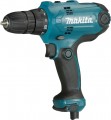 |
|---|---|---|
| Apro D750C 899152 | Makita DF0300 | |
| Outdated Product | from $181.44 | |
| TOP sellers | ||
Model DF0300 comes with 1 bit per set, model DF0300X comes with a set of bits (28 pcs), and model DF0300X1 comes with a hand screwdriver D-58833. | ||
| Product type | drill driver | drill driver |
| Design | gun | gun |
Specs | ||
| Real power | 550 W | |
| Power consumption | 750 W | 320 W |
| Rotation speed | 400/1600 rpm | 450/1500 rpm |
| Torque | 50 Nm with adjustment 22 steps | 56 Nm with adjustment 20 steps |
| Reducer | 2-speed | 2-speed |
| Number of speeds | 2 | 2 |
| Reverse | slider | slider |
| Cable length | 4 m | 2.5 m |
| Size | 220x67x206 mm | |
| Length | 220 mm | |
| Weight | 1.7 kg | 1.2 kg |
Chuck | ||
| Chuck type | keyless | keyless |
| Chuck diameter | 10 mm | 10 mm |
| Quick chuck change |  |  |
| Wood drilling max. ⌀ | 20 mm | 28 mm |
| Metal drilling max. ⌀ | 8 mm | 10 mm |
Features | ||
| Features | power button lock | |
| In box | case (bag) | bat |
Power supply | ||
| Power source | mains (230 V) | mains (230 V) |
| Added to E-Catalog | april 2023 | october 2019 |


Compare Apro D750C 899152 and Makita DF0300
You may be interested in
My comparisons
Apro D750C 899152 often compared

Makita DF0300 often compared


Glossary
Real power
The useful power of the tool is the maximum power that it can deliver to the working nozzle. This power is always less than the power consumed (see below), since part of the electricity inevitably goes to heat and friction in the tool mechanisms. In addition, this parameter is not given for every model, often information in the characteristics is limited to power consumption. Nevertheless, the actual capabilities of the tool directly depend on the net power: the higher it is, the greater the speed and/or torque this model is able to develop, the easier it is for it to cope with tasks that require high efforts. So, to compare different devices with each other, it is best to use this parameter (of course, you can only compare models of the same type or similar in type).
Also note that high working power is not always an advantage: it accordingly affects the dimensions, weight and price of the tool, while in fact high speeds and efforts are not always necessary. Detailed recommendations on the optimal values for different tools and different types of work can be found in special sources.
Also note that high working power is not always an advantage: it accordingly affects the dimensions, weight and price of the tool, while in fact high speeds and efforts are not always necessary. Detailed recommendations on the optimal values for different tools and different types of work can be found in special sources.
Power consumption
The total power consumed by a mains-powered electric tool (see "Power Source"). It is considered the main criterion for assessing the overall capabilities of a particular model: more power allows you to achieve more speed and/or torque. However a more correct parameter for such an assessment is useful (working) power, but it is far from always indicated, and tools of the same type with similar power consumption usually do not differ much in terms of working power. In addition, data on power consumption also allows you to estimate the load on the power grid or other power source; in some cases this is unnecessary.
As for specific figures, for different types of tools, the characteristic power values will be different. For example, from 750 to 1000 W is considered a very solid indicator for a screwdriver, while for classic drills this is an average value, among such devices there are options even for 1.5 kW or more. Detailed recommendations on choosing a tool for this parameter can be found in special sources. We only note that it does not always make sense to chase the maximum values high power noticeably affects the dimensions, weight and price of the unit, despite the fact that it is far from always required.
As for specific figures, for different types of tools, the characteristic power values will be different. For example, from 750 to 1000 W is considered a very solid indicator for a screwdriver, while for classic drills this is an average value, among such devices there are options even for 1.5 kW or more. Detailed recommendations on choosing a tool for this parameter can be found in special sources. We only note that it does not always make sense to chase the maximum values high power noticeably affects the dimensions, weight and price of the unit, despite the fact that it is far from always required.
Rotation speed
The speed of rotation of the working nozzle provided by the tool.
If a single number is indicated in this paragraph (for example, 1800), it can be either a standard, constant, or maximum rotation speed. This refers to the maximum speed if the tool has more than one speed (see "Number of speeds") and/or a speed controller (see "Functions"). In turn, two or three numbers through an oblique line (for example, 1100/2300/3400) are indicated only for models that have the corresponding number of individual speeds. Each of these numbers indicates the standard (and in the presence of a speed controller — the maximum) number of revolutions at one of the speeds.
Anyway, when choosing a tool by the number of revolutions, it is worth considering both its general type (see "Device") and the specifics of the intended work. Detailed recommendations on this matter are quite extensive, it makes no sense to give them in full here — it is better to turn to special sources. We note only a few general points. So, high -speed drills nowadays are considered to be drills capable of delivering more than 3000 rpm. In general, high speed contributes to productivity, but there is also a downside: increasing the speed (for the same power) reduces torque — accordingly, the efficiency of working with stubborn materials and large diameter nozzles decreases. Therefore, it makes sense to specifically look for a "high-speed" tool only if speed is of key impor...tance; it doesn’t hurt to make sure that the model you choose can provide the required efficiency and torque.
If a single number is indicated in this paragraph (for example, 1800), it can be either a standard, constant, or maximum rotation speed. This refers to the maximum speed if the tool has more than one speed (see "Number of speeds") and/or a speed controller (see "Functions"). In turn, two or three numbers through an oblique line (for example, 1100/2300/3400) are indicated only for models that have the corresponding number of individual speeds. Each of these numbers indicates the standard (and in the presence of a speed controller — the maximum) number of revolutions at one of the speeds.
Anyway, when choosing a tool by the number of revolutions, it is worth considering both its general type (see "Device") and the specifics of the intended work. Detailed recommendations on this matter are quite extensive, it makes no sense to give them in full here — it is better to turn to special sources. We note only a few general points. So, high -speed drills nowadays are considered to be drills capable of delivering more than 3000 rpm. In general, high speed contributes to productivity, but there is also a downside: increasing the speed (for the same power) reduces torque — accordingly, the efficiency of working with stubborn materials and large diameter nozzles decreases. Therefore, it makes sense to specifically look for a "high-speed" tool only if speed is of key impor...tance; it doesn’t hurt to make sure that the model you choose can provide the required efficiency and torque.
Torque
Torque is the maximum force with which this model is capable of turning the working nozzle.
Higher torque gives more options, it allows you to cope with complex tasks such as drilling in hard materials, unscrewing stuck screws and nuts, etc. On the other hand, a lot of force requires corresponding power — and this, in turn, affects the dimensions , weight and cost of the tool itself, and also puts forward increased power requirements (mains power, battery capacity or pressure / compressor performance). And for some tasks, excessive torque is basically unacceptable, so for maximum versatility, it is desirable to have torque control — and this affects the cost even more. And the more steps, the more optimally you can configure the tool to perform a particular type of work. So the general rule is this: when choosing, it is worth considering the specifics of the planned work, and not chasing the greatest working effort.
Detailed recommendations on choosing the optimal torque for different types of tools (see "Device") can be found in special sources. Here we note that it is of key importance primarily for screwdrivers, although it is also given for other types of tools. At the same time, in the “weakest” models, the maximum working force does not exceed 15 Nm, in the most powerful ones it is more than 150 Nm.
Higher torque gives more options, it allows you to cope with complex tasks such as drilling in hard materials, unscrewing stuck screws and nuts, etc. On the other hand, a lot of force requires corresponding power — and this, in turn, affects the dimensions , weight and cost of the tool itself, and also puts forward increased power requirements (mains power, battery capacity or pressure / compressor performance). And for some tasks, excessive torque is basically unacceptable, so for maximum versatility, it is desirable to have torque control — and this affects the cost even more. And the more steps, the more optimally you can configure the tool to perform a particular type of work. So the general rule is this: when choosing, it is worth considering the specifics of the planned work, and not chasing the greatest working effort.
Detailed recommendations on choosing the optimal torque for different types of tools (see "Device") can be found in special sources. Here we note that it is of key importance primarily for screwdrivers, although it is also given for other types of tools. At the same time, in the “weakest” models, the maximum working force does not exceed 15 Nm, in the most powerful ones it is more than 150 Nm.
Cable length
The length of the cord attached to the mains powered tool (see "Power Source").
The longer the wire - the farther from the outlet you can use the tool without switching it, the more freedom the user has. On the other hand, an overly long cable creates inconvenience during storage and transportation, and even during operation it can get under your feet (or even your hands). Given this, in most cases, manufacturers equip their products with network cables from 2 to 4 m long. This gives a sufficient degree of freedom without creating inconvenience, and for situations where the length of the wire is not enough, there are extension cords. Of course, even in this range, you can choose a cable for a specific situation: for example, for a city apartment 2 - 2.5 m will be quite enough, but for a construction site it is desirable to have a longer wire.
The longer the wire - the farther from the outlet you can use the tool without switching it, the more freedom the user has. On the other hand, an overly long cable creates inconvenience during storage and transportation, and even during operation it can get under your feet (or even your hands). Given this, in most cases, manufacturers equip their products with network cables from 2 to 4 m long. This gives a sufficient degree of freedom without creating inconvenience, and for situations where the length of the wire is not enough, there are extension cords. Of course, even in this range, you can choose a cable for a specific situation: for example, for a city apartment 2 - 2.5 m will be quite enough, but for a construction site it is desirable to have a longer wire.
Length
The overall tool size from the back of the housing to the tip of the chuck (or gearbox for models without a chuck) helps determine how easily it will work in tight spaces. In practical terms, the "length" parameter is most crucial when assembling furniture, installing drywall, working on cars, or doing electrical work, where every extra centimeter can be the deciding factor in whether you can reach the fastening point at all.
Longer models often have better balance and may feature a more powerful gearbox and convenient handle, but in confined areas, they lose out to compact ones—especially when using long bits, drills, or screwdriver attachments.
Longer models often have better balance and may feature a more powerful gearbox and convenient handle, but in confined areas, they lose out to compact ones—especially when using long bits, drills, or screwdriver attachments.
Weight
The total weight of the tool is usually the device itself, without attachments. For battery models (see "Power Source"), usually, the weight is indicated with a standard battery installed; for battery-powered models, the weight can be given both with and without batteries, but in this case this point is not particularly important.
Other things being equal, less weight simplifies work, increases accuracy of movement and allows you to use the tool for longer without tiring. However, note that high power and productivity inevitably increase the mass of the tool; and various tricks to reduce weight increase the price and can reduce reliability. In addition, in some cases, a massive design is more preferable. First of all, this applies to work with a large load — for example, drilling holes of large diameter, or making recesses with impact: a heavy tool is more stable, it is less prone to jerks and shifts due to uneven material, vibration of mechanisms, etc.
It is also worth noting that specific weight values are directly related to the type of tool (see "Device"). Screwdrivers are the lightest — in most of them this figure does not exceed 500 g. Screwdrivers and drill drivers are more "heavy": their average weight is 1.1 – 1.5 kg, although there are many lighter ( 0.6 – 1 kg) and heavier ( 1.6 – 2 kg or more ) models. And clas...sic drills and wrenches have the greatest weight: such a tool must be quite powerful, so for them 1.6 – 2 kg is an average, 2.1 – 2.5 kg is above average, and many units weigh more than 2, 5 kg.
Other things being equal, less weight simplifies work, increases accuracy of movement and allows you to use the tool for longer without tiring. However, note that high power and productivity inevitably increase the mass of the tool; and various tricks to reduce weight increase the price and can reduce reliability. In addition, in some cases, a massive design is more preferable. First of all, this applies to work with a large load — for example, drilling holes of large diameter, or making recesses with impact: a heavy tool is more stable, it is less prone to jerks and shifts due to uneven material, vibration of mechanisms, etc.
It is also worth noting that specific weight values are directly related to the type of tool (see "Device"). Screwdrivers are the lightest — in most of them this figure does not exceed 500 g. Screwdrivers and drill drivers are more "heavy": their average weight is 1.1 – 1.5 kg, although there are many lighter ( 0.6 – 1 kg) and heavier ( 1.6 – 2 kg or more ) models. And clas...sic drills and wrenches have the greatest weight: such a tool must be quite powerful, so for them 1.6 – 2 kg is an average, 2.1 – 2.5 kg is above average, and many units weigh more than 2, 5 kg.
Quick chuck change
The ability to quickly remove the cartridge and replace it with another, and, usually, by hand, without the use of additional tools. A quick change of cartridge is found mainly in drill drivers (see "Device"): in different modes, such devices require different types of cartridges (one for a drill, the other for a bit), and the ability to quickly change one type to another in some situations is extremely useful .
Wood drilling max. ⌀
The largest diameter of holes that the tool can make when drilling with a conventional drill in wood.
The larger the hole diameter, the higher the resistance of the material, the more power the tool must provide and the higher the load on it. Therefore, the maximum allowable drilling diameter must not be exceeded, even if the chuck allows you to install a thicker drill bit — this can lead to tool breakage and even injury to others.
It is worth noting that some types of wood can have a fairly high density, and for them the actual allowable drill diameter will be, accordingly, less than the claimed one. However, this is true mainly for exotic breeds, which are extremely rare in our area.
The larger the hole diameter, the higher the resistance of the material, the more power the tool must provide and the higher the load on it. Therefore, the maximum allowable drilling diameter must not be exceeded, even if the chuck allows you to install a thicker drill bit — this can lead to tool breakage and even injury to others.
It is worth noting that some types of wood can have a fairly high density, and for them the actual allowable drill diameter will be, accordingly, less than the claimed one. However, this is true mainly for exotic breeds, which are extremely rare in our area.