
Comparison Logitech G203 Lightsync vs Logitech G102 Lightsync
Add to comparison | 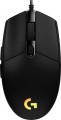 | 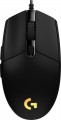 |
|---|---|---|
| Logitech G203 Lightsync | Logitech G102 Lightsync | |
| Compare prices 43 | Compare prices 1 | |
| User reviews | ||
| TOP sellers | ||
RGB backlight. Sensitivity 8000 DPI. Omron switches. | ||
| Product type | mouse | mouse |
| Connection | wired | wired |
| Sensor | optical | optical |
| Type | for game | for game |
Sensor and control | ||
| Sensor resolution | 200 – 8000 DPI | 200 – 8000 DPI |
| Max. acceleration | 25 G | 25 G |
| Max. speed | 200 ips | 200 ips |
| Max. polling rate | 1000 Hz (1 ms) | |
| Number of buttons | 5 | 5 |
| Side buttons |  | |
| DPI-button | | |
| Switch type | mechanical | |
| Scroll wheels | 1 | 1 |
Additional features | ||
| Suitable for left-handers | | |
| Optimal grip | digital | digital |
| Programmable buttons | | |
| Built-in memory | | |
| Lighting | RGB | RGB |
| Lighting effects | Logitech Lightsync | Logitech Lightsync |
| Feet material | teflon (PTFE) | |
Connection and power supply | ||
| Cable | USB-A | USB-A |
| Cable length | 2.1 m | 2.1 m |
General | ||
| Size (LxWxH) | 117x62x38 mm | 117x62x38 mm |
| Weight | 85 g | 85 g |
| Color | ||
| Added to E-Catalog | april 2020 | april 2020 |




Compare Logitech G203 Lightsync and G102 Lightsync
Both mice, Logitech G203 Lightsync and Logitech G102 Lightsync, have similar features, including an optical sensor with up to 8000 DPI resolution, 5 buttons, and RGB lighting with Logitech Lightsync effects. However, the G102 stands out with PTFE foot material and a higher polling rate of 1000 Hz, which can provide smoother movement. At the same time, the G203 has similar dimensions and weight but is only available in black, whereas the G102 offers more color options. The choice between them may depend on design preferences and the need for a higher polling rate.
Price comparison
You may be interested in
Logitech G203 Lightsync often compared


Logitech G102 Lightsync often compared


Glossary
Max. polling rate
The polling rate shows how often the mouse sensor exchanges data with the computer about cursor movement. This parameter is measured in hertz (Hz), with one second being taken as the unit of time for its assessment. The smoothness and speed of cursor movement directly depend on the polling rate of the sensor. Directly connected to it is the mouse response time — this is the time interval required for the signal about the manipulator's movement to reach the display of the cursor position change on the screen. Response time is measured in milliseconds (ms). The higher the mouse's "hertz rate," the lesser the response time it demonstrates. The most common value can be considered 1000 Hz with a response time of 1 millisecond. For competitive games, attention should be paid to faster mice, including 2000 Hz, 4000 Hz, and 8000 Hz. Values below might negatively manifest just in gaming scenarios.
Switch type
The type of switches in a mouse indicates the mechanism used under the main buttons to register a click. It affects the feel when pressing, actuation speed, lifespan, and resistance to accidental double clicks.
— Optical. Button mechanisms where the press is registered not by closing metal contacts but by interrupting a light beam. This makes them faster, less prone to wear, and almost unaffected by accidental double-click issues.
These switches are especially valued in gaming mice, where response speed and stability after a large number of clicks are crucial. For example, in shooters or MOBA games, they help achieve clear feedback without delay and contact bouncing.
— Mechanical. Classic button mechanisms where a click is registered due to the closing of metal contacts. They provide a familiar tactile feel, a well-audible click, and are widely used in both office and gaming models.
Compared to optical switches, mechanical ones are usually simpler and cheaper, but over time the contacts may wear out. For example, with active gaming or daily work, after a few years, a double click might occur instead of a single press.
— Optical. Button mechanisms where the press is registered not by closing metal contacts but by interrupting a light beam. This makes them faster, less prone to wear, and almost unaffected by accidental double-click issues.
These switches are especially valued in gaming mice, where response speed and stability after a large number of clicks are crucial. For example, in shooters or MOBA games, they help achieve clear feedback without delay and contact bouncing.
— Mechanical. Classic button mechanisms where a click is registered due to the closing of metal contacts. They provide a familiar tactile feel, a well-audible click, and are widely used in both office and gaming models.
Compared to optical switches, mechanical ones are usually simpler and cheaper, but over time the contacts may wear out. For example, with active gaming or daily work, after a few years, a double click might occur instead of a single press.
Feet material
- Teflon (PTFE). Polytetrafluoroethylene (PTFE) glides - also known as Teflon - are characterized by an extremely low coefficient of friction. As a result, mice with Teflon feet boast excellent glide and high cursor speed on any type of surface. The minimum level of friction allows you to easily control the movements of the mouse. Manipulators with Teflon gliders perform well in dynamic games and reduce wrist strain during prolonged work at the computer.
— Metal. When properly sanded, the metal feet provide excellent glide for the mouse, and they also have a long service life before abrasion. Note that manipulators with metal gliders are best used on plastic or other hard-wearing playing surfaces. Using a mouse without a mouse pad runs the risk of scratching the surface.
— Metal. When properly sanded, the metal feet provide excellent glide for the mouse, and they also have a long service life before abrasion. Note that manipulators with metal gliders are best used on plastic or other hard-wearing playing surfaces. Using a mouse without a mouse pad runs the risk of scratching the surface.