
Comparison Olympus TG-7 vs Olympus TG-5
Add to comparison | 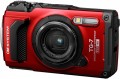 |  |
|---|---|---|
| Olympus TG-7 | Olympus TG-5 | |
| Compare prices 26 | from $609.99 | |
| User reviews | ||
| TOP sellers | ||
Thermometer. Pressure gauge. Protection: against shocks up to 100 kg, against drops from a height of up to 2.1 metres (according to Olympus tests), against moisture (at a depth of 15 metres - according to IEC publication 529 IPX8). | Thermometer. Pressure gauge. Protection: against shocks up to 100 kg, against drops from a height of up to 2.1 metres (according to Olympus tests), against moisture (at a depth of 15 metres - according to IEC publication 529 IPX8). | |
| Camera type | digital compact | digital compact |
Sensor | ||
| Sensor | CMOS BSI | CMOS (CMOS) |
| Sensor size | 1/2.3" | 1/2.3" |
| Effective MP number | 12 | 12 |
| Maximum image size | 4000x3000 px | 4000x3000 px |
| Light sensitivity (ISO) | 100 - 12800 | 100 - 12800 |
| RAW format recording |  | |
Lens | ||
| Aperture | f/2.0 - f/4.9 | f/2.0 - f/4.9 |
| Focal length | 25 - 100 mm | 25 - 100 mm |
| Optical zoom | 4 | 4 |
| Image stabilization | optical | optical |
| Min. focus distance | 10 cm | 10 cm |
| Macro shooting, from | 1 cm | 1 cm |
Photo shooting | ||
| Number of scene programs | 28 | |
| Frames per series (JPEG) | 100 шт | |
| HDR | | |
| White balance measuring | | |
| Exposure compensation | ± 2 EV, in 1/3 EV steps | ± 2 EV, in 1/3 EV steps |
| Auto bracketing | | |
| Exposure modes | auto aperture priority manual mode | auto aperture priority manual mode |
| Metering system | point centre-weighted sensor (estimated) | point centre-weighted sensor (estimated) |
Video recording | ||
| Full HD (1080) | 1920x1080 px 60 fps | 1920x1080 px 120 fps |
| Ultra HD (4K) | 3840x2160 px 30 fps | 3840x2160 px 30 fps |
| Video scene modes | 7 | |
| File recording formats | MPEG-4, H.264 | M-JPEG, H.264 |
| Backlight | |  |
| Connection ports | HDMI v 1.4 | micro HDMI v 1.4 |
Focus | ||
| Autofocus modes | one shot tracking in face | one shot tracking in face |
| Focus points | 25 шт | 25 шт |
Viewfinder and shutter | ||
| Viewfinder | in absent | in absent |
| Shutter speed | 4 - 1/2000 с | 4 - 1/2000 с |
| Continuous shooting | 20 fps | 22 fps |
Screen | ||
| Screen size | 3 '' | 3 '' |
| Screen resolution | 1040 thousand pixels | 460 thousand pixels |
Memory and communications | ||
| Memory cards types | SD, SDHC, SDXC | SD, SDHC, SDXC |
| Communications | GPS Wi-Fi 4 (802.11n) smartphone control | GPS Wi-Fi 4 (802.11n) smartphone control |
Flash | ||
| Built-in flash | | |
Power source | ||
| Power source | battery | battery |
| Battery model | LI-92B, LI-50B | LI-92B, LI-50B |
| Shots per charge | 340 шт | 340 шт |
General | ||
| Charger model | LI-50C, F‑3AC | LI-50C, F‑3AC |
| Material | steel | steel |
| Protection | diving | diving |
| Dimensions (WxHxD) | 114x66x33 mm | 113x66x32 mm |
| Weight | 330 g | 250 g |
| Color | ||
| Added to E-Catalog | september 2023 | may 2017 |




Compare Olympus TG-7 and TG-5
Price comparison
You may be interested in
My comparisons
Olympus TG-7 often compared


Glossary
Sensor
— CCD (CCD). Abbreviation for Charge-Coupled Device. In such sensors, information is read from the photosensitive element according to the “line at a time” principle — an electronic signal is output to the image processor in the form of separate lines (there is also a “frame at a time” variant). In general, such matrices have good characteristics, but they are more expensive than CMOS. In addition, they are poorly suited for some specific conditions — for example, shooting with point light sources in the frame — which is why you have to use various additional technologies in the camera, which also affect the cost.
— CMOS (CMOS). The main advantages of CMOS matrices are ease of manufacture, low cost and power consumption, more compact dimensions than those of CCDs, and the ability to transfer a number of functions (focus, exposure metering, etc.) directly to the sensor, thus reducing the dimensions of the camera. In addition, the camera processor can read the entire image from such a matrix at once (rather than line by line, as in CCD); this avoids distortion when shooting fast-moving objects. The main disadvantage of CMOS is the increased possibility of noise, especially at high ISO values.
— CMOS (CMOS) BSI. BSI is an abbreviation for the English phrase "Backside Illumination". This is the name of "inverted" CMOS sensors, the light on which does not penetrate from the side of the photodiodes, but from the back of the matrix (from the side of the subst...rate). With this implementation, the photodiodes receive more light, since it is not blocked by other elements of the image sensor. As a result, back-illuminated sensors boast high light sensitivity, which allows you to create images of better quality with less noise when shooting in low light conditions. BSI CMOS sensors require less light to properly expose a photo. In production, back-illuminated sensors are more expensive than traditional CMOS sensors.
— LiveMOS. A variety of matrices made using the technology of metal oxide semiconductors (MOS, MOS — Metal-Oxide Semiconductor). Compared to CMOS sensors, it has a simplified design, which provides less tendency to overheat and, as a result, a lower noise level. It is well suited for the "live" viewing mode (viewing in real time) of the image from the matrix on the screen or in the camera's viewfinder, which is why it received the word "Live" in the title. They also feature high data transfer rates.
— CMOS (CMOS). The main advantages of CMOS matrices are ease of manufacture, low cost and power consumption, more compact dimensions than those of CCDs, and the ability to transfer a number of functions (focus, exposure metering, etc.) directly to the sensor, thus reducing the dimensions of the camera. In addition, the camera processor can read the entire image from such a matrix at once (rather than line by line, as in CCD); this avoids distortion when shooting fast-moving objects. The main disadvantage of CMOS is the increased possibility of noise, especially at high ISO values.
— CMOS (CMOS) BSI. BSI is an abbreviation for the English phrase "Backside Illumination". This is the name of "inverted" CMOS sensors, the light on which does not penetrate from the side of the photodiodes, but from the back of the matrix (from the side of the subst...rate). With this implementation, the photodiodes receive more light, since it is not blocked by other elements of the image sensor. As a result, back-illuminated sensors boast high light sensitivity, which allows you to create images of better quality with less noise when shooting in low light conditions. BSI CMOS sensors require less light to properly expose a photo. In production, back-illuminated sensors are more expensive than traditional CMOS sensors.
— LiveMOS. A variety of matrices made using the technology of metal oxide semiconductors (MOS, MOS — Metal-Oxide Semiconductor). Compared to CMOS sensors, it has a simplified design, which provides less tendency to overheat and, as a result, a lower noise level. It is well suited for the "live" viewing mode (viewing in real time) of the image from the matrix on the screen or in the camera's viewfinder, which is why it received the word "Live" in the title. They also feature high data transfer rates.
Number of scene programs
The number of scene programs provided in the camera design.
Scene programs are preset settings for some of the most common shooting scenes - for example, Portrait, Landscape, Sports, Sunset, etc. In addition to these presets, this list may include special effects and creative tools (such as color swap or fisheye), as well as exposure modes (see below). The presence of scene programs is especially useful for beginners and non-professional photographers, as it eliminates the need to tinker with each setting separately - just select the most suitable program, and all the necessary settings will be set automatically. The more scene programs the camera design provides, the wider its automatic adjustment capabilities.
Scene programs are preset settings for some of the most common shooting scenes - for example, Portrait, Landscape, Sports, Sunset, etc. In addition to these presets, this list may include special effects and creative tools (such as color swap or fisheye), as well as exposure modes (see below). The presence of scene programs is especially useful for beginners and non-professional photographers, as it eliminates the need to tinker with each setting separately - just select the most suitable program, and all the necessary settings will be set automatically. The more scene programs the camera design provides, the wider its automatic adjustment capabilities.
Frames per series (JPEG)
The highest number of shots a camera can capture “in one go” in JPEG continuous shooting.
The technical features of modern digital cameras are such that during continuous shooting, photos have to be recorded in a special buffer, and only then, after the end of the series, they can be copied to a memory card. This buffer has a limited size, so the number of frames in one series is also limited. At the same time, we note that this indicator is usually indicated for shooting at the highest possible resolution (see "Maximum image size"); at lower resolutions, the volume of each image is reduced, and the number of frames in the series may turn out to be more than stated in the specifications.
JPEG, the most popular digital photography format today, is smaller and requires less processing power than RAW (see "Recording in RAW Format"). Therefore, in a JPEG series, as a rule, more frames are available to the photographer. However, in some models that have two separate buffers (for RAW and JPEG), it may be the other way around.
The technical features of modern digital cameras are such that during continuous shooting, photos have to be recorded in a special buffer, and only then, after the end of the series, they can be copied to a memory card. This buffer has a limited size, so the number of frames in one series is also limited. At the same time, we note that this indicator is usually indicated for shooting at the highest possible resolution (see "Maximum image size"); at lower resolutions, the volume of each image is reduced, and the number of frames in the series may turn out to be more than stated in the specifications.
JPEG, the most popular digital photography format today, is smaller and requires less processing power than RAW (see "Recording in RAW Format"). Therefore, in a JPEG series, as a rule, more frames are available to the photographer. However, in some models that have two separate buffers (for RAW and JPEG), it may be the other way around.
Full HD (1080)
The maximum resolution and frame rate of video captured by the camera in Full HD (1080p).
The traditional Full HD video resolution in this case is 1920x1080; other options are more specific and practically do not occur in modern cameras. Regarding the frame rate, it is worth noting first of all that a normal (not slow-motion) video is shot at a speed of up to 60 fps, and in this case, the higher the frame rate, the smoother the video will be, the less jerks will be noticeable when moving in the frame. If the frame rate is 100 fps or higher, this usually means that the camera has a slow-motion video mode.
The traditional Full HD video resolution in this case is 1920x1080; other options are more specific and practically do not occur in modern cameras. Regarding the frame rate, it is worth noting first of all that a normal (not slow-motion) video is shot at a speed of up to 60 fps, and in this case, the higher the frame rate, the smoother the video will be, the less jerks will be noticeable when moving in the frame. If the frame rate is 100 fps or higher, this usually means that the camera has a slow-motion video mode.
Video scene modes
The number and / or types of scene programs for shooting videos provided in the design of the camera.
Scene programs are a set of presets designed for different shooting situations - for example, in sunlight, on a cloudy day, in a darkened room, etc. Also, this list may include other specific modes - for example, creative tools. In any case, the presence of scene programs facilitates the choice of video shooting parameters, which is very useful for novice users.
Scene programs are a set of presets designed for different shooting situations - for example, in sunlight, on a cloudy day, in a darkened room, etc. Also, this list may include other specific modes - for example, creative tools. In any case, the presence of scene programs facilitates the choice of video shooting parameters, which is very useful for novice users.
File recording formats
File formats in which the camera can record video. Given that the footage is designed to be viewed on an external screen, you should make sure that the playback device (DVD player, media centre, etc.) is able to work with the appropriate formats. At the same time, many camera models themselves can play the role of a player by connecting to a TV via an audio / video output or HDMI (see the corresponding paragraphs of the glossary). And if the video materials are to be viewed on a computer, you should not pay special attention to this parameter at all: problems with format incompatibility in such cases rarely occur, but are usually solved by installing the appropriate codec.
Backlight
The ability to illuminate the scene being shot when the camera is in video recording mode. This feature can be indispensable when shooting in low light conditions: it eliminates the need for additional light sources, besides, its own illumination is always directed to the same place as the lens.
The built-in flash is usually used for illumination (see below), but the presence of a flash does not mean that it can be used in this mode. Therefore, if the backlight function is important to you, you should choose from models where it is directly stated.
The built-in flash is usually used for illumination (see below), but the presence of a flash does not mean that it can be used in this mode. Therefore, if the backlight function is important to you, you should choose from models where it is directly stated.
Connection ports
— USB-C. A universal USB interface using a Type C connector. USB ports (of all types) are mainly used for connecting the camera to a computer to transfer captured materials, manage settings, update firmware, etc. Specifically, the Type C connector is comparable in size to the earlier miniUSB and microUSB, but it has a reversible design that allows the plug to be inserted either way. Moreover, USB-C often operates at a USB 10Gbps standard, allowing for connection speeds up to 10 Gbps—a useful feature when transferring large amounts of content.
— HDMI. An all-encompassing digital interface that allows video (including high resolution) and audio (up to multichannel) to be transmitted via a single cable. Having such a port allows the use of the camera as a player: it can be directly connected to a TV, monitor, projector, etc., to view captured materials on a big screen. These transmission capabilities may include not only video playback but also displaying captured photos as a slideshow. HDMI inputs are found in most modern video devices, and connection is usually not problematic.
Currently, several versions of the HDMI interface are available on the market:
— Headphone Output. An audio output that allows headphones to be connected to the camera. It is typically represented by a classic 3.5mm mini-jack. Such an output provides the ability to monitor sound in real time during video recording. This is especially important when shooting interviews, video blogs, and other similar projects.
— Microphone Input. A specialized input for connecting an external microphone to the camera. External microphones significantly outperform built-in ones in sound quality. Firstly, they are less sensitive to the camera's "own" sounds—from buttons, control wheels, focus motors, etc. (and if the microphone uses a long cable and is not mounted on the body, these sounds will not be audible at all). Secondly, external microphones themselves have more advanced characteristics. On the other hand, their use is mainly justified for professional video recording; therefore, the presence of a microphone input usually corresponds to advanced video shooting capabilities.
— HDMI. An all-encompassing digital interface that allows video (including high resolution) and audio (up to multichannel) to be transmitted via a single cable. Having such a port allows the use of the camera as a player: it can be directly connected to a TV, monitor, projector, etc., to view captured materials on a big screen. These transmission capabilities may include not only video playback but also displaying captured photos as a slideshow. HDMI inputs are found in most modern video devices, and connection is usually not problematic.
Currently, several versions of the HDMI interface are available on the market:
- v 1.4. The oldest of the current versions, released in 2009. Nevertheless, it supports 3D video, can work with resolutions up to 4096x2160 at 24 fps, and in Full HD resolution, the frame rate can reach up to 120 fps. Besides the original v.1.4, there are also improved modific...ations — v.1.4a and v.1.4b; they are similar in basic capabilities, with improvements primarily focused on 3D content.
- v 2.0. A significant HDMI update, introduced in 2013. In this version, the maximum frame rate at 4K increased to 60 fps, and new features include support for ultra-wide format 21:9. In the v.2.0a update, HDR support was added to the interface's capabilities; in v.2.0b, this feature was enhanced and expanded.
- v 2.1. Despite the similar naming to v.2.0, this version, released in 2017, was a very significant update. It added support for 8K and even 10K at speeds of up to 120 fps, as well as further expanded capabilities for working with HDR. A dedicated cable—HDMI Ultra High Speed—was released for this version, and all v.2.1 capabilities are only available using cables of this standard, although basic functions can be used with simpler cables.
— Headphone Output. An audio output that allows headphones to be connected to the camera. It is typically represented by a classic 3.5mm mini-jack. Such an output provides the ability to monitor sound in real time during video recording. This is especially important when shooting interviews, video blogs, and other similar projects.
— Microphone Input. A specialized input for connecting an external microphone to the camera. External microphones significantly outperform built-in ones in sound quality. Firstly, they are less sensitive to the camera's "own" sounds—from buttons, control wheels, focus motors, etc. (and if the microphone uses a long cable and is not mounted on the body, these sounds will not be audible at all). Secondly, external microphones themselves have more advanced characteristics. On the other hand, their use is mainly justified for professional video recording; therefore, the presence of a microphone input usually corresponds to advanced video shooting capabilities.
Continuous shooting
Continuous shooting speed provided by the camera at the maximum frame resolution. At lower resolutions, the speed may be higher, but this value is considered the key characteristic.
In continuous shooting, the photographer presses the button, and the camera takes several shots in a row, usually at intervals of a fraction of a second. Such shooting is convenient, for example, for capturing fast-moving objects: it allows you to choose the most successful from a series of frames, or to show the dynamics of movement using the entire series. And the higher the speed, the more effective the shooting, the more frames the camera can capture in a period of time. On the other hand, speed requires appropriate hardware and can significantly affect the cost.
In continuous shooting, the photographer presses the button, and the camera takes several shots in a row, usually at intervals of a fraction of a second. Such shooting is convenient, for example, for capturing fast-moving objects: it allows you to choose the most successful from a series of frames, or to show the dynamics of movement using the entire series. And the higher the speed, the more effective the shooting, the more frames the camera can capture in a period of time. On the other hand, speed requires appropriate hardware and can significantly affect the cost.