
Comparison Andes DC1018P vs Ergo UPS-A01-8
Add to comparison | 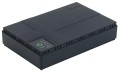 | 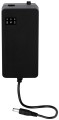 |
|---|---|---|
| Andes DC1018P | Ergo UPS-A01-8 | |
| Outdated Product | Outdated Product | |
| User reviews | ||
| TOP sellers | ||
This model is available in different capacities (8.8 Ah and 10.4 Ah). Please confirm the details with the store before ordering. | ||
| Type | low voltage UPS (router, camera) | low voltage UPS (router, camera) |
| Form factor | standard (flat) | standard (flat) |
Input | ||
| Input voltage | 1 phase (230V) | 12 В |
| Input voltage range | 85 – 265 В | |
| Bypass (direct connection) | in absent | in absent |
Output | ||
| Output voltage | DC (constant voltage) | DC (constant voltage) |
| Rated output power | 18 W | |
| USB-A for charging | 1 pcs | |
| DC output | 1 x DC 12 H 1.5 A | |
| PoE output (LAN) | 15 H/24 H 0.6 A | |
Battery | ||
| Total battery capacity | 8.8 Ah | 8.8 Ah |
| Battery type | Li-ion (lithium-ion) | Li-ion (lithium-ion) |
Protection | ||
| Protection | short circuit protection overload protection | short circuit protection overload protection |
General | ||
| Operating temperature | 0 – 45 °C | |
| Dimensions (HxWxD) | 32x160x102 mm | 41x48x95 mm |
| Weight | 0.4 kg | 0.27 kg |
| Added to E-Catalog | october 2024 | october 2024 |


Compare Andes DC1018P and Ergo UPS-A01-8
You may be interested in
Andes DC1018P often compared


Glossary
Input voltage
The input voltage for which the UPS is designed. This parameter practically also determines the type of network — different voltages correspond to a different number of phases:
— 1 phase (230 V). Connection to ordinary household networks of the 230 V standard. It is these networks that are used by most devices powered by uninterruptible power supplies: computers, video and audio equipment, gas boilers, air conditioners, medical equipment, etc. Therefore, the vast majority of modern UPSs are designed specifically for 230 V. At the same time, relatively low-power models can work directly from the outlet, but for devices with a high maximum output power — from 3.5 kVA — a special connection format (directly to the shield) may be required.
— 3 phases (400 V). Connection to three-phase networks of 400 V format. Such networks are used to power powerful industrial equipment, as well as to supply energy from substations to entire segments of the power grid (for example, the entire building). Accordingly, in the case of a UPS, it makes sense to use such an input voltage only in the most powerful models designed for a significant load — for example, an entire data centre, or an industrial workshop with high requirements for process continuity. The effective output power of such “uninterruptible power supplies” is from 4 kW, and the output voltage (see below) can be either single- or three-phase....
— 1 phase (230 V) / 3 phases (400 V). Uninterruptible devices that allow connection to any of the types of networks described above. Most of these devices are, in fact, models for three phases, supplemented by the ability to work also from 230 V. Note that for operation from a single-phase network, such models usually need to be connected directly to the shield, and the output power with such a connection may be lower the claimed maximum (this point needs to be specified separately).
— 1 phase (230 V). Connection to ordinary household networks of the 230 V standard. It is these networks that are used by most devices powered by uninterruptible power supplies: computers, video and audio equipment, gas boilers, air conditioners, medical equipment, etc. Therefore, the vast majority of modern UPSs are designed specifically for 230 V. At the same time, relatively low-power models can work directly from the outlet, but for devices with a high maximum output power — from 3.5 kVA — a special connection format (directly to the shield) may be required.
— 3 phases (400 V). Connection to three-phase networks of 400 V format. Such networks are used to power powerful industrial equipment, as well as to supply energy from substations to entire segments of the power grid (for example, the entire building). Accordingly, in the case of a UPS, it makes sense to use such an input voltage only in the most powerful models designed for a significant load — for example, an entire data centre, or an industrial workshop with high requirements for process continuity. The effective output power of such “uninterruptible power supplies” is from 4 kW, and the output voltage (see below) can be either single- or three-phase....
— 1 phase (230 V) / 3 phases (400 V). Uninterruptible devices that allow connection to any of the types of networks described above. Most of these devices are, in fact, models for three phases, supplemented by the ability to work also from 230 V. Note that for operation from a single-phase network, such models usually need to be connected directly to the shield, and the output power with such a connection may be lower the claimed maximum (this point needs to be specified separately).
Input voltage range
In this case, the input voltage range is implied, in which the UPS is able to supply a stable voltage to the load only due to its own regulators, without switching to the battery. For redundant UPSs (see "Type") this range is quite small, approximately 190 to 260 V; for interactive and especially inverter ones, it is much wider. Some UPS models allow you to manually set the input voltage range.
Rated output power
The effective output power of the UPS is, in fact, the maximum active power of the load that can be connected to the device.
Active power is consumed directly for the operation of the device; it is expressed in watts. In addition to it, most AC devices also consume reactive power, which is "wasted" (relatively speaking) is spent by coils and capacitors. Apparent power (denoted in volt-amperes) is precisely the sum of active and reactive power; it is this characteristic that should be used in accurate electrical calculations. See "Maximum output power" for details; here we note that when selecting a UPS for a relatively simple application, it is quite possible to use only effective power. This is at least easier than converting the watts claimed in the characteristics of the connected devices into full power volt-amps.
The most modest modern "uninterruptibles" give out less than 500 watts. 501 – 1000 W can be considered an average value, 1.1 – 2 kW is above average, and in the most powerful models this figure exceeds 2 kW and can reach very impressive values (up to 1000 kW or more in some industrial class UPS).
Active power is consumed directly for the operation of the device; it is expressed in watts. In addition to it, most AC devices also consume reactive power, which is "wasted" (relatively speaking) is spent by coils and capacitors. Apparent power (denoted in volt-amperes) is precisely the sum of active and reactive power; it is this characteristic that should be used in accurate electrical calculations. See "Maximum output power" for details; here we note that when selecting a UPS for a relatively simple application, it is quite possible to use only effective power. This is at least easier than converting the watts claimed in the characteristics of the connected devices into full power volt-amps.
The most modest modern "uninterruptibles" give out less than 500 watts. 501 – 1000 W can be considered an average value, 1.1 – 2 kW is above average, and in the most powerful models this figure exceeds 2 kW and can reach very impressive values (up to 1000 kW or more in some industrial class UPS).
USB-A for charging
The number of USB-A type ports provided in the UPS intended for charging external devices, such as smartphones or tablets.
This number corresponds to the number of gadgets that can be charged simultaneously. However, it's worth noting that not every UPS with this function is capable of charging USB devices from its own battery without external power supply — it's better to verify this possibility before purchasing.
This number corresponds to the number of gadgets that can be charged simultaneously. However, it's worth noting that not every UPS with this function is capable of charging USB devices from its own battery without external power supply — it's better to verify this possibility before purchasing.
DC output
The presence of a DC connector (or several such outputs) in the device for powering external devices with direct current. A standard DC jack is round in shape and has a pin in the center. However, its dimensions may differ in depth and diameter. The voltages output to the DC output may vary.
PoE output (LAN)
Availability of a LAN connector in the UPS with support for PoE (Power over Ethernet) power supply. This technology allows energy to be transmitted via an Ethernet cable to power network devices. It is possible to power such devices directly from the UPS, which ensures equipment backup in case of power supply interruptions. Such devices include IP video surveillance cameras, access points, various sensors, etc.
Operating temperature
Ambient temperature range in which the UPS is guaranteed to maintain normal operation.
All modern "uninterruptible" without problems endure the temperatures typical for residential and office premises. Therefore, it makes sense to pay attention to this parameter if the device is planned to be used in more extreme conditions — for example, in an unheated room, or vice versa, in a production workshop with a high air temperature. At the same time, it's ok to take a margin for temperature: this will give a guarantee in case of unforeseen situations, besides, the wider the temperature range, the higher the overall resistance to adverse conditions.
All modern "uninterruptible" without problems endure the temperatures typical for residential and office premises. Therefore, it makes sense to pay attention to this parameter if the device is planned to be used in more extreme conditions — for example, in an unheated room, or vice versa, in a production workshop with a high air temperature. At the same time, it's ok to take a margin for temperature: this will give a guarantee in case of unforeseen situations, besides, the wider the temperature range, the higher the overall resistance to adverse conditions.