
Comparison Hoco J101B Astute vs BLOW PB40A
Add to comparison | 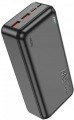 | 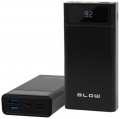 |
|---|---|---|
| Hoco J101B Astute | BLOW PB40A | |
| Outdated Product | Outdated Product | |
| User reviews | ||
| TOP sellers | ||
Small size and weight (taking into account the large capacity). Low current charging. MicroUSB and Apple Lightning inputs. Display. | ||
| Battery capacity | 30000 mAh 111 W*h | 40000 mAh 148 W*h |
| Real capacity | 17700 mAh | 25200 mAh |
| Battery type | Li-Pol | Li-Pol |
Charging gadgets / outputs | ||
| USB-C | 1 pcs | 1 pcs |
| USB-A | 2 pcs | 2 pcs |
| USB-C1 | 20 W | 18 W |
| USB-A1 | 22.5 W | 18 W |
| USB-A2 | 22.5 W | 18 W |
Power bank charging | ||
| Power bank charging inputs | USB-C microUSB | USB-C Apple Lightning microUSB |
| Power bank charge power | 18 W | 18 W |
Features | ||
| Low current charging |  |  |
| Fast charge | Quick Charge 3.0 Power Delivery 3.0 | Quick Charge 3.0 Power Delivery 3.0 |
| Bundled cables (adapters) | microUSB | |
| Features | info display | |
General | ||
| Body material | plastic | plastic |
| Dimensions | 146x68x41 mm | 140x68x27 mm |
| Weight | 596 g | 430 g |
| Added to E-Catalog | january 2023 | december 2022 |


Compare Hoco J101B Astute and BLOW PB40A
You may be interested in
My comparisons
Hoco J101B Astute often compared


BLOW PB40A often compared

Glossary
Battery capacity
The capacity of a powerbank indicates the amount of energy it can store and is usually specified in two formats in the specifications — mAh and Wh. The mAh value is more familiar to most buyers and helps quickly understand the class of the model, while Wh more accurately reflects the total energy reserve and is more convenient for a more accurate comparison of devices.
For example, a powerbank with 10000 mAh usually has about 37 Wh, a model with 20000 mAh — approximately 74 Wh, and a version with 30000 mAh — about 111 Wh. The higher these values, the more charges for a smartphone, headphones, watch, or other devices can be expected, but the larger, heavier, and usually more expensive the device becomes.
At the same time, it is important to remember that the actual output is always lower than the nominal figures due to energy conversion losses. Therefore, capacity is one of the main parameters that immediately shows whether the powerbank is suitable for a day's backup or for more serious autonomous use.
Real capacity
The real capacity of the power bank.
Real capacity is the amount of energy that a power bank is able to transfer to rechargeable gadgets. This amount is inevitably lower than the nominal capacity (see above) — most often by about 1.6 times (due to the fact that part of the energy goes to additional features and transmission losses). However, it is by real capacity that it is easiest to evaluate the actual capabilities of an external battery: for example, if this figure is 6500 mAh, this model is guaranteed to be enough for two full charges of a smartphone with a 3000 mAh battery and smartwatches for 250 mAh.
The capacity in this case is indicated for 5 V — the standard USB charging voltage. At the same time, the features of milliamp-hours as a unit of capacity are such that the actual amount of energy in the battery depends not only on the number of mAh, but also on the operating voltage. In fact, this means that when using fast charging technologies (see below) that involve increased voltage, the actual value of the actual capacity will differ from the claimed one (it will be lower). There are formulas and methods for calculating this value, they can be found in special sources.
Real capacity is the amount of energy that a power bank is able to transfer to rechargeable gadgets. This amount is inevitably lower than the nominal capacity (see above) — most often by about 1.6 times (due to the fact that part of the energy goes to additional features and transmission losses). However, it is by real capacity that it is easiest to evaluate the actual capabilities of an external battery: for example, if this figure is 6500 mAh, this model is guaranteed to be enough for two full charges of a smartphone with a 3000 mAh battery and smartwatches for 250 mAh.
The capacity in this case is indicated for 5 V — the standard USB charging voltage. At the same time, the features of milliamp-hours as a unit of capacity are such that the actual amount of energy in the battery depends not only on the number of mAh, but also on the operating voltage. In fact, this means that when using fast charging technologies (see below) that involve increased voltage, the actual value of the actual capacity will differ from the claimed one (it will be lower). There are formulas and methods for calculating this value, they can be found in special sources.
USB-C1
The power capacity of the main USB-C port, which among USB-C connectors is typically the most powerful. This specification is especially important for smartphones with fast charging, tablets, portable consoles, and laptops that require increased power supply.
Values around 18 – 30 W are usually sufficient for fast charging smartphones, 45 – 65 W are suitable for portable consoles, some ultrabooks, and other more demanding devices, and 100 W and above are even designed for powerful laptops and heavy loads.
Values around 18 – 30 W are usually sufficient for fast charging smartphones, 45 – 65 W are suitable for portable consoles, some ultrabooks, and other more demanding devices, and 100 W and above are even designed for powerful laptops and heavy loads.
USB-A1
The power on USB-A1 port shows the maximum output power of the main USB-A port, which among USB-A connectors is usually the most powerful. Values around 10 – 18 W are typically sufficient for regular or fast charging of smartphones, 22.5 – 33 W are already interesting for faster charging of compatible models, while higher values for USB-A are significantly rarer than for USB-C. Compared to USB-A2, USB-A3, or USB-A4, it often makes more sense to connect the most demanding device to USB-A1 if maximum speed from this type of port is needed.
However, the USB-A format itself is already less promising today than USB-C, so such a port is more often used for smartphones, headphones, watches, speakers, and other mobile devices rather than heavy-duty applications like laptops.
However, the USB-A format itself is already less promising today than USB-C, so such a port is more often used for smartphones, headphones, watches, speakers, and other mobile devices rather than heavy-duty applications like laptops.
USB-A2
The maximum power of the second USB-A output, which is usually slightly less than USB-A1, but is still suitable for charging smartphones, accessories, and other everyday devices.
Power bank charging inputs
The type of input used to charge the power bank's own battery. Simply put, this paragraph indicates which connector on the cable you need to charge the power bank. At the same time, some models provide several inputs for charging at once, which simplifies the search for a cable. Also note that for models with a built-in power bank charging connector (see below), the type of this connector is specified separately.
Most often in modern power banks there are standard connectors microUSB, USB type C and/or Apple Lightning. A lot of accessories are produced for such connectors — cables, network and car chargers, adapters, etc.; so there is usually no difficulty in finding a source of energy. Less common are models with DC input, they are usually equipped with their own power supply (or at least a cable under such a connector). Here is a more detailed description of the different types of inputs:
— microUSB. A smaller version of the USB connector, still very popular in portable tech, despite the active spread of the more advanced USB type C. It has relatively modest capabilities — in particular, it does not allow the implementation of some advanced fast charging technologies. On the other hand, it is very easy to find a source of energy for such a connector: both modern and many of the frankly outdated cables and chargers are...suitable for it.
— USB type C. A miniature type of USB connector, positioned, among other things, as the successor to microUSB. The most noticeable improvement is the reversible design, which allows you not to worry about which side of the plug is inserted into the connector. However, in the case of power banks, this is not the only or even the main advantage: USB type C has more extensive capabilities, allows more powerful currents and use a wider range of fast charging technologies (and Power Delivery was originally created specifically for this connector). Note that in some models the same connector of this type can be used both as an input for charging the battery and as an output for charging external devices — moreover, with automatic switching between these modes.
— Apple Lightning. Initially, this connector is designed for portable gadgets made by Apple. However, in the case of power banks, it can also be found in third-party devices: the idea is that the presence of Lightning allows you to charge an external battery using a cable from an iPhone or iPad and eliminates the need to look for a separate wire. For a number of reasons, this charging input is rarely used as the only one, more often it is provided in addition to microUSB or USB type C (see above).
— DC input. DC is a standard covering several types of connectors at once. Their common feature is a signature round shape, but the diameter, rated voltage and power can be different. In this sense, such connectors are not as convenient as USB type C, Lightning and other generally accepted standards — with a DC socket, it is best to use a native power supply (usually it comes bundled right away), and finding a third-party power source can be a problem. On the other hand, inputs of this type have practically no power limitations, it is easier to achieve high power supply with them than with the connectors described above. Therefore, DC inputs are used mainly in high-capacity power banks, where charging through a "weaker" interface would take an unreasonably long time. However, such models can also be equipped with standard microUSB or USB type C connectors "just in case".
Most often in modern power banks there are standard connectors microUSB, USB type C and/or Apple Lightning. A lot of accessories are produced for such connectors — cables, network and car chargers, adapters, etc.; so there is usually no difficulty in finding a source of energy. Less common are models with DC input, they are usually equipped with their own power supply (or at least a cable under such a connector). Here is a more detailed description of the different types of inputs:
— microUSB. A smaller version of the USB connector, still very popular in portable tech, despite the active spread of the more advanced USB type C. It has relatively modest capabilities — in particular, it does not allow the implementation of some advanced fast charging technologies. On the other hand, it is very easy to find a source of energy for such a connector: both modern and many of the frankly outdated cables and chargers are...suitable for it.
— USB type C. A miniature type of USB connector, positioned, among other things, as the successor to microUSB. The most noticeable improvement is the reversible design, which allows you not to worry about which side of the plug is inserted into the connector. However, in the case of power banks, this is not the only or even the main advantage: USB type C has more extensive capabilities, allows more powerful currents and use a wider range of fast charging technologies (and Power Delivery was originally created specifically for this connector). Note that in some models the same connector of this type can be used both as an input for charging the battery and as an output for charging external devices — moreover, with automatic switching between these modes.
— Apple Lightning. Initially, this connector is designed for portable gadgets made by Apple. However, in the case of power banks, it can also be found in third-party devices: the idea is that the presence of Lightning allows you to charge an external battery using a cable from an iPhone or iPad and eliminates the need to look for a separate wire. For a number of reasons, this charging input is rarely used as the only one, more often it is provided in addition to microUSB or USB type C (see above).
— DC input. DC is a standard covering several types of connectors at once. Their common feature is a signature round shape, but the diameter, rated voltage and power can be different. In this sense, such connectors are not as convenient as USB type C, Lightning and other generally accepted standards — with a DC socket, it is best to use a native power supply (usually it comes bundled right away), and finding a third-party power source can be a problem. On the other hand, inputs of this type have practically no power limitations, it is easier to achieve high power supply with them than with the connectors described above. Therefore, DC inputs are used mainly in high-capacity power banks, where charging through a "weaker" interface would take an unreasonably long time. However, such models can also be equipped with standard microUSB or USB type C connectors "just in case".
Low current charging
Low current charging allows you to seamlessly charge devices that do not require high current. This allows you to extend the life cycle of the devices and protect them as much as possible during charging. Such devices include smartwatches, headphones, headsets, etc.
Bundled cables (adapters)
Types of cables and/or adapters for charging external devices included with the power bank.
The type of these cables is indicated by the plug used to connect to the charging gadget; the connection to the power bank itself is usually through a standard USB-A or USB type C output. It should be emphasized that this refers to removable cables/adapters; types of built-in charging cables are specified separately (if available — see below).
Overall, this parameter allows you to assess the capabilities of the power bank available "out of the box," without purchasing additional accessories. As for specific interfaces, most external batteries these days come with cables/adapters for microUSB, USB type C, and/or Lightning; more specific connectors are extremely rare. Here are the features of the most popular options:
— microUSB. A connector extremely common in modern portable gadgets. It is less convenient than the newer USB type C and has fewer working characteristics, but it still maintains popularity.
— USB type C. A relatively new standard for miniature USB connectors, used for charging both in portable devices and larger ones — particularly some ultra-compact laptops. Physically, it differs from microUSB with slightly larger sizes and a reversible design, allowing the plug to be connected in either direction. In terms of performance, USB...type C is notable for better compatibility with fast-charging technologies: more such technologies can be used with it, and Power Delivery was originally designed for this connector. However, having a USB type C cable does not necessarily mean support for fast charging.
— Lightning. A standard proprietary connector used in compact Apple gadgets; such technology is not found with other manufacturers.
Note that if several types of included cables/adapters are specified in the characteristics, the specific format of such accessories may vary. For example, the "microUSB plus USB type C" option could mean two separate cables, one cable with two plugs, a cable with one connector plus an adapter for another, etc.
The type of these cables is indicated by the plug used to connect to the charging gadget; the connection to the power bank itself is usually through a standard USB-A or USB type C output. It should be emphasized that this refers to removable cables/adapters; types of built-in charging cables are specified separately (if available — see below).
Overall, this parameter allows you to assess the capabilities of the power bank available "out of the box," without purchasing additional accessories. As for specific interfaces, most external batteries these days come with cables/adapters for microUSB, USB type C, and/or Lightning; more specific connectors are extremely rare. Here are the features of the most popular options:
— microUSB. A connector extremely common in modern portable gadgets. It is less convenient than the newer USB type C and has fewer working characteristics, but it still maintains popularity.
— USB type C. A relatively new standard for miniature USB connectors, used for charging both in portable devices and larger ones — particularly some ultra-compact laptops. Physically, it differs from microUSB with slightly larger sizes and a reversible design, allowing the plug to be connected in either direction. In terms of performance, USB...type C is notable for better compatibility with fast-charging technologies: more such technologies can be used with it, and Power Delivery was originally designed for this connector. However, having a USB type C cable does not necessarily mean support for fast charging.
— Lightning. A standard proprietary connector used in compact Apple gadgets; such technology is not found with other manufacturers.
Note that if several types of included cables/adapters are specified in the characteristics, the specific format of such accessories may vary. For example, the "microUSB plus USB type C" option could mean two separate cables, one cable with two plugs, a cable with one connector plus an adapter for another, etc.
Features
Additional functions and features provided in the design of the power bank. Such features may include, but are not limited to, an info display, a USB hub mode, a photocell for solar charging, a lighting source ( flashlight or lamp), and a shock -resistant body. Here's a more detailed description of each of these options:
— Info display. Own display installed on the power bank body. As a rule, it has a simple LCD matrix capable of displaying 2 - 3 characters and, in some cases, individual special icons. However, even such a screen provides a lot of additional information, makes it easier to manage the power bank and monitor its status.
— USB hub. Possibility of working as a USB hub (splitter). In this mode, the external battery’s own USB connectors act as USB inputs of a PC or laptop to which the power bank is connected. The connection itself, as a rule, is also carried out using the USB standard, and the battery can be charged. This function is convenient primarily because it allows you to use one USB port simultaneously to charge the power bank and connect a peripheral device (or even several). However, it does not hurt to make sure that the power supply of this port is sufficient to provide all these functions; and the charging speed may be quite slo...w. If the power bank is fully charged, it can also be useful as a classic USB hub: to increase the number of ports available for connecting peripherals, and also as a kind of remote USB extension cable (for example, if there is a free USB port only on the rear panel of the system unit, which is difficult to get to).
- Flashlight. In this case, a flashlight means a built-in light source of relatively low power, usually directional (as opposed to the lamp described below). Such a source performs an auxiliary function; it can be useful, for example, for illuminating the road at night, for short-term illumination in a dark room (basement, cellar), etc.
- Lamp. Built-in light source, usually in the form of an oblong panel of several LEDs; such a panel can be made folding. Unlike flashlights (see above), lamps provide not directional, but diffused light, which has a shorter range, but covers a larger space. Such lighting can be useful, for example, for reading, for illuminating a room during a power outage, and even for creating a certain atmosphere.
- Shock protection. Enhanced protection against impacts and shocks. The specific degree of such protection may vary; it should be clarified according to the official characteristics; however, most models in this category are capable of at least transferring a fall from a height of about 1 - 1.2 m onto a flat hard surface without consequences. Well, in any case, such devices will be more resistant to mechanical stress than conventional ones. It is also worth noting that shock protection in modern power banks is most often combined with protection from dust and moisture (see above), although there are exceptions to this rule.
— Charging from the sun. Possibility of charging the power bank from the sun or other bright light source. To do this, a corresponding device is installed in the body - a solar battery (photocell). This function can be especially useful during a long stay away from civilization - for example, on a hike. And although the efficiency of solar panels in general is not very high, when exposed to bright light for a long time, you can accumulate quite a lot of energy.
— Info display. Own display installed on the power bank body. As a rule, it has a simple LCD matrix capable of displaying 2 - 3 characters and, in some cases, individual special icons. However, even such a screen provides a lot of additional information, makes it easier to manage the power bank and monitor its status.
— USB hub. Possibility of working as a USB hub (splitter). In this mode, the external battery’s own USB connectors act as USB inputs of a PC or laptop to which the power bank is connected. The connection itself, as a rule, is also carried out using the USB standard, and the battery can be charged. This function is convenient primarily because it allows you to use one USB port simultaneously to charge the power bank and connect a peripheral device (or even several). However, it does not hurt to make sure that the power supply of this port is sufficient to provide all these functions; and the charging speed may be quite slo...w. If the power bank is fully charged, it can also be useful as a classic USB hub: to increase the number of ports available for connecting peripherals, and also as a kind of remote USB extension cable (for example, if there is a free USB port only on the rear panel of the system unit, which is difficult to get to).
- Flashlight. In this case, a flashlight means a built-in light source of relatively low power, usually directional (as opposed to the lamp described below). Such a source performs an auxiliary function; it can be useful, for example, for illuminating the road at night, for short-term illumination in a dark room (basement, cellar), etc.
- Lamp. Built-in light source, usually in the form of an oblong panel of several LEDs; such a panel can be made folding. Unlike flashlights (see above), lamps provide not directional, but diffused light, which has a shorter range, but covers a larger space. Such lighting can be useful, for example, for reading, for illuminating a room during a power outage, and even for creating a certain atmosphere.
- Shock protection. Enhanced protection against impacts and shocks. The specific degree of such protection may vary; it should be clarified according to the official characteristics; however, most models in this category are capable of at least transferring a fall from a height of about 1 - 1.2 m onto a flat hard surface without consequences. Well, in any case, such devices will be more resistant to mechanical stress than conventional ones. It is also worth noting that shock protection in modern power banks is most often combined with protection from dust and moisture (see above), although there are exceptions to this rule.
— Charging from the sun. Possibility of charging the power bank from the sun or other bright light source. To do this, a corresponding device is installed in the body - a solar battery (photocell). This function can be especially useful during a long stay away from civilization - for example, on a hike. And although the efficiency of solar panels in general is not very high, when exposed to bright light for a long time, you can accumulate quite a lot of energy.