
Comparison Intertool FT-1116 vs GRUNTEK 295201940
Add to comparison | 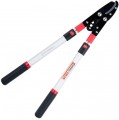 | 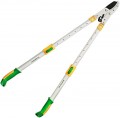 |
|---|---|---|
| Intertool FT-1116 | GRUNTEK 295201940 | |
| Outdated Product | Outdated Product | |
| User reviews | ||
| TOP sellers | ||
Lopper length adjustable with telescopic handles, from 700 mm to 1030 mm | ||
| Type | loppers | loppers |
| Design | two-handed | two-handed |
Specs | ||
| Max. cutting diameter | 40 mm | 52 mm |
| Blade length | 75 mm | |
| Detachable blade |  |  |
| Handle adjustment | | |
General | ||
| Handle material | aluminium | aluminium |
| Handle material | rubber | rubber |
| Length | 1020 mm | 1050 mm |
| Weight | 1600 g | 1612 g |
| Added to E-Catalog | september 2020 | july 2018 |


Compare Intertool FT-1116 and GRUNTEK 295201940
You may be interested in
My comparisons
Intertool FT-1116 often compared

GRUNTEK 295201940 often compared


Glossary
Max. cutting diameter
The largest diameter (thickness) of a branch that the tool can handle.
The larger the maximum cut diameter, the more powerful this model, the lower the likelihood that a certain branch will be too tough for the tool. At the same time, note that to ensure high power, long handles and strong blades are needed, which accordingly affects the dimensions, weight and price. Therefore, it is worth choosing according to this parameter with a certain margin, but at the same time, this margin should not be too large.
As for specific figures, a maximum diameter of 20 mm or less is considered relatively small, but it often turns out to be quite enough for simple work. 21 – 30 mm — the average value, 31 – 40 mm — above average, and in loppers the maximum thickness can exceed 40 mm.
The larger the maximum cut diameter, the more powerful this model, the lower the likelihood that a certain branch will be too tough for the tool. At the same time, note that to ensure high power, long handles and strong blades are needed, which accordingly affects the dimensions, weight and price. Therefore, it is worth choosing according to this parameter with a certain margin, but at the same time, this margin should not be too large.
As for specific figures, a maximum diameter of 20 mm or less is considered relatively small, but it often turns out to be quite enough for simple work. 21 – 30 mm — the average value, 31 – 40 mm — above average, and in loppers the maximum thickness can exceed 40 mm.
Blade length
The length of the blades provided in the tool. Usually, the characteristics indicate the working length of the blades — from the tip to the rotary axis.
Both long and short blades have their own specifics, advantages and disadvantages. So, the long length is optimal for working with relatively thin branches: it allows you to cut several of them at a time, and also makes it possible to reach into hard-to-reach places. At the same time, short blades are more compact and provide more force for the same length of handles, which is convenient when working with thick branches. More detailed recommendations on choosing the length of the blades for a specific situation can be found in special sources.
Both long and short blades have their own specifics, advantages and disadvantages. So, the long length is optimal for working with relatively thin branches: it allows you to cut several of them at a time, and also makes it possible to reach into hard-to-reach places. At the same time, short blades are more compact and provide more force for the same length of handles, which is convenient when working with thick branches. More detailed recommendations on choosing the length of the blades for a specific situation can be found in special sources.
Detachable blade
The presence of a removable blade(blades) in the design of the tool. This feature provides additional convenience and savings. First, the blade is usually more convenient to sharpen and clean by removing it from the tool; secondly, a damaged blade can be replaced with a new one purchased separately — this is cheaper than purchasing a whole new tool.