
Comparison Tekhmann BCE-2014 B vs Gartner BCE-2020
Add to comparison | 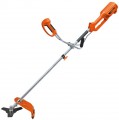 | 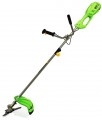 |
|---|---|---|
| Tekhmann BCE-2014 B | Gartner BCE-2020 | |
| Outdated Product | Outdated Product | |
| User reviews | ||
| TOP sellers | ||
| Type | grass trimmer | grass trimmer |
| Motor type | electric (mains) | electric (mains) |
Mowing | ||
| Cutting width | 38 cm | 40 cm |
| Trimmer blade width | 25.5 cm | |
| Cutting system | rotary | rotary |
Trimmer design | ||
| Motor location | top | top |
| Shaft type | straight | straight |
| Handle type | bike handle | bike handle |
| Line diameter | 2.4 mm | |
| More features | foldable shaft shoulder strap | foldable shaft shoulder strap |
In box | ||
| Nozzles | 2-tooth blade spool of line | 2-tooth blade spool of line |
Motor | ||
| Motor power | 2000 W | 2000 W |
| Soft start |  |  |
General | ||
| Deck material | plastic | plastic |
| Weight | 5.3 kg | 4.5 kg |
| Added to E-Catalog | june 2019 | july 2018 |


Compare Tekhmann BCE-2014 B and Gartner BCE-2020
Lawnmowers Tekhmann BCE-2014 B and Gartner BCE-2020 have similar characteristics but there are a few key differences. Both devices are equipped with 2000W electric motors and rotary cutting systems. However, the cutting width for the Gartner is 40 cm, which is slightly larger than the 38 cm of the Tekhmann. Weight also differs: Gartner is lighter by 1.3 kg (4.5 kg compared to 5.3 kg for Tekhmann). While Tekhmann has soft start, Gartner lacks this feature. Both trimmers have a detachable shaft and come with similar attachments.
You may be interested in
My comparisons
Tekhmann BCE-2014 B often compared


Gartner BCE-2020 often compared


Glossary
Cutting width
The capture width provided by the unit, in other words, the width of the strip of land cultivated in one pass. In fact, this size corresponds to the width of the working nozzle.
The large working width is useful when processing large open spaces, as it allows you to finish the job in a small number of passes. On the other hand, for hard-to-reach places, relatively narrow tools are better suited, able to go where a wider unit will not fit. In addition, the width of the tool directly affects the weight and price.
In general, it makes sense to compare in terms of working width only units of the same type (see above). However, it is worth noting here that trimmers do not differ so much from each other — most models capture from 25 to 45 cm (and a wide processing band is provided by moving the nozzle from side to side). As for the other types, in the most modest models the capture width does not exceed 40 cm, in the heaviest and most powerful it can be 56 – 60 cm or even more(in mini tractors — up to 1.5 m).
The large working width is useful when processing large open spaces, as it allows you to finish the job in a small number of passes. On the other hand, for hard-to-reach places, relatively narrow tools are better suited, able to go where a wider unit will not fit. In addition, the width of the tool directly affects the weight and price.
In general, it makes sense to compare in terms of working width only units of the same type (see above). However, it is worth noting here that trimmers do not differ so much from each other — most models capture from 25 to 45 cm (and a wide processing band is provided by moving the nozzle from side to side). As for the other types, in the most modest models the capture width does not exceed 40 cm, in the heaviest and most powerful it can be 56 – 60 cm or even more(in mini tractors — up to 1.5 m).
Trimmer blade width
The width (diameter) of the trimmer knife characterizes the size of the paddle knife (or saw blade). Such a nozzle has a smaller capture width than a fishing line, however, it allows you to mow more dense thickets, including shrubs.
Line diameter
The diameter of the fishing line supplied with the trimmer (more precisely, with a reel attachment, see "Tips").
In modern models, this parameter can be from 1 to 4 mm. At the same time, a thicker fishing line handles better with dense thickets, but it works rougher, the treated lawn is not particularly even, and for the effective operation of such a nozzle, a fairly powerful engine is needed. On the other hand, a fine line provides a clean and neat cut, but is not suitable for heavy vegetation and large stems. Thus, thick fishing line is usually equipped with powerful units designed for "launched" lawns with an abundance of thick stems. Thin, on the other hand, is found mainly in low-power electric trimmers with a lower engine location, designed for neat lawns with regularly cut grass.
We also recall that many trimmers have the ability to replace the standard reel with another one that differs in line thickness.
In modern models, this parameter can be from 1 to 4 mm. At the same time, a thicker fishing line handles better with dense thickets, but it works rougher, the treated lawn is not particularly even, and for the effective operation of such a nozzle, a fairly powerful engine is needed. On the other hand, a fine line provides a clean and neat cut, but is not suitable for heavy vegetation and large stems. Thus, thick fishing line is usually equipped with powerful units designed for "launched" lawns with an abundance of thick stems. Thin, on the other hand, is found mainly in low-power electric trimmers with a lower engine location, designed for neat lawns with regularly cut grass.
We also recall that many trimmers have the ability to replace the standard reel with another one that differs in line thickness.
Soft start
The presence of a soft start system in the lawn mower engine.
The design features of electric motors are such that when power is applied directly, the start occurs very abruptly — both in a mechanical and electrical sense. Firstly, the engine itself spins up in a jerk, in a very short time, which increases the wear of its parts. Secondly, at the moment of start-up, there is a sharp jump in current strength, which creates significant loads on the power grid (or the batteries of the unit). The soft start system eliminates these phenomena: it limits the starting current, allowing the motor to accelerate smoothly and preventing voltage surges.
On the other hand, additional electronic circuits affect the cost, sometimes quite significantly. So there are few models with this feature nowadays, and you should pay attention to them mainly in cases where the mentioned advantages are of fundamental importance — for example, if the device is purchased for a house with weak wiring that does not tolerate voltage surges.
The design features of electric motors are such that when power is applied directly, the start occurs very abruptly — both in a mechanical and electrical sense. Firstly, the engine itself spins up in a jerk, in a very short time, which increases the wear of its parts. Secondly, at the moment of start-up, there is a sharp jump in current strength, which creates significant loads on the power grid (or the batteries of the unit). The soft start system eliminates these phenomena: it limits the starting current, allowing the motor to accelerate smoothly and preventing voltage surges.
On the other hand, additional electronic circuits affect the cost, sometimes quite significantly. So there are few models with this feature nowadays, and you should pay attention to them mainly in cases where the mentioned advantages are of fundamental importance — for example, if the device is purchased for a house with weak wiring that does not tolerate voltage surges.