
Comparison PXN V10 vs Logitech G923 for PS/PC
Add to comparison | 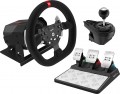 | 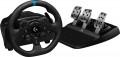 |
|---|---|---|
| PXN V10 | Logitech G923 for PS/PC | |
from $239.99 | Compare prices 9 | |
| User reviews | ||
| TOP sellers | ||
Realistic feedback. Programmable dual clutch control. Progressive brake pedal. Rudder rotation range 900°. Built-in RPM indicator. | ||
| Device type (configuration) | steering wheel and pedals | steering wheel and pedals |
| Steering wheel size | 27 cm | 28 cm |
| Detachable steering wheel |  |  |
| Compatibility | PC (Windows) Xbox PlayStation 4 | PC (Windows) PlayStation 4 PlayStation 5 |
| Connection | wired | wired |
| Cable | USB-A | USB-A |
| Max polling rate | 1000 Hz (1 ms) | |
Technical specifications | ||
| Total number of buttons | 14 | 14 |
| Feedback | power | power |
| Drive type | belt | geared |
| Max. torque | 3.2 Nm | 2.3 Nm |
| D-pad controller | | |
| Steering wheel turn | 270° – 900° | 900° |
| Paddle shifters | 4 pcs | 2 pcs |
| Pedals | accelerator brake clutch | accelerator brake clutch |
General information | ||
| Mounting | clamps | clamps |
| Steering wheel cover | eco-leather | leather |
| Power source | network | network |
| Weight | 2250 g | |
| Color | ||
| Added to E-Catalog | march 2023 | september 2020 |





Compare PXN V10 and Logitech G923 for PS/PC
Comparing the PXN V10 and the Logitech G923 Trueforce, it can be noted that both steering wheels have wired connection and are compatible with PC, Xbox, and PlayStation. However, the G923 supports PlayStation 5, which may be important for users of this platform. Both devices offer force feedback and have 14 buttons, but the G923 stands out with leather steering wheel material, which can enhance comfort during gameplay. The steering wheel rotation of the PXN V10 varies from 270° to 900°, whereas the G923 is fixed at 900°. In terms of gearboxes, the PXN V10 offers a shifter and paddles, whereas the G923 uses paddle shifters. Both steering wheels have table mounting with clamps, providing stability during gameplay.
Price comparison
You may be interested in
PXN V10 often compared


Logitech G923 for PS/PC often compared


Glossary
Steering wheel size
The size of a gaming steering wheel usually refers to the diameter of the wheel in round and D-shaped forms and affects the realism of control, rotation speed, and grip comfort. Compact wheels, around 20 – 24 cm, are more common in simple models and are suitable for arcade racing but feel less realistic. A size of 27 – 30 cm is considered more versatile and closer to an actual car steering wheel, making it convenient for simulators, GT, rally, and everyday play. Larger wheels, 31 – 35 cm, are more often used in advanced setups, especially for trucking simulators, drifts, or the most realistic seating.
For formula wheels or steering wheels with a cut-off shape, the size is more often indicated by the maximum width between the outermost grip points.
For formula wheels or steering wheels with a cut-off shape, the size is more often indicated by the maximum width between the outermost grip points.
Detachable steering wheel
The ability to detach the steering wheel from the base. This is convenient for storage, transportation, and changing the wheel for different types of racing: for example, installing a round wheel for drifting or a yoke for formula simulators.
Compatibility
Compatibility shows which devices a gaming wheel can work with: PC, PlayStation, Xbox, Nintendo Switch or specific console generations. It is important to check this parameter before purchasing because a PC wheel does not always fit a console, and models for PlayStation and Xbox often have different versions (PS3, PS4, PS5) due to the proprietary license and electronics inside the base.
Special attention should be given to steering wheels that have specific compatibility with bases. In most cases, all bases from the brand are suitable, but it is better to confirm this additionally.
Special attention should be given to steering wheels that have specific compatibility with bases. In most cases, all bases from the brand are suitable, but it is better to confirm this additionally.
Max polling rate
The polling rate indicates how often the controller sends data on button presses and movements to the system, usually measured in Hz, and directly affects the sense of responsiveness. The higher the polling rate, the smaller the "time window" between your action and how it appears in the game, making the control feel more precise, especially in shooters, fighting games, and rhythm games. However, the real effect also depends on the type of connection: with a cable, a high polling rate is often more stable, whereas with Bluetooth, it may be limited by the protocol or power saving, so two identical gamepads may feel different in wired and wireless modes. Thus, if you are playing a competitive shooter, a higher polling rate helps more accurately "catch" micro-movements of the stick; for more relaxed games, the difference may be hardly noticeable.
Drive type
The drive type indicates how the motor's force is transmitted to the wheel and how realistic the feedback feels in the game.
— Gear-driven. A gear mechanism transmits the motor's force to the wheel through a gear transmission, making these models generally simpler and more affordable. It provides basic feedback and is suitable for getting acquainted with racing, but may feel noisier, more stepped, and less smooth than belt or direct drive. Therefore, a gear-driven wheel is suitable for Forza, Need for Speed, or initial runs in simulators without serious precision demands.
— Belt-driven. The transfer of force through a belt makes the wheel rotation smoother and quieter compared to a gear mechanism. This type of drive usually smooths out jerks better, provides pleasant feedback, and is suitable for those looking for a noticeable step up from basic models. A belt-driven wheel is well-suited for circuit racing, where smooth trajectory handling and precise car correction are important.
— Hybrid. A combined drive uses several types of force transmission, most often belts and gears, to combine affordable pricing with smoother feedback. It generally operates more softly than a purely gear-driven mechanism but does not offer the precision and speed of direct drive. A hybrid wheel is suitable for a player who has outgrown the basic model but is not yet ready to invest in an expensive Direct Drive base.
— Direct. A direct drive system transmit...s motor force directly to the steering shaft, without belts and gears, allowing the wheel to react as quickly and accurately as possible. This option is valued for its powerful feedback, detailed transmission of small effects, and absence of play, though it is usually more expensive and requires secure mounting. For example, direct drive is well-suited for serious sim racing, where feeling tire slip, car weight, and the moment of drifting is important.
— Gear-driven. A gear mechanism transmits the motor's force to the wheel through a gear transmission, making these models generally simpler and more affordable. It provides basic feedback and is suitable for getting acquainted with racing, but may feel noisier, more stepped, and less smooth than belt or direct drive. Therefore, a gear-driven wheel is suitable for Forza, Need for Speed, or initial runs in simulators without serious precision demands.
— Belt-driven. The transfer of force through a belt makes the wheel rotation smoother and quieter compared to a gear mechanism. This type of drive usually smooths out jerks better, provides pleasant feedback, and is suitable for those looking for a noticeable step up from basic models. A belt-driven wheel is well-suited for circuit racing, where smooth trajectory handling and precise car correction are important.
— Hybrid. A combined drive uses several types of force transmission, most often belts and gears, to combine affordable pricing with smoother feedback. It generally operates more softly than a purely gear-driven mechanism but does not offer the precision and speed of direct drive. A hybrid wheel is suitable for a player who has outgrown the basic model but is not yet ready to invest in an expensive Direct Drive base.
— Direct. A direct drive system transmit...s motor force directly to the steering shaft, without belts and gears, allowing the wheel to react as quickly and accurately as possible. This option is valued for its powerful feedback, detailed transmission of small effects, and absence of play, though it is usually more expensive and requires secure mounting. For example, direct drive is well-suited for serious sim racing, where feeling tire slip, car weight, and the moment of drifting is important.
Max. torque
The max torque indicates the force with which the steering base can resist the steering wheel's turn. The higher the torque, the more strongly tire grip, impacts, skids, curbs, and load in turns are felt, making the control closer to that of a real car. Simple steering wheels usually provide up to 3 Nm, more advanced models — 4-8 Nm, and powerful Direct Drive bases can deliver 10-20 Nm and above.
Meanwhile, in simulators, the force is often adjusted for the game, car, and user's comfort. For example, for arcade racing, a small effort is enough, whereas for iRacing, Assetto Corsa, or serious drifting, a powerful base with a torque reserve provides more accurate and rich feedback.
Meanwhile, in simulators, the force is often adjusted for the game, car, and user's comfort. For example, for arcade racing, a small effort is enough, whereas for iRacing, Assetto Corsa, or serious drifting, a powerful base with a torque reserve provides more accurate and rich feedback.
D-pad controller
D-pad controller helps control the menu, camera, and additional functions directly from the gaming wheel without resorting to the keyboard or gamepad. It is usually a cross-shaped pad with up, down, left, and right presses, and some models also support diagonal commands. This element is convenient for switching cameras, navigating settings, selecting menu items, controlling onboard functions, or issuing quick commands during a race.
Steering wheel turn
The steering wheel rotation angle in the control wheel (see "Device Type"). This parameter is measured by the total range — from one extreme point to the other; accordingly, the rotation angle from the mid position will be half of the total. For instance, an indicator of 180° means the wheel can turn both right and left by 90°.
This parameter directly affects both the overall level and the purpose of the wheel. Models with a rotation angle up to 270° are predominantly entry-level and are mainly intended for arcade racing enthusiasts without a significant emphasis on realism, as well as for children and beginner gamers. More advanced wheels have a rotation angle of 900°, or even 1080°. These figures are not arbitrary — they correspond to the steering wheel rotation ranges in most production cars (900°) and some racing supercars (1080°). Thus, such features make using the wheel as realistic as possible — on the other hand, they significantly impact the cost.
The range of steering wheel rotation can be adjusted by the steering angle adjustment function (if this feature is implemented in the game controller). The option is set either directly in the game or through the software that manages the wheel's operation.
This parameter directly affects both the overall level and the purpose of the wheel. Models with a rotation angle up to 270° are predominantly entry-level and are mainly intended for arcade racing enthusiasts without a significant emphasis on realism, as well as for children and beginner gamers. More advanced wheels have a rotation angle of 900°, or even 1080°. These figures are not arbitrary — they correspond to the steering wheel rotation ranges in most production cars (900°) and some racing supercars (1080°). Thus, such features make using the wheel as realistic as possible — on the other hand, they significantly impact the cost.
The range of steering wheel rotation can be adjusted by the steering angle adjustment function (if this feature is implemented in the game controller). The option is set either directly in the game or through the software that manages the wheel's operation.
Paddle shifters
Paddle shifters behind the steering wheel, which can be pressed with fingers without removing hands from the wheel, are most often used for gear shifting. Basic models usually have two paddles: the right one is for shifting up, and the left one is for shifting down. More advanced wheels may have 4 or 6 paddles, with additional pairs used for clutch, manual start, DRS, car adjustments, or other commands in simulators. The more paddle shifters there are, the more convenient it is to control important functions directly from the wheel, especially in F1, GT, and other racing simulators.