
Comparison LG OM-6560 vs LG OM-7560
Add to comparison | 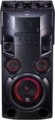 | 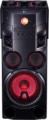 |
|---|---|---|
| LG OM-6560 | LG OM-7560 | |
from $302.00 up to $350.65 | from $412.00 | |
| TOP sellers | ||
| Features | party | party |
| Number of channels | 2.1 | 2.1 |
Playback | ||
| Media | USB port CD | USB port CD |
Radio | ||
| Tuner bands | FM | FM |
Tech specs | ||
| System power | 500 W | 1000 W |
| Power per channel | 160 W | 300 W |
| Subwoofer power | 180 W | 400 W |
| Number of bands | 2 | 2 |
| Frequency range | 40 – 20000 Hz | 40 – 20000 Hz |
| Phase inverter |  | |
| Equalizer | | |
| Bass Boost | | |
Interfaces and features | ||
| Interfaces | Bluetooth | Bluetooth |
| More features | karaoke time alarm | karaoke time alarm |
Connectors | ||
| Inputs | RCA mini-Jack (3.5 mm) for microphone | RCA mini-Jack (3.5 mm) for microphone |
| Outputs | RCA | RCA |
General | ||
| Lighting effects | | |
| Remote control | | |
| USB for charging gadgets | | |
| Dimensions (HxWxD) | 715x330x302 mm | 815x330x302 mm |
| Weight | 13.3 kg | 16.8 kg |
| Color | ||
| Added to E-Catalog | september 2016 | july 2016 |


Compare LG OM-6560 and OM-7560
You may be interested in
My comparisons
LG OM-6560 often compared


LG OM-7560 often compared


Glossary
System power
The total sound power provided by the audio system at maximum volume, in other words, the total power of all the speakers provided by the device (including the subwoofer).
The higher the power, the louder the system will sound and the larger the area it can cover. On the other hand, high power significantly affects the price, dimensions, weight and power consumption of the device. In addition, when evaluating and comparing according to this indicator, it is worth considering some nuances. Firstly, some manufacturers go to the trick and give in the characteristics not the average, but the peak sound power; such numbers can be quite impressive, but they have very little to do with real loudness. So if it seems to you that the claimed power is too high, it's ok to clarify what exactly is meant in this case. Secondly, when comparing, it is worth considering the presence of a subwoofer — it plays an auxiliary role, but it can account for more than half of the total system power. Because of this, for equal total power, a device with a subwoofer may be quieter than a model without a subwoofer: for example, a 2.0 40W system will have 20W per main channel, while a 2.1 40W model may have 20W per subwoofer, and only 10 watts for the main speakers.
The higher the power, the louder the system will sound and the larger the area it can cover. On the other hand, high power significantly affects the price, dimensions, weight and power consumption of the device. In addition, when evaluating and comparing according to this indicator, it is worth considering some nuances. Firstly, some manufacturers go to the trick and give in the characteristics not the average, but the peak sound power; such numbers can be quite impressive, but they have very little to do with real loudness. So if it seems to you that the claimed power is too high, it's ok to clarify what exactly is meant in this case. Secondly, when comparing, it is worth considering the presence of a subwoofer — it plays an auxiliary role, but it can account for more than half of the total system power. Because of this, for equal total power, a device with a subwoofer may be quieter than a model without a subwoofer: for example, a 2.0 40W system will have 20W per main channel, while a 2.1 40W model may have 20W per subwoofer, and only 10 watts for the main speakers.
Power per channel
Nominal sound power (see "System power") on each of the main channels of the audio system. This indicator is most often indicated in models with a subwoofer (see "Number of channels"); knowing it, you can estimate the power distribution between the main speakers and the subwoofer.
Subwoofer power
The subwoofer power rating is a bass driver used in 2.1 and 3.1 systems (see "Number of Channels"). For rated power in general, see "System Power"; and in the case of a subwoofer, this indicator allows you to evaluate the volume and richness of the bass produced by the audio system, as well as the ratio between the power of the main channels and the “subwoofer”).