
Comparison ECG KM 150 Minimo vs Cloer 7560
Add to comparison | 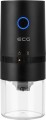 | 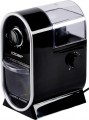 |
|---|---|---|
| ECG KM 150 Minimo | Cloer 7560 | |
| Outdated Product | Outdated Product | |
| TOP sellers | ||
Built-in 1250 mAh lithium polymer battery. Collapsible design. Compact sizes. Battery operated and powered via USB-C. | Millstone grinding system. Flexible adjustment of grinding degree. Operational safety. Spacious compartment for ground coffee. Pulse mode. | |
| Type | battery-powered | |
| Grinding system | ceramic millstones | metal millstones |
Specs | ||
| Bean compartment capacity | 25 g | 150 g |
| Power | 13 W | 150 W |
| Pulse mode |  | |
| Adjusting the grind | | |
| Dispenser |  | |
General | ||
| Removable bowl | | |
| Compartment for ground coffee | | |
| The volume of the compartment for ground coffee | 120 g | |
| Compartment for cord | | |
| Cable length | 0.83 m | |
| Material | plastic | plastic |
| Dimensions | 185x74x74 mm | 230x180x130 mm |
| Weight | 0.4 kg | 1.44 kg |
| Color | ||
| Added to E-Catalog | september 2022 | may 2022 |


Compare ECG KM 150 Minimo and Cloer 7560
You may be interested in
My comparisons
ECG KM 150 Minimo often compared


Glossary
Type
— Manual. Mechanical coffee grinders operate based on a stone mill principle, where one mill wheel is attached to the grinder's body, and the second rotates with a handle. Coffee beans are crushed and ground into small particles as they pass between the millstones. The grinding process is slow, preventing the beans from heating up and avoiding any possibility of overheating or burning them. Manual coffee grinders typically use burrs made of materials such as cast iron, hardened steel, ceramic, or stone. When it comes to adjusting the grind size, most manual grinders offer stepped settings with audible clicks, while models with stepless adjustment provide the most precise and customizable settings. These mechanical coffee grinders are highly regarded for their ability to bring out the aromatic qualities and flavors of the coffee beans.
Grinding system
— Knives. The grinding system is based on the use of a rotary blade (or blades) that spin at high speed. The main advantages of such a system are its low cost combined with decent efficiency. However, its capabilities are quite limited. For instance, the grind size in blade coffee grinders depends on the operating time and in most models is controlled solely manually, by turning it on for the desired duration (which requires some skill and familiarity with the device's features). And even if a separate grind size adjustment (see below) is provided in the design, the product turns out to be less uniform than when processed with burrs. Additionally, blade coffee grinders require caution when in use due to the presence of the blades themselves (though most modern devices have appropriate safety systems). Nonetheless, given the combination of cost and capabilities, such devices are considered optimal for home use.
— Burrs. In these systems, grinding is carried out by crushing coffee beans between two rotating discs (metal or ceramic) — the burrs.
Metal burrs are valued for their durability and speed, which is why they are often used in models for daily coffee and for those who love espresso and need precise grind consistency. However, metal burrs can heat the beans more during long grinding sessions and usually react more noticeably to build quality and cleanliness,...so regular cleaning and reasonable pauses are important.
Ceramic burrs are more often chosen for their “calmer” operation and less heat generation during grinding, which helps preserve the aroma, especially if grinding longer or frequently. Ceramic doesn't rust and is usually neutral to odors, so the taste is purer with careful maintenance, and the grind is even for alternative brewing methods and home use. However, ceramic burrs are more sensitive to impacts and hard particles, making careful handling and quality beans without foreign inclusions more important.
— Burrs. In these systems, grinding is carried out by crushing coffee beans between two rotating discs (metal or ceramic) — the burrs.
Metal burrs are valued for their durability and speed, which is why they are often used in models for daily coffee and for those who love espresso and need precise grind consistency. However, metal burrs can heat the beans more during long grinding sessions and usually react more noticeably to build quality and cleanliness,...so regular cleaning and reasonable pauses are important.
Ceramic burrs are more often chosen for their “calmer” operation and less heat generation during grinding, which helps preserve the aroma, especially if grinding longer or frequently. Ceramic doesn't rust and is usually neutral to odors, so the taste is purer with careful maintenance, and the grind is even for alternative brewing methods and home use. However, ceramic burrs are more sensitive to impacts and hard particles, making careful handling and quality beans without foreign inclusions more important.
Bean compartment capacity
The maximum number of coffee beans that the grinder can hold and process at one time, without "refilling". Note that we are talking about the maximum capacity — a smaller amount of coffee can be loaded into the grinder.
The standard portion of coffee per cup is 5-7 g, and the capacity of a pack of coffee is 100 g. Accordingly, it is worth choosing a model according to capacity, taking into account how much coffee you need to grind at a time. For domestic use, a capacity of 100-200 g is considered quite sufficient, but in professional models designed for coffee shops, bars, etc., this value can reach 1.5 kg or even more. There are coffee grinders that allow you to grind only part of the coffee loaded into them.
The standard portion of coffee per cup is 5-7 g, and the capacity of a pack of coffee is 100 g. Accordingly, it is worth choosing a model according to capacity, taking into account how much coffee you need to grind at a time. For domestic use, a capacity of 100-200 g is considered quite sufficient, but in professional models designed for coffee shops, bars, etc., this value can reach 1.5 kg or even more. There are coffee grinders that allow you to grind only part of the coffee loaded into them.
Power
The maximum power consumed by the device during operation. In coffee grinders, productivity is primarily associated with this parameter: the higher the power, the faster the grinder handles with the task (ceteris paribus). The suitability of the coffee grinder for working with solid products also depends on the power — more powerful models are better suited for these purposes.
Buying powerful models for everyday use in life is hardly justified: they are expensive, and the time savings are small. But in the professional sphere (for example, in a cafe), where the speed of preparation is crucial, high-power coffee grinders are very useful.
Buying powerful models for everyday use in life is hardly justified: they are expensive, and the time savings are small. But in the professional sphere (for example, in a cafe), where the speed of preparation is crucial, high-power coffee grinders are very useful.
Dispenser
The presence of a dispenser in the design of the coffee grinder. This device is designed to dispense ground coffee in portions. Most often, this portion is 7 g (the standard for one cup of espresso), however, there are models where the volume of the dispenser can be changed at will. Coffee grinders with a dispenser will be useful for lovers of exact recipes, as well as in cafes, restaurants, etc., where both strict accounting of coffee consumption is required, as well as compliance with each portion of the specified standards.
Removable bowl
The presence of a removable bowl in the design of the coffee grinder.
This feature is found mainly among knife-type models (see "Grinding system") — it is most relevant for them. Thanks to this bowl, the unloading of ground coffee is greatly facilitated: instead of turning the entire grinder over, it is enough to remove the working container and pour the finished product out of it. Also note that the bowl is usually removed along with the knives — this, in turn, is convenient for cleaning and washing the device.
This feature is found mainly among knife-type models (see "Grinding system") — it is most relevant for them. Thanks to this bowl, the unloading of ground coffee is greatly facilitated: instead of turning the entire grinder over, it is enough to remove the working container and pour the finished product out of it. Also note that the bowl is usually removed along with the knives — this, in turn, is convenient for cleaning and washing the device.
The volume of the compartment for ground coffee
The capacity of the ground coffee compartment provided in the coffee grinder.
About such a compartment, see above. On the one hand, capacity affects the amount of coffee that can be ground in one go before filling the compartment, on the other hand, on the dimensions of the compartment and, accordingly, the entire device. With this in mind, in most models this figure is from 100 to 200 g — this is the optimal value in terms by the ratio of capacity and size. At the same time, for domestic use, you can choose a model with a smaller capacity; and coffee grinders with capacious tanks are convenient, for example, for specialty stores where coffee beans can be ground in the presence of a buyer.
About such a compartment, see above. On the one hand, capacity affects the amount of coffee that can be ground in one go before filling the compartment, on the other hand, on the dimensions of the compartment and, accordingly, the entire device. With this in mind, in most models this figure is from 100 to 200 g — this is the optimal value in terms by the ratio of capacity and size. At the same time, for domestic use, you can choose a model with a smaller capacity; and coffee grinders with capacious tanks are convenient, for example, for specialty stores where coffee beans can be ground in the presence of a buyer.
Compartment for cord
Compartment for placing the power cord directly in the coffee maker. This feature greatly simplifies storage: when the device is not in use, the cord can be hidden inside the case, and it will not get tangled and interfere. Some models may have devices for uniform winding of the wire, which prevents bending and possible fractures.