
Comparison Daewoo DAST 5040Li vs Daewoo DAST 3000E
Add to comparison | 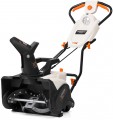 | 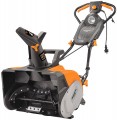 |
|---|---|---|
| Daewoo DAST 5040Li | Daewoo DAST 3000E | |
| Outdated Product | Outdated Product | |
| TOP sellers | ||
The battery and charger are not included. | ||
| Motor type | electric (battery) | electric (mains) |
Snow removing | ||
| Working width | 46 cm | 51 cm |
| Snow height | 27 cm | 33 cm |
| Adjustable throw direction |  | |
| Throw distance adjustment | | |
| Min. throw distance | 1 m | 1 m |
| Max. throw distance | 10 m | 12 m |
| Working mechanism | rubber auger | rubber auger |
| Auger / brush rotation speed | 2600 rpm | |
Design characteristics | ||
| Design | lights | lights |
| Movement | wheels | wheels |
Motor | ||
| Motor power | 3000 W | |
Battery | ||
| Battery in set | in absent | |
| Battery voltage | 40 В | |
| Compatible batteries | DABT 2540Li, DABT 4040Li, DABT 5040Li | |
| Charger | no | |
General | ||
| Noise level | 89 dB | 96 dB |
| Weight | 20 kg | 17 kg |
| Added to E-Catalog | october 2018 | october 2016 |


Compare Daewoo DAST 5040Li and DAST 3000E
You may be interested in
My comparisons
Daewoo DAST 5040Li often compared

Daewoo DAST 3000E often compared


Glossary
Motor type
— Petrol. An internal combustion engine that uses gasoline as fuel. Such engines are often more powerful than electric ones, and do not depend on being connected to the mains or the length of the power cord. On the other hand, gasoline snow blowers are usually heavier, have a higher noise level, and emit combustion products into the air. In addition, they are more expensive to operate and require the purchase of fuel and lubricants. You should pay attention to such machines if you plan to work on large areas and/or in the absence of electricity.
— Diesel. Internal combustion engines running on diesel fuel. It is easier to achieve high torque in such engines than in gasoline engines; however, this requires sacrificing speed, but this is not critical for snow blowers. In addition, diesel fuel is cheaper than gasoline. On the other hand, the engines themselves are quite expensive and difficult to maintain, and at low temperatures they often have problems starting. Therefore, diesel engines are not very widespread; they are found only in a few models of heavy professional snow blowers.
— Electric(mains). Snow blowers with electric motors are usually powered by a regular 230 V mains. Compared to gasoline ones, such devices are lighter, cheaper to operate, produce less noise and do not pollute the air; in addition, they are more compact and easier to store. On th...e other hand, the power of electric snow blowers is usually significantly lower, and mobility is limited by the length of the power cord. Such models can be recommended primarily to those who plan to clean relatively small areas in the immediate vicinity of power sources - for example, the yard of a private house or the exit from a garage.
— Electric (battery). Snow blowers with an electric motor, powered by a built-in battery. Such models have very low power and limited operating time, while they are more expensive and weigh more than their mains-powered counterparts. On the other hand, a battery-powered snow blower works without being connected to the mains and does not depend on the length of the wire. So such a unit will be an ideal choice for cleaning a relatively small area near which there are no sockets.
— Diesel. Internal combustion engines running on diesel fuel. It is easier to achieve high torque in such engines than in gasoline engines; however, this requires sacrificing speed, but this is not critical for snow blowers. In addition, diesel fuel is cheaper than gasoline. On the other hand, the engines themselves are quite expensive and difficult to maintain, and at low temperatures they often have problems starting. Therefore, diesel engines are not very widespread; they are found only in a few models of heavy professional snow blowers.
— Electric(mains). Snow blowers with electric motors are usually powered by a regular 230 V mains. Compared to gasoline ones, such devices are lighter, cheaper to operate, produce less noise and do not pollute the air; in addition, they are more compact and easier to store. On th...e other hand, the power of electric snow blowers is usually significantly lower, and mobility is limited by the length of the power cord. Such models can be recommended primarily to those who plan to clean relatively small areas in the immediate vicinity of power sources - for example, the yard of a private house or the exit from a garage.
— Electric (battery). Snow blowers with an electric motor, powered by a built-in battery. Such models have very low power and limited operating time, while they are more expensive and weigh more than their mains-powered counterparts. On the other hand, a battery-powered snow blower works without being connected to the mains and does not depend on the length of the wire. So such a unit will be an ideal choice for cleaning a relatively small area near which there are no sockets.
Working width
The width of the strip of snow that the snow blower can clear in one pass. The larger the capture width, the fewer passes will be required to process the site, which is especially important on large areas. On the other hand, for processing small spaces, clearing individual paths, etc. significant width is not required (moreover, a “narrow” snow blower will pass more easily in a hard-to-reach place). The larger the capture width, the more powerful the engine, usually, ceteris paribus.
The most compact modern snow blowers have a working width of less than 50 cm, these are mainly electric models of low power, although gasoline units are also found. A width of 50 – 60 cm can be called relatively small, 60 – 70 cm — medium, and in the largest models this figure exceeds 70 cm.
The most compact modern snow blowers have a working width of less than 50 cm, these are mainly electric models of low power, although gasoline units are also found. A width of 50 – 60 cm can be called relatively small, 60 – 70 cm — medium, and in the largest models this figure exceeds 70 cm.
Snow height
The maximum thickness of the snow layer that the snow blower removes in one pass. If you plan to regularly remove snow as it falls in a small area (for example, in the courtyard of your own private house), a grip height of up to 20 cm will be enough. If the opportunity to remove snow is rare (for example, in a country house where you visit only on weekends), you should pay attention to more powerful models with a height of about 50 cm.
Max. throw distance
The maximum distance to which the snow blower can throw the collected snow (for models without throwing distance adjustment, the operating range itself). This value is rather arbitrary, since snow can be strongly dispersed in flight. Nevertheless, it characterizes the capabilities of the unit well and allows you to compare it with other models.
Long range is important mainly when working on large areas — it allows you to throw snow across the cultivated area so that it does not have to be collected a second time. As for specific figures, the value up to 10 m is considered relatively small, 11 – 15 m — average, and in the most "long-range" models this figure can be 16 m or more.
Long range is important mainly when working on large areas — it allows you to throw snow across the cultivated area so that it does not have to be collected a second time. As for specific figures, the value up to 10 m is considered relatively small, 11 – 15 m — average, and in the most "long-range" models this figure can be 16 m or more.
Auger / brush rotation speed
The speed of rotation of the working tool of the snow blower.
Other things being equal, a higher speed is good for performance, a lower speed gives more torque and improves efficiency in hard snow and crust. However, in fact, this parameter is more of a reference than practically significant: manufacturers select the speed in such a way as to ensure sufficient efficiency and productivity. In addition, many models are produced with several gears, where the rotation speed can be adjusted.
Other things being equal, a higher speed is good for performance, a lower speed gives more torque and improves efficiency in hard snow and crust. However, in fact, this parameter is more of a reference than practically significant: manufacturers select the speed in such a way as to ensure sufficient efficiency and productivity. In addition, many models are produced with several gears, where the rotation speed can be adjusted.
Motor power
Snowblower motor power in watts. This designation is used for all electric models; for units with an internal combustion engine (see "Motor type"), the designation in horsepower may also be given (see above).
The higher the motor power, the higher the snowblower's flow rate, the better it copes with high dense snowdrifts and icy crust. However, more powerful engines consume more fuel, weigh more and cost more, and their use is not always justified. Detailed recommendations on choosing the optimal power for a specific situation can be found in special sources.
The higher the motor power, the higher the snowblower's flow rate, the better it copes with high dense snowdrifts and icy crust. However, more powerful engines consume more fuel, weigh more and cost more, and their use is not always justified. Detailed recommendations on choosing the optimal power for a specific situation can be found in special sources.
Battery in set
Battery features with which the snowblower of the corresponding design is equipped (see "Engine Type").
— Not included. This option is beneficial if you already own tools from the same brand and several compatible batteries: you save on purchasing additional batteries and just get the "body" for your needs. Compared to the set "with battery," the entry price is lower, but it's essential to check compatibility in advance regarding platform, voltage, and recommended capacity. Otherwise, you might experience weak power or short operation time; a typical example is purchasing a snowblower "without a battery" for existing batteries from a trimmer/lawn mower to clear the path to the house or parking spot.
— Battery. The snowblower is sold ready to use "out of the box," and you don't need to assess compatibility from scratch. This is a good choice for your first battery-powered snowblower, making it important to start clearing snow without additional purchases and risks. Compared to a model without a battery, the set is usually more expensive, but you receive a straightforward starter kit. — 2 batteries. The inclusion of two batteries significantly enhances convenience: either you simply double the energy reserve, or (as is often the case with models with a dual slot), the snowblower can operate using two batteries simultaneously, receiving more power and more stable traction under load. Compared to the one-battery version, you...need to recharge less often, handle dense snow better, and clear the area faster.
— 4 batteries. The maximum autonomy reserve within a single platform, designed for large amounts of cleaning and extended operation throughout the day. Even if the snowblower itself operates on two batteries simultaneously (which is typical for powerful models with a dual slot), the other two serve as backup: you can continue clearing almost without pauses, just swapping batteries as they deplete. Compared to "2 batteries," this option is suited for large yards, long driveways, or multiple cleaning zones in succession.
— Not included. This option is beneficial if you already own tools from the same brand and several compatible batteries: you save on purchasing additional batteries and just get the "body" for your needs. Compared to the set "with battery," the entry price is lower, but it's essential to check compatibility in advance regarding platform, voltage, and recommended capacity. Otherwise, you might experience weak power or short operation time; a typical example is purchasing a snowblower "without a battery" for existing batteries from a trimmer/lawn mower to clear the path to the house or parking spot.
— Battery. The snowblower is sold ready to use "out of the box," and you don't need to assess compatibility from scratch. This is a good choice for your first battery-powered snowblower, making it important to start clearing snow without additional purchases and risks. Compared to a model without a battery, the set is usually more expensive, but you receive a straightforward starter kit. — 2 batteries. The inclusion of two batteries significantly enhances convenience: either you simply double the energy reserve, or (as is often the case with models with a dual slot), the snowblower can operate using two batteries simultaneously, receiving more power and more stable traction under load. Compared to the one-battery version, you...need to recharge less often, handle dense snow better, and clear the area faster.
— 4 batteries. The maximum autonomy reserve within a single platform, designed for large amounts of cleaning and extended operation throughout the day. Even if the snowblower itself operates on two batteries simultaneously (which is typical for powerful models with a dual slot), the other two serve as backup: you can continue clearing almost without pauses, just swapping batteries as they deplete. Compared to "2 batteries," this option is suited for large yards, long driveways, or multiple cleaning zones in succession.
Battery voltage
Nominal voltage of the battery used in the unit with the corresponding engine type (see above). Theoretically, a higher voltage allows you to achieve more power, but in fact there is no direct relationship between these points. In addition, manufacturers choose batteries to deliver the intended power, rotational speed, and other performance. Therefore, in the selection and normal use of the unit, this parameter has a secondary, reference value; it may be needed mainly for some specific tasks, for example, searching for a spare battery or a “non-native” charger, or comparing different batteries by capacity (see below).
Compatible batteries
The name of the battery that is compatible with the device. It helps to buy a spare or find a suitable one in case of a breakdown of the main one.