
Comparison Marshall Middleton vs Marshall Emberton II
Add to comparison | 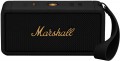 | 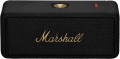 |
|---|---|---|
| Marshall Middleton | Marshall Emberton II | |
| Compare prices 3 | Compare prices 4 | |
| User reviews | ||
| TOP sellers | ||
Large power, good moisture protection, long battery life. Quick charge: 20 minutes for 2 hours of use. | Good level of moisture protection, excellent battery life (30 hours), fine tuning, control and firmware update using a proprietary application. There is a fast charging function: in 20 minutes it charges up to 4 hours of operation. There is a fast charging function: in 20 minutes it charges up to 4 hours of work. | |
Connection | ||
| Sources and media | Bluetooth v5.1 mini-Jack (3.5 mm) | Bluetooth v5.1 |
Acoustic characteristics | ||
| Number of channels | 2.0 (stereo) | 2.0 (stereo) |
| Lines | 2 | |
| Sound pressure level SPL | 87 dB | 87 dB |
| Passive emitter |  | |
| Output power | 60 W | 20 W |
| Frequency range | 50 – 20000 Hz | 60 – 20000 Hz |
| Speaker synchronization | Marshall Stack Mode | Marshall Stack Mode |
| Features | Multipoint mobile app | mobile app |
| More features | handle / strap | |
Battery | ||
| Battery life | 20 h | 30 h |
| Charging time | 4.5 h | 3 h |
| USB charging port | USB-C | USB-C |
General | ||
| Waterproof | IP67 | IP67 |
| Material | plastic | plastic |
| Size (HxWxD) | 109x230x95 mm | 68x160x77 mm |
| Weight | 1800 g | 700 g |
| Color | ||
| Added to E-Catalog | march 2023 | november 2022 |



Compare Marshall Middleton and Emberton II
When comparing portable speakers Marshall Middleton and Marshall Emberton II, it is important to note several key differences. Middleton features an output power of 60 W and a battery life of 20 hours, while Emberton II offers 20 W and an impressive 30 hours of operation. Both devices have IP67 water resistance, but Middleton is heavier (1.8 kg compared to Emberton II's 0.7 kg), which may affect portability. In terms of sound, Middleton provides a more powerful bass, but Emberton II offers a more balanced sound with good detail. It is also worth noting that Emberton II supports the Stack Mode feature for connecting multiple speakers, which Middleton does not have.
Price comparison
You may be interested in
Marshall Middleton often compared


Marshall Emberton II often compared


Glossary
Sources and media
— Bluetooth. Wireless technology for transmitting sound from mobile phones, tablets, etc. Allows connecting a device wirelessly at a short distance from the signal source. The quality and overall capabilities of Bluetooth depend on the version:
Bluetooth 4. Each version brings improvements over the previous one. For instance, version 4.0 integrated three standards: traditional Bluetooth, high-speed channel, and a power-saving mode for small data volumes. This optimized channel usage and battery consumption. In version 4.1, interference resistance was enhanced near 4G LTE modules. Version 4.2 mainly offered overall improvements in speed and security.
Bluetooth 5.0. One of the most significant innovations of the Bluetooth 5.0 standard was the expansion of the BLE ("Bluetooth Low Energy") mode capabilities: when necessary, the device can increase range by reducing speed, or speed up transmission by reducing range. Additionally, several enhancements were made for simultaneous operation with multiple connected devices.
— Bluetooth 5.1. A substantial upgrade in version 5.1 was the ability for precise positioning of the signal transmitter (receiver). While previous versions could only determine distance, version 5.1 can also determine direction. This improved navigation functionality, enhancing smart home systems, locatin...g connected devices, etc. Additionally, improvements again addressed power-saving and simultaneous operation with multiple connected devices.
— Bluetooth 5.2. The next update after 5.1 in the Bluetooth 5 generation. The main innovations in this version were a range of security enhancements, additional power consumption optimization in LE mode, and a new audio signal format for synchronizing parallel playback on multiple devices.
— Bluetooth 5.3. The Bluetooth v 5.3 wireless communication protocol was introduced at the beginning of 2022. Innovations speeded up the channel agreement process between the controller and the device, implemented fast switching between low duty cycle and high-speed mode, improved bandwidth and connection stability by reducing susceptibility to interference. In case of unexpected interference in Low Energy mode, the channel selection procedure for switching is now faster. The 5.3 protocol does not present fundamental innovations, but several qualitative improvements are evident.
— Bluetooth 5.4. Introduced in early 2023, the version increased the range and data exchange speed. Also, Bluetooth v 5.4 enhanced the BLE power-saving mode. This protocol uses new security features to protect data from unauthorized access, has increased connection reliability by selecting the best channel for communication, and prevents connection losses due to interference.
— Mini-Jack (3.5 mm). Standard Aux audio input for connecting speakers to an audio signal source — for example, a laptop or smartphone.
— USB. Presence of a USB port allows connecting USB flash drives, mobile phones, MP3 players, and other similar peripherals to portable speakers. Therefore, such models have a built-in player and enable using connected gadgets solely as storage devices.
— Card reader. Like the above-described USB, this feature implies the presence of a built-in player in the speaker system. A card reader allows using memory cards as storage where songs can be recorded.
— FM receiver. An integrated tuner, allowing the speaker system to function as a full-fledged FM radio receiver — this range is popular among music radio stations (particularly due to the ability to broadcast sound in stereo format).
Bluetooth 4. Each version brings improvements over the previous one. For instance, version 4.0 integrated three standards: traditional Bluetooth, high-speed channel, and a power-saving mode for small data volumes. This optimized channel usage and battery consumption. In version 4.1, interference resistance was enhanced near 4G LTE modules. Version 4.2 mainly offered overall improvements in speed and security.
Bluetooth 5.0. One of the most significant innovations of the Bluetooth 5.0 standard was the expansion of the BLE ("Bluetooth Low Energy") mode capabilities: when necessary, the device can increase range by reducing speed, or speed up transmission by reducing range. Additionally, several enhancements were made for simultaneous operation with multiple connected devices.
— Bluetooth 5.1. A substantial upgrade in version 5.1 was the ability for precise positioning of the signal transmitter (receiver). While previous versions could only determine distance, version 5.1 can also determine direction. This improved navigation functionality, enhancing smart home systems, locatin...g connected devices, etc. Additionally, improvements again addressed power-saving and simultaneous operation with multiple connected devices.
— Bluetooth 5.2. The next update after 5.1 in the Bluetooth 5 generation. The main innovations in this version were a range of security enhancements, additional power consumption optimization in LE mode, and a new audio signal format for synchronizing parallel playback on multiple devices.
— Bluetooth 5.3. The Bluetooth v 5.3 wireless communication protocol was introduced at the beginning of 2022. Innovations speeded up the channel agreement process between the controller and the device, implemented fast switching between low duty cycle and high-speed mode, improved bandwidth and connection stability by reducing susceptibility to interference. In case of unexpected interference in Low Energy mode, the channel selection procedure for switching is now faster. The 5.3 protocol does not present fundamental innovations, but several qualitative improvements are evident.
— Bluetooth 5.4. Introduced in early 2023, the version increased the range and data exchange speed. Also, Bluetooth v 5.4 enhanced the BLE power-saving mode. This protocol uses new security features to protect data from unauthorized access, has increased connection reliability by selecting the best channel for communication, and prevents connection losses due to interference.
— Mini-Jack (3.5 mm). Standard Aux audio input for connecting speakers to an audio signal source — for example, a laptop or smartphone.
— USB. Presence of a USB port allows connecting USB flash drives, mobile phones, MP3 players, and other similar peripherals to portable speakers. Therefore, such models have a built-in player and enable using connected gadgets solely as storage devices.
— Card reader. Like the above-described USB, this feature implies the presence of a built-in player in the speaker system. A card reader allows using memory cards as storage where songs can be recorded.
— FM receiver. An integrated tuner, allowing the speaker system to function as a full-fledged FM radio receiver — this range is popular among music radio stations (particularly due to the ability to broadcast sound in stereo format).
Lines
A band is a specific part of the frequency range reproduced by an acoustic system. In single-way acoustics, only universal speakers are used that are responsible for the entire operating range. The presence of several bands means the use of specialized speakers, “tailored” to certain frequencies: for example, in two-way speakers, separate high-frequency “tweeters” are most often provided, and in three-way speakers the frequencies are divided into low, medium and high.
For different frequencies, the optimal speaker design will also be different; thus, the multi-band design allows for better sound quality. On the other hand, single-way speakers are lighter, more compact and less expensive. This is exactly what most portable speakers are, since Hi-Fi sound is not alien to them.
For different frequencies, the optimal speaker design will also be different; thus, the multi-band design allows for better sound quality. On the other hand, single-way speakers are lighter, more compact and less expensive. This is exactly what most portable speakers are, since Hi-Fi sound is not alien to them.
Output power
The total power of all channels of the speaker system. The higher the power, the larger the size of the room in which the audio system can be used, however, more powerful portable speakers usually have larger dimensions and weight.
Frequency range
The range of audio frequencies reproduced by the audio system. The wider the range, the richer the sound, the more details the speakers can convey, especially in the low and high frequencies. At the same time, we note that the average human ear is able to hear sounds in the range of about 16 – 20,000 Hz, and it makes no sense to provide a wider range in speakers — a person simply will not hear it. Also note that a wide frequency range alone does not guarantee good sound quality.
Features
— Microphone for speakerphone. The ability to use portable speakers as a speakerphone system for conversations on a paired mobile phone. In this mode, the speakers connect to the device via Bluetooth, and the speech is transmitted to the interlocutor using the built-in microphone. The voice of the subscriber on the other end of the line is output not to the speaker of the phone, but directly through the speakers of the speaker system. This is often much more convenient than holding the phone close to the ear, or in situations when your hands are busy. In addition, speakerphone can be very useful if several people need to participate in the conversation.
— NFC chip. NFC is a short-range wireless communication technology (about 10 cm). It allows for many different uses, but in portable speakers it is usually used as an addition to Bluetooth, making it easier to set up a communication. For example, a smartphone with an NFC module can simply be brought to a speaker with the same function — and both devices will automatically recognize each other, and the user will only need to confirm the communication.
— Multipoint. The technology used in Bluetooth models allows the speaker to connect to several devices simultaneously. Thanks to this, you can, for example, listen to music from a laptop, and when a call comes in on your mobile phone, switch the speakers to a c...onversation. Different manufacturers have their own features of this technology, and therefore, if the multipoint function is critical for you, you should separately clarify the details of its operation in the selected model.
— Bass Boost. A function that provides amplification of low frequencies — for powerful and rich bass. Often implemented as a single button, with which you can actually "turn the bass on and off." Bass Boost is more convenient than adjusting low frequencies using an equalizer; in addition, various special technologies can be used to enhance bass.
— Mobile application. The ability to operate the functions and settings of portable sound system through a mobile application for a smartphone or tablet. The device usually communicates with gadgets via the Bluetooth wireless protocol. The proprietary software may include tools for flexible sound adjustment (equalizer, bass boost, etc.), wireless communication management, sound source selection, etc. Also, the ability to update the firmware of portable sound system is often implemented through a mobile application.
— Light effects. Such effects can be different — from the simplest set of lights flashing at a constant frequency to advanced color music systems that produce multi-colored patterns in time with the music being played. In any case, this function has more of an entertaining meaning and does not affect the sound of the device in any way.
— NFC chip. NFC is a short-range wireless communication technology (about 10 cm). It allows for many different uses, but in portable speakers it is usually used as an addition to Bluetooth, making it easier to set up a communication. For example, a smartphone with an NFC module can simply be brought to a speaker with the same function — and both devices will automatically recognize each other, and the user will only need to confirm the communication.
— Multipoint. The technology used in Bluetooth models allows the speaker to connect to several devices simultaneously. Thanks to this, you can, for example, listen to music from a laptop, and when a call comes in on your mobile phone, switch the speakers to a c...onversation. Different manufacturers have their own features of this technology, and therefore, if the multipoint function is critical for you, you should separately clarify the details of its operation in the selected model.
— Bass Boost. A function that provides amplification of low frequencies — for powerful and rich bass. Often implemented as a single button, with which you can actually "turn the bass on and off." Bass Boost is more convenient than adjusting low frequencies using an equalizer; in addition, various special technologies can be used to enhance bass.
— Mobile application. The ability to operate the functions and settings of portable sound system through a mobile application for a smartphone or tablet. The device usually communicates with gadgets via the Bluetooth wireless protocol. The proprietary software may include tools for flexible sound adjustment (equalizer, bass boost, etc.), wireless communication management, sound source selection, etc. Also, the ability to update the firmware of portable sound system is often implemented through a mobile application.
— Light effects. Such effects can be different — from the simplest set of lights flashing at a constant frequency to advanced color music systems that produce multi-colored patterns in time with the music being played. In any case, this function has more of an entertaining meaning and does not affect the sound of the device in any way.
More features
— LCD display. This screen makes device control more visual: it can display the operating mode, equalizer settings, battery charge level, etc.
— Handle/strap. The presence of a handle or strap makes wearing the speaker more comfortable. So the handle is used mainly in large stereo speakers and makes them similar to boomboxes ( cassette recorders) of yesteryear. The strap can be used both for large speakers and for miniature ones, which allows you to hang them on your hand, on elements of a backpack, etc.
- Flashlight. This feature likely won't replace a high-end, dedicated flashlight. The power of the built-in flashlight is usually enough to illuminate at least a distance of 2 - 3 meters, and models with a bicycle mount (see above) can even play the role of a headlight (although, again, they are inferior to specialized bicycle lights).
— Carabiner/suspension A device in the form of a latch that allows you to attach the speaker to items of clothing, backpack straps, etc.
— Bicycle mount. A special device designed to mount the speaker on a bicycle, usually on the handlebars, at the user’s fingertips. Such models are often complemented by a hands-free function, which allows you to communicate on the phone without taking your hands off the...steering wheel.
— Handle/strap. The presence of a handle or strap makes wearing the speaker more comfortable. So the handle is used mainly in large stereo speakers and makes them similar to boomboxes ( cassette recorders) of yesteryear. The strap can be used both for large speakers and for miniature ones, which allows you to hang them on your hand, on elements of a backpack, etc.
- Flashlight. This feature likely won't replace a high-end, dedicated flashlight. The power of the built-in flashlight is usually enough to illuminate at least a distance of 2 - 3 meters, and models with a bicycle mount (see above) can even play the role of a headlight (although, again, they are inferior to specialized bicycle lights).
— Carabiner/suspension A device in the form of a latch that allows you to attach the speaker to items of clothing, backpack straps, etc.
— Bicycle mount. A special device designed to mount the speaker on a bicycle, usually on the handlebars, at the user’s fingertips. Such models are often complemented by a hands-free function, which allows you to communicate on the phone without taking your hands off the...steering wheel.
Battery life
Operating time of a portable audio system without connecting to an external power source (network or USB port, depending on the capabilities). Note that manufacturers tend to indicate battery life in their specifications under optimal conditions for energy saving: at low volume, without using additional functions, etc. Therefore, in fact, this indicator may be noticeably lower than the claimed one, and speakers with a long operating time will not sound at full volume for the specified hours.
Charging time
The time it takes to charge a fully discharged device to 100% charge.