
Comparison Airpulse A300 Pro vs Airpulse A300
Add to comparison | 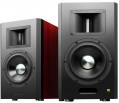 | 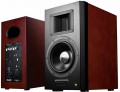 |
|---|---|---|
| Airpulse A300 Pro | Airpulse A300 | |
| Compare prices 2 | Compare prices 2 | |
| User reviews | ||
| TOP sellers | ||
Wireless KleerNet connection between speakers. Each speaker is completely independent and can work separately. On the back wall there are treble and bass level controls. | On the back wall there are treble and bass level controls. | |
| Features | homemade | homemade |
| Mount | shelf | shelf |
Specs | ||
| Type | active | active |
| Number of channels | 2.0 system | 2.0 system |
| Number of speakers | 2 | 2 |
| Number of bands | 2 | 2 |
| Signal to noise ratio | 90 dB | 90 dB |
Power / frequency | ||
| Front | 130 W/channel | 80 W/channel |
| Total rated power | 260 W | 160 W |
| Overall frequency range | 40 – 40000 Hz | 40 – 40000 Hz |
Design | ||
| Design features | phase inverter back treble adjustment bass control ribbon emitter horn design | phase inverter back treble adjustment bass control ribbon emitter horn design |
Connectors | ||
| Inputs | RCA mini-Jack (3.5 mm) balanced XLR optical coaxial USB port | RCA mini-Jack (3.5 mm) balanced XLR optical coaxial USB port |
General | ||
| Bluetooth | v 5.0 | v 5.0 |
| AptX |  | |
| Remote control | | |
| Woofer size (LF/MF) | 165 mm | 165 mm |
| Finishing material | MDF | MDF |
| Front speaker dimensions (HxWxD) | 38.5x22.5x35 cm | 38.5x22.5x34 cm |
| Weight | 24.3 kg | 24 kg |
| Color | ||
| Added to E-Catalog | october 2022 | january 2019 |


Compare Airpulse A300 Pro and A300
Acoustic systems Airpulse A300 Pro and Airpulse A300 have similar characteristics but differ in power. The A300 Pro offers 130W per channel and a total power of 260W, while the A300 has 80W per channel and 160W in total. Both devices support Bluetooth 5.0 and have similar connectors, including USB and optical input. In design, both models use a ribbon tweeter and horn construction. The speaker sizes differ slightly: the A300 Pro is 1 cm wider and 1 cm deeper. The choice between them depends on your power and sound requirements.
Price comparison
You may be interested in
Airpulse A300 Pro often compared


Airpulse A300 often compared


Glossary
Front
Rated power of one front speaker. See "Total Power Rating" below for details on power rating. Here we note that the higher the power, the louder the system component can sound — of course, with a properly selected amplifier. In addition, this parameter is very important for matching with the amplifier: it is desirable that the output power on the corresponding amplifier channel be less than the power of the speaker. If the incoming signal is more powerful, distortions in the sound and even damage to the speakers are possible, and if it is weaker, then the sound volume will decrease (in other words, it will not be possible to use the full potential of the acoustics), but this moment will be critical only for listening at maximum volume.
Total rated power
The total rated power of all speaker components, in other words, the sum of the powers of all speakers. As a nominal one, they usually indicate the highest average (rms) power at which acoustics can operate for a long time without overloads and damage. In this case, individual power surges can significantly exceed this value, however, it is the rated power that is the main characteristic of any speaker.
First of all, the sound volume depends on this characteristic: the more powerful the speakers, the louder the sound they can produce if there is a suitable amplifier. In addition, in passive and passive-active models, compatibility with an external amplifier also depends on the power: the output power of the “amplifier” should not exceed the power of the acoustics connected to it, otherwise overloads and even breakdowns are possible.
Detailed recommendations regarding the choice of speakers for power for a particular situation can be found in special sources. However, in general, an indicator of up to 100 W by the standards of modern acoustics is considered quite modest, 100 – 200 W — average, 200 – 300 W — above average, and the most powerful sets give out up to 500 W or even more.
In conclusion, we note two more nuances. Firstly, when comparing different systems according to this ch...aracteristic, one must also take into account the sound format in which they work. In particular, if there is a subwoofer, it can account for a significant part of the total power — up to half or more. As a result, for example, a 2.1 set of 50 W with a 20-watt subwoofer at the main frequencies will not be able to pull out the same volume as a 40-watt 2.0 system: in the first case, each main channel will have only 15 watts, in the second — 20 watts. Secondly, in multichannel systems, the total power can be distributed among the channels in different proportions; so, say, two 5.1 systems with the same total power can differ markedly in front and rear balance at maximum volume.
First of all, the sound volume depends on this characteristic: the more powerful the speakers, the louder the sound they can produce if there is a suitable amplifier. In addition, in passive and passive-active models, compatibility with an external amplifier also depends on the power: the output power of the “amplifier” should not exceed the power of the acoustics connected to it, otherwise overloads and even breakdowns are possible.
Detailed recommendations regarding the choice of speakers for power for a particular situation can be found in special sources. However, in general, an indicator of up to 100 W by the standards of modern acoustics is considered quite modest, 100 – 200 W — average, 200 – 300 W — above average, and the most powerful sets give out up to 500 W or even more.
In conclusion, we note two more nuances. Firstly, when comparing different systems according to this ch...aracteristic, one must also take into account the sound format in which they work. In particular, if there is a subwoofer, it can account for a significant part of the total power — up to half or more. As a result, for example, a 2.1 set of 50 W with a 20-watt subwoofer at the main frequencies will not be able to pull out the same volume as a 40-watt 2.0 system: in the first case, each main channel will have only 15 watts, in the second — 20 watts. Secondly, in multichannel systems, the total power can be distributed among the channels in different proportions; so, say, two 5.1 systems with the same total power can differ markedly in front and rear balance at maximum volume.
Weight
The total weight of all components of the speaker system.