
Comparison Denon RCD-N11 vs Denon RCD-N10
Add to comparison | 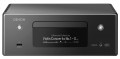 | 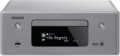 |
|---|---|---|
| Denon RCD-N11 | Denon RCD-N10 | |
from $689.19 up to $834.40 | from $499.00 | |
| User reviews | ||
| TOP sellers | ||
Supports all popular Internet streaming services. Possibility of organizing a “multi-room” system. The device is compatible with Alexa and Google Assistant voice assistants. | Support for all popular internet streaming services. The possibility of organizing a "multi-room" system. The device is compatible with Alexa voice assistant. | |
| Features | home | home |
Design | ||
| Built-in amplifier |  | |
| Disc load | frontal | frontal |
Communications | ||
| Playback | CD-Audio AM/FM radio network streaming audio internet radio | CD-Audio AM/FM radio network streaming audio internet radio |
| Audio formats support | FLAC, ALAC, WAV, DSD, MP3, WMA, AAC | FLAC, ALAC, WAV, DSD, MP3, WMA, AAC |
| Interfaces | AirPlay 2 Wi-Fi Bluetooth LAN USB (type A) | AirPlay 2 Wi-Fi Bluetooth LAN USB (type A) |
Tech specs | ||
| Frequency range | 20 – 20000 Hz | 20 – 20000 Hz |
| Signal to noise ratio | 86 dB | 86 dB |
| Harmonic distortion | 0.1 % | 0.1 % |
Connection | ||
| Outputs | On headphones To subwoofer | On headphones To subwoofer |
| For passive acoustics | 2 pairs | 2 pairs |
| Inputs | Optical RCA | Optical RCA |
General | ||
| Power per channel | 65 W | 30 W |
| Power consumption | 55 W | 55 W |
| Remote control | | |
| Two line display | | |
| Dimensions (WxDxH) | 233x200x153 mm | 280x305x108 mm |
| Weight | 2.4 kg | 3.4 kg |
| Color | ||
| Added to E-Catalog | april 2021 | april 2019 |


Compare Denon RCD-N11 and RCD-N10
When comparing the CD players Denon RCD-N11 and Denon RCD-N10, several key differences can be highlighted. Both devices have a built-in amplifier and support all popular audio formats, however, the RCD-N11 offers more power per channel — 65W compared to 30W for the RCD-N10. Both players have front-loading disc and support internet radio, but the RCD-N11 is also compatible with Google Assistant, while the RCD-N10 only supports Alexa. The size and weight of the devices also differ: the RCD-N11 is more compact (233x200x153 mm, 2.4 kg) compared to the RCD-N10 (280x305x108 mm, 3.4 kg).
You may be interested in
My comparisons
Denon RCD-N11 often compared


Denon RCD-N10 often compared


Glossary
Power per channel
The highest rated signal power that a CD player with built-in amplifier (see above) can deliver to each channel without overloading. Rated is the average (rms) sound power output for a certain period of time; individual power surges can be much higher, but this indicator is still considered the main one.
By power, the overall volume of the player’s sound is most often estimated: the more powerful the amplifier, the louder the speakers connected to it can play. However, the use of this parameter is not limited to this. So, it is desirable that the nominal power of the speaker system connected to the player is not lower than that of the amplifier — otherwise, when working at high volume, the speakers may be damaged. On the other hand, it is worth bearing in mind that as you approach the maximum power, the number of distortions introduced into the sound increases: for example, a 200-watt amplifier at half power will sound cleaner than a 100-watt one at full power. Therefore, to ensure the purest sound, it makes sense to use powerful amplifiers operating at a low (by their standards) volume.
Note that with different load resistance, the power per channel will also be different; therefore, when specifying this parameter, it is often specified for which acoustics (at 2, 4, 6 or 8 ohms) the specified value is relevant.
By power, the overall volume of the player’s sound is most often estimated: the more powerful the amplifier, the louder the speakers connected to it can play. However, the use of this parameter is not limited to this. So, it is desirable that the nominal power of the speaker system connected to the player is not lower than that of the amplifier — otherwise, when working at high volume, the speakers may be damaged. On the other hand, it is worth bearing in mind that as you approach the maximum power, the number of distortions introduced into the sound increases: for example, a 200-watt amplifier at half power will sound cleaner than a 100-watt one at full power. Therefore, to ensure the purest sound, it makes sense to use powerful amplifiers operating at a low (by their standards) volume.
Note that with different load resistance, the power per channel will also be different; therefore, when specifying this parameter, it is often specified for which acoustics (at 2, 4, 6 or 8 ohms) the specified value is relevant.