
Comparison Creality Ender 5 Pro vs Creality Ender 5
Add to comparison | 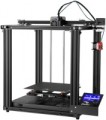 | 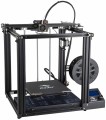 |
|---|---|---|
| Creality Ender 5 Pro | Creality Ender 5 | |
from $309.00 | from $789.99 | |
| TOP sellers | ||
| Print technology | deposition modeling (FDM/FFF) | deposition modeling (FDM/FFF) |
| Filament material | ABS PLA TPU Wood | ABS PLA TPU Wood |
| 3D model file format | .stl , .obj, .amf | .stl , .obj, .amf |
| Compatible software | Cura, Simplify3D, Repetier-Host | Cura, Simplify3D, Repetier-Host |
| Object dimensions (HxWxD) | 300x220x220 mm | 300x220x220 mm |
| Object volume | 14.5 L | 14.5 L |
Printing process | ||
| Kinematics | Core XY | Core XY |
| Min layer thickness | 100 µm | 100 µm |
| Print speed | 180 mm/s | 180 mm/s |
| Nozzle diameter | 0.4 mm | 0.4 mm |
| Min thread diameter | 1.75 mm | 1.75 mm |
| Heating bed temperature | 125 °C | 135 °C |
| Extruder (nozzle) temperature | 260 °C | 260 °C |
| Number of extruders | 1 | 1 |
More features | ||
| Features | heated bed resume print | heated bed resume print |
| Data transfer | card reader PC connection (USB-B) | card reader PC connection (USB-B) |
General | ||
| LCD display | + | + |
| Power | 270 W | 350 W |
| Dimensions | 55x48.5x51 cm | 55x48.5x51 cm |
| Weight | 11.8 kg | 11.8 kg |
| Added to E-Catalog | february 2020 | february 2020 |


Compare Creality Ender 5 Pro and Ender 5
You may be interested in
My comparisons
Creality Ender 5 Pro often compared


Creality Ender 5 often compared


Glossary
Heating bed temperature
Maximum heating temperature in 3D printers with heated bed (for more details, see the relevant paragraph). The higher the limit, the more varieties of plastic can be used for printing. So, models with heating up to 100 °C are suitable for 3D printing with PLA plastic, with a bed temperature of 100 to 120 °C — for working with ABS plastic and nylon, high-temperature ones — allow the use of polycarbonate and refractory varieties of plastic.
Power
Rated input power of the printer, in fact — the highest power consumed by the device in regular operation.
This indicator is directly related to the specs of the device, primarily the overall performance. However, generally, 3D printers are a relatively economical devices: among solutions that are not related to specialized industrial equipment, values of more than 1 kW are extremely rare, and even in the most performant models this figure does not exceed 3 kW. For such capacities, an ordinary household power outlet is quite enough, so you have to pay attention to power consumption mainly in specific cases — for example, when assessing the load on a voltage stabilizer or a backup power source.
This indicator is directly related to the specs of the device, primarily the overall performance. However, generally, 3D printers are a relatively economical devices: among solutions that are not related to specialized industrial equipment, values of more than 1 kW are extremely rare, and even in the most performant models this figure does not exceed 3 kW. For such capacities, an ordinary household power outlet is quite enough, so you have to pay attention to power consumption mainly in specific cases — for example, when assessing the load on a voltage stabilizer or a backup power source.