
Comparison Yato YT-38951 vs Utool U10103
Add to comparison | 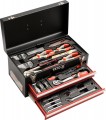 | 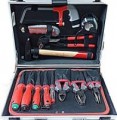 |
|---|---|---|
| Yato YT-38951 | Utool U10103 | |
| Compare prices 1 | Outdated Product | |
| TOP sellers | ||
Metal box with sliding shelves. | ||
| Total number of items | 80 | 92 |
| Square drive size | 1/2, 1/4 " | 1/2, 1/4 " |
Heads and bits | ||
| Socket heads (6 points) | 17 | 13 |
| Socket heads sizes (6 points) | 5 – 19 mm | 4 — 24 mm |
| Spark plug sockets | 1 | 2 |
| Bits | 20 | 31 |
| Adapter | 1 | 1 |
| Bit holder | 1 | |
| Ratchet wrench | 1 | 1 |
| Screwdriver handle | 1 | |
Wrenches | ||
| Combination wrenches | 12 | 8 |
| Wrench sizes | 6 –19 mm | 8 — 19 mm |
| Adjustable wrench |  |  |
| Hex wrenches | 8 | 9 |
| Hex wrenches size | 1.5, 2, 2.5, 3, 4, 5, 5.5, 6 mm | 1.5, 2, 2.5, 3, 4, 5, 6, 7, 8, 10 mm |
| Torx wrenches | 7 | |
| Torx wrench sizes | T10, T15, T20, T25, T27, T30, T40 | |
General accessories | ||
| Screwdriver | 5 | 4 |
| Slotted | SL5x75, SL6x100, SL8x150 | SL5.5x75, SL6.5x100 |
| Cross-recess | PH1x75, PH2x100 | PZ1x75, PZ2x100 |
| Hammer | 1 | 1 |
| Pliers | 2 | 2 |
| Wire cutters | 1 | 1 |
| Adjustable pliers | | |
| Knife | | |
| Saw | | |
Special tools | ||
| Voltage indicator | analog (220 V) | |
More features | ||
| Tape measure | | |
| Tool storage | box | metal case |
| Weight | 11 kg | |
| Added to E-Catalog | january 2019 | november 2018 |



Compare Yato YT-38951 and Utool U10103
Price comparison
You may be interested in
My comparisons
Yato YT-38951 often compared


Glossary
Total number of items
The total number of core items included in the set.
In this case, the main items are all devices that are directly used during work: non-separable tools (traditional wrenches, hammers, pliers ...), elements of collapsible tools (for example, a ratchet for removable heads and 5 such heads will be considered 6 units) , as well as accessories (such as extensions or universal joints). Additional accessories — such as lights — may or may not be included in this count, depending on the manufacturer; however, there are usually few such accessories, and they do not fundamentally affect the total number of items.
The most modest modern tool kits include up to 25 units. However, such kits are very popular — they are inexpensive and at the same time can be very versatile. 25 – 50 items is still quite a small number, 50 – 75 pcs can be called an average, 76 – 100 items are more than average, and the most extensive modern sets can include 100 – 150 items or even more.
The general rules for choosing this parameter are obvious: a more extensive set, usually, is more multifunctional, but more expensive, weighs more and takes up more space. It is also worth bearing in mind that with a similar number of items, the specific assortment of these items in differ...ent sets may be different; so when choosing, it is worth specifying not only the number of tools, but also their specific composition.
In this case, the main items are all devices that are directly used during work: non-separable tools (traditional wrenches, hammers, pliers ...), elements of collapsible tools (for example, a ratchet for removable heads and 5 such heads will be considered 6 units) , as well as accessories (such as extensions or universal joints). Additional accessories — such as lights — may or may not be included in this count, depending on the manufacturer; however, there are usually few such accessories, and they do not fundamentally affect the total number of items.
The most modest modern tool kits include up to 25 units. However, such kits are very popular — they are inexpensive and at the same time can be very versatile. 25 – 50 items is still quite a small number, 50 – 75 pcs can be called an average, 76 – 100 items are more than average, and the most extensive modern sets can include 100 – 150 items or even more.
The general rules for choosing this parameter are obvious: a more extensive set, usually, is more multifunctional, but more expensive, weighs more and takes up more space. It is also worth bearing in mind that with a similar number of items, the specific assortment of these items in differ...ent sets may be different; so when choosing, it is worth specifying not only the number of tools, but also their specific composition.
Socket heads (6 points)
Number of hex sockets included in the tool kit.
All end heads are accessories for a collapsible tool; during operation, they are mounted on a ratchet, wrench or other similar device. The head itself has the appearance of a characteristic “cap”, which, during operation, is put on a bolt, nut, etc. This design, among other things, allows you to work with parts located in recesses and some other hard-to-reach places that cannot be reached with open-ended, captive or split keys. And compared to a set of classic socket wrenches, the holder plus socket set takes up much less space, providing almost the same functionality.
As for the 6 faces, this type of socket head is the most famous and widespread, because. most modern nuts and bolts have this shape.
All end heads are accessories for a collapsible tool; during operation, they are mounted on a ratchet, wrench or other similar device. The head itself has the appearance of a characteristic “cap”, which, during operation, is put on a bolt, nut, etc. This design, among other things, allows you to work with parts located in recesses and some other hard-to-reach places that cannot be reached with open-ended, captive or split keys. And compared to a set of classic socket wrenches, the holder plus socket set takes up much less space, providing almost the same functionality.
As for the 6 faces, this type of socket head is the most famous and widespread, because. most modern nuts and bolts have this shape.
Socket heads sizes (6 points)
Working size range of hex sockets (see above) supplied with the kit. This parameter allows you to evaluate how the heads fit the dimensions of the fasteners with which they are planned to be used.
Spark plug sockets
The number of spark plug heads supplied with the tool kit.
Like all interchangeable heads, candlesticks are put on the appropriate device during operation — for example, a ratchet (see above) or a tap wrench (see below). The specifics of their use is reflected in the name: the main purpose of this type of nozzle is the installation and dismantling of spark plugs in automobile engines. By design, spark plug sockets are generally similar to end heads, but they are much longer — otherwise working with candles would be impossible.
There is no single standard for fastening modern spark plugs, so several spark plug heads can be supplied in a set. At the same time, note that with the same number of such accessories, their specific types in different sets may be different; this nuance needs to be clarified before buying.
Like all interchangeable heads, candlesticks are put on the appropriate device during operation — for example, a ratchet (see above) or a tap wrench (see below). The specifics of their use is reflected in the name: the main purpose of this type of nozzle is the installation and dismantling of spark plugs in automobile engines. By design, spark plug sockets are generally similar to end heads, but they are much longer — otherwise working with candles would be impossible.
There is no single standard for fastening modern spark plugs, so several spark plug heads can be supplied in a set. At the same time, note that with the same number of such accessories, their specific types in different sets may be different; this nuance needs to be clarified before buying.
Bits
The number of bits supplied with the tool kit. A bat in this case is called a working nozzle, which plays the role of a screwdriver tip; in fact, they are most often used with screwdriver handles (see above).
Many types of splines (slots) are used in modern fasteners — starting with the well-known straight, cross-shaped ( Phillips and Pozidriv), Torx sprockets and ending with exotics like Torq-set (a cross with lines shifted from the centre), Pentalobe (with five ledges), etc. .P. In addition, the size of the slots can also vary, and in many cases, tool matching in size is very important. Accordingly, the more bits supplied with the set, the more versatile it is, the higher the probability that it will contain a nozzle of the desired type and size. However, the specific list of bits in the kit also does not hurt to clarify — in order to make sure that it has all the varieties you need. In the characteristics of individual sets, these data are given in the paragraph "Bit sizes" (see below).
Many types of splines (slots) are used in modern fasteners — starting with the well-known straight, cross-shaped ( Phillips and Pozidriv), Torx sprockets and ending with exotics like Torq-set (a cross with lines shifted from the centre), Pentalobe (with five ledges), etc. .P. In addition, the size of the slots can also vary, and in many cases, tool matching in size is very important. Accordingly, the more bits supplied with the set, the more versatile it is, the higher the probability that it will contain a nozzle of the desired type and size. However, the specific list of bits in the kit also does not hurt to clarify — in order to make sure that it has all the varieties you need. In the characteristics of individual sets, these data are given in the paragraph "Bit sizes" (see below).
Bit holder
Auxiliary bench tool that adapts the fit of the bit to the drill chuck. One end of the bit holder is fixed in the chamber, the other — in the shank of the bit, which allows you to work with any type of equipment. It is used when performing work on screwing fasteners in spaces where it encounters certain difficulties. Many bit holders have the ability to magnetically hold fasteners.
Screwdriver handle
Number of screwdriver handles supplied with the tool kit.
Such handles, in fact, are screwdrivers without a tip — in its place there is a seat for a bit. It can be either a square (see above) or a hexagon socket, often magnetic; in fact, the presence of more than one handle in the kit is typical mainly for cases where different types of fasteners are used. Also note that, in addition to fixed mounts, in which the bit is fixed rigidly, there are also reversible devices — with a ratchet mechanism, similar in operation to ratchets (see above).
Theoretically, bits can be used with other types of tools — for example, the ratchets described above — and in many sets this possibility is directly provided. At the same time, it is work in the format of a screwdriver that is considered the classic option, and often it is he who is optimal.
Such handles, in fact, are screwdrivers without a tip — in its place there is a seat for a bit. It can be either a square (see above) or a hexagon socket, often magnetic; in fact, the presence of more than one handle in the kit is typical mainly for cases where different types of fasteners are used. Also note that, in addition to fixed mounts, in which the bit is fixed rigidly, there are also reversible devices — with a ratchet mechanism, similar in operation to ratchets (see above).
Theoretically, bits can be used with other types of tools — for example, the ratchets described above — and in many sets this possibility is directly provided. At the same time, it is work in the format of a screwdriver that is considered the classic option, and often it is he who is optimal.
Combination wrenches
Number of combination wrenches supplied with the kit. Note that some modern kits include only combination wrenches, without any other fixtures or accessories.
Combined are called bilateral keys, on which different types of working profiles are located on different sides. Most often, such keys combine open-end and cap profile, very rarely — open-end and end. The technical features of each of these types are described in the corresponding entries in the glossary. However, anyway, the working dimensions of the profiles in one tool, usually, are the same — this allows, without changing the key, to choose the best option for a specific part, depending on the features of the work. As for the quantity, it is worth considering here: sets with the same number of keys of the same type may differ in the specific sizes of these tools. Such nuances should be clarified before buying separately.
Combined are called bilateral keys, on which different types of working profiles are located on different sides. Most often, such keys combine open-end and cap profile, very rarely — open-end and end. The technical features of each of these types are described in the corresponding entries in the glossary. However, anyway, the working dimensions of the profiles in one tool, usually, are the same — this allows, without changing the key, to choose the best option for a specific part, depending on the features of the work. As for the quantity, it is worth considering here: sets with the same number of keys of the same type may differ in the specific sizes of these tools. Such nuances should be clarified before buying separately.
Wrench sizes
Dimensions of the wrenches supplied in the set. Specified as a range — from the minimum to the maximum size. In this case, the specific distribution of different types of keys over the range may be different. An example is the following set: 17 open-end wrenches, 5 box wrenches, size range 6 – 24 mm. In such a set, box wrenches are almost guaranteed not to cover the entire range of sizes, but for open-end wrenches, this is quite likely. Such details can be specified separately.
Also note that a wrench size of 24mm or more is considered quite large for today's general purpose tools. However, on the market you can find sets that include wrenches for 27 mm, 30 mm and even 32 mm.
Also note that a wrench size of 24mm or more is considered quite large for today's general purpose tools. However, on the market you can find sets that include wrenches for 27 mm, 30 mm and even 32 mm.