
Comparison Babolat Evoke 105 vs Babolat Evoke 102
Add to comparison | 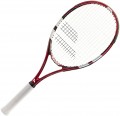 | 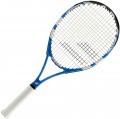 |
|---|---|---|
| Babolat Evoke 105 | Babolat Evoke 102 | |
from $66.52 | from $66.52 | |
| TOP sellers | ||
| Age | adult | adult |
| Frame material | aluminium alloy | carbon (graphite) |
| Racquet length | 685 mm | 685 mm |
| String surface area | 680 cm² | 660 cm² |
| String pattern | 16x19 | |
| Balance | handle | handle |
| Weight | 275 g | 270 g |
| Color | ||
| Added to E-Catalog | april 2017 | april 2015 |


Compare Babolat Evoke 105 and Evoke 102
Rackets Babolat Evoke 105 and Babolat Evoke 102 are designed for adults, but they have several key differences. Evoke 105 is made from aluminum alloy, whereas Evoke 102 is made from carbon (graphite), which makes the latter lighter and more durable. The length of both rackets is 685 mm, but the string surface area of Evoke 105 is larger — 680 cm² compared to 660 cm² for Evoke 102. The weight of Evoke 105 is 275 g, while Evoke 102 weighs 270 g. Both options have a handle balance that provides convenience in play. The choice between them may depend on preferences in material and string surface area.
You may be interested in
My comparisons
Babolat Evoke 105 often compared


Babolat Evoke 102 often compared

Glossary
Frame material
The material from which the racket frame is made. Today, the most popular are two solutions: aluminium alloy and carbon (graphite).
Aluminium alloy is the simplest, most affordable and reliable solution, which nevertheless is not very popular in modern sports. The advantage of aluminium rackets is their long service life and good resistance to mechanical damage — it is quite difficult to break them on the court. Most often used in the production of children's rackets.
Carbon (graphite) is the most popular material today for making tennis rackets, both professional and amateur. It boasts low weight and good strength. It is quite rare that rackets are made from pure carbon; more often, various metal alloys are used (carbon, titanium, etc.), and each manufacturer has its own “recipe” for the ideal alloy.
Aluminium alloy is the simplest, most affordable and reliable solution, which nevertheless is not very popular in modern sports. The advantage of aluminium rackets is their long service life and good resistance to mechanical damage — it is quite difficult to break them on the court. Most often used in the production of children's rackets.
Carbon (graphite) is the most popular material today for making tennis rackets, both professional and amateur. It boasts low weight and good strength. It is quite rare that rackets are made from pure carbon; more often, various metal alloys are used (carbon, titanium, etc.), and each manufacturer has its own “recipe” for the ideal alloy.
String surface area
There is a simple pattern here: the larger the area of the string surface and the lower the rigidity of the string tension, the higher the impact force and the lower its accuracy. This parameter is directly related to the string formula.
Now on the market there are rackets with the following string surface area: Midsize (452 – 574 cm²), Midplus (580 – 677 cm²), Oversize (710 – 742 cm²).
Now on the market there are rackets with the following string surface area: Midsize (452 – 574 cm²), Midplus (580 – 677 cm²), Oversize (710 – 742 cm²).
String pattern
A string pattern is a scheme for stretching racquet strings. Represents two numbers: the first of them is the number of longitudinal strings, and the second is the number of transverse ones. A racquet with a lower string density will provide more power, while a higher density racquet will provide better ball control. It is important to pay attention to the fact that the same string pattern on rackets with different head areas will provide different stiffness. For example, a racquet with a Midplus head and a 16x19 formula will be stiffer than a similar model with an Oversize head.
Weight
As the weight of the racquet increases, the impact force increases, but its accuracy decreases. On the contrary, it is easier to swing with a light rocket, but at the same time, the player needs to make more effort to give the ball the desired speed.