
Comparison AEG T8DBG49SR vs AEG T8DEE48S
Add to comparison | 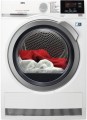 | 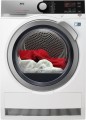 |
|---|---|---|
| AEG T8DBG49SR | AEG T8DEE48S | |
| Expecting restock | from $803.67 up to $1,175.96 | |
| TOP sellers | ||
Inverter motor. SensiDry heat pump drying technology. ProSense cycle smart tuning technology. Absolute Care drying system. Simple and reliable ÖKOFlow filtration system. | ||
| Drying type | condensing (heat pump) | condensing (heat pump) |
| Capacity | 9 kg | 8 kg |
| Drum volume | 118 L | 117 L |
| Inverter motor |  | |
Features | ||
| Number of drying programmes | 10 | 10 |
| Anti-crease function | | |
| Moisture sensor | | |
| Delay start timer | | |
| Quick dry | | |
| Drum lighting |  | |
| Drain into sewer | | |
| Condensate tank indicator | | |
| Condensate tank volume | 5.28 L | 5.28 L |
Efficiency classes | ||
| Energy class | A++ | A++ |
| Drying class | B | B |
| Noise level | 65 dB | 66 dB |
More specs | ||
| Controls | rotary knob + touch controls | rotary knob + touch controls |
| Display | LED | LED |
| Child lock | | |
| Door shape | round with glass | round with glass |
| Door opening | leftward | leftward |
| Dimensions (HxWxD) | 85x59.6x66.3 cm | 85x59.6x66.3 cm |
| Country of origin | Poland | |
| Color | ||
| Added to E-Catalog | june 2019 | february 2017 |


Compare AEG T8DBG49SR and T8DEE48S
You may be interested in
My comparisons
AEG T8DBG49SR often compared

AEG T8DEE48S often compared


Glossary
Capacity
The maximum amount of laundry that can be loaded into the dryer; in other words, the largest weight of laundry that the machine can efficiently process in one cycle.
Capacity is usually indicated by the weight of the dry laundry. Thanks to this, when preparing the laundry for washing, you can immediately assess whether it will fit in the dryer at a time or, on the contrary, you can get by with a small drying. However, even the most modest modern dryers (and even slim ones up to 50 cm) in most cases hold 7 kg — this is comparable to loading the drum of a medium-capacity washing machine. And in the most capacious models, this figure can reach 10 – 11 kg. It is quite enough for domestic and even professional use (for example, in laundromats or laundries of hotels, etc.). However, the typical figures are drying for 8 kg and models for 9 kg of laundry. Bigger capacity is relevant for industrial equipment and is not found in consumer-level models.
Also, when choosing, note that in the specs the maximum capacity is usually indicated for linen made of cotton fabric. For other, more voluminous materials, the capacity can be noticeably less — for example, the weight limit for wool products is usually 4-5 times less than for cotton.
Capacity is usually indicated by the weight of the dry laundry. Thanks to this, when preparing the laundry for washing, you can immediately assess whether it will fit in the dryer at a time or, on the contrary, you can get by with a small drying. However, even the most modest modern dryers (and even slim ones up to 50 cm) in most cases hold 7 kg — this is comparable to loading the drum of a medium-capacity washing machine. And in the most capacious models, this figure can reach 10 – 11 kg. It is quite enough for domestic and even professional use (for example, in laundromats or laundries of hotels, etc.). However, the typical figures are drying for 8 kg and models for 9 kg of laundry. Bigger capacity is relevant for industrial equipment and is not found in consumer-level models.
Also, when choosing, note that in the specs the maximum capacity is usually indicated for linen made of cotton fabric. For other, more voluminous materials, the capacity can be noticeably less — for example, the weight limit for wool products is usually 4-5 times less than for cotton.
Drum volume
The internal volume of the dryer drum.
A larger drum can accommodate more laundry, but there is no rigid dependence here: models with the same volume may differ in maximum load. It is because to process a large mass of laundry, one need not only a capacious drum but also an engine of appropriate power. At the same time, in a larger drum, the same mass of laundry will dry more efficiently than in a small one, because laundry will be more freely distributed over the drum, crumpled less, and warm air will better penetrate the folds of the fabric. As a result, for the same drum volume, a model with a smaller load will be more efficient and performant than a model with a larger load. On the other hand, a volumetric drum takes up more space and the dimensions of the dryer are largely determined by the dimensions of the drum.
A larger drum can accommodate more laundry, but there is no rigid dependence here: models with the same volume may differ in maximum load. It is because to process a large mass of laundry, one need not only a capacious drum but also an engine of appropriate power. At the same time, in a larger drum, the same mass of laundry will dry more efficiently than in a small one, because laundry will be more freely distributed over the drum, crumpled less, and warm air will better penetrate the folds of the fabric. As a result, for the same drum volume, a model with a smaller load will be more efficient and performant than a model with a larger load. On the other hand, a volumetric drum takes up more space and the dimensions of the dryer are largely determined by the dimensions of the drum.
Drum lighting
Lighting system for the internal volume of the device. It usually turns on automatically when the dryer door is opened - thus reducing the likelihood that some items (especially small and dark ones) will be forgotten in the drum.
Drain into sewer
This option allows you to automate the process of draining the condensate collection tank (respectively, it is relevant only for dryers with a condensation principle of operation). At the end of the drying process, the condensate accumulated in the tank is automatically drained into the sewer. To do this, a pump and a hose are provided in a dryer with a drain into the sewer. The function of draining into the sewer allows you to significantly simplify the operation of the dryer, while in models without this option, the user must drain the condensate tank manually. Of course, manual emptying does not require much effort because the average condensate collection tank has a volume of about 5 litres, but still not very convenient.
Noise level
The noise level generated by the dryer during operation. Usually, the specs indicate the maximum volume of the device, in the noisiest mode — when other programmes are running, this figure may be lower. We note that the noise level also depends on the features of the installation: for example, if the machine does not stand firmly on all four legs, vibration from drum rotation can create additional noise. And the tiled walls amplify the sound by creating an echo. Nevertheless, it is best to evaluate the device precisely by the noise level stated in the specifications. And here it is worth bearing in mind that the decibel used to denote loudness is a non-linear value, and it is best to evaluate the actual loudness of the unit using comparative tables. Here is the simplest such table for the volume range in which modern dryers operate:
65 dB — a person's voice in raised tones at a distance of 1 m;
70 dB — a loud conversation of several people at the same distance;
75 dB — loud laughter at a distance of 1 m;
80 dB — motorcycle engine, medium power vacuum cleaner.
The quieter the machine is, the more comfortable it will be to use and the better it will be suitable for a specific environment (for example, if there is a small child in the house or if you plan to run drying at night). At the same time, it is worth considering not only the actual noise level but also the installation location of the device. If the dryer is planned to...be installed in the basement of a private house with thick ceilings and the bedroom is located on the second floor, you can not pay much attention to the noise level: even the loudest unit is unlikely to create inconvenience.
65 dB — a person's voice in raised tones at a distance of 1 m;
70 dB — a loud conversation of several people at the same distance;
75 dB — loud laughter at a distance of 1 m;
80 dB — motorcycle engine, medium power vacuum cleaner.
The quieter the machine is, the more comfortable it will be to use and the better it will be suitable for a specific environment (for example, if there is a small child in the house or if you plan to run drying at night). At the same time, it is worth considering not only the actual noise level but also the installation location of the device. If the dryer is planned to...be installed in the basement of a private house with thick ceilings and the bedroom is located on the second floor, you can not pay much attention to the noise level: even the loudest unit is unlikely to create inconvenience.
Country of origin
The country in which, according to the manufacturer, the model is manufactured. Despite the fact that most of the capacities are concentrated in China, European factories (in Germany, Poland, Slovenia, Turkey, etc.) for the production of household appliances have not gone away. And certain models can be produced there. In general, such a division into a Chinese or European factory should not particularly affect the quality of products, but the stereotype of a reliable European assembly is present in us. However, it is possible that the model may have a country of manufacture, for example, Poland, and in the store under the same article, you will meet China.