
Comparison XP-PEN Star 03 vs Huion H640P
Add to comparison | 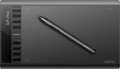 | 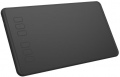 |
|---|---|---|
| XP-PEN Star 03 | Huion H640P | |
from $59.99 | Compare prices 1 | |
| User reviews | ||
| TOP sellers | ||
High pen sensitivity. 6 customizable express keys. Stylus stand. | ||
| Product type | graphics Tablet | graphics Tablet |
| Format | A5 | A6 |
| Workspace | 260x170 mm | 160x100 mm |
| Aspect ratio | 16:10 | |
| Control keys | 8 | 6 |
Connection | ||
| Connection type | wired | wired |
| Connector on device | microUSB | microUSB |
| Compatibility | Windows MacOS | Windows MacOS |
Pen | ||
| Pen model | P01 | PW100 |
| Pen power source | no battery (passive) | no battery (passive) |
| Max. reading height | 10 mm | 10 mm |
| Pressure levels | 8192 | 8192 |
| Resolution | 5080 lpi | 5080 lpi |
| Eraser |  |  |
| Control keys | 2 | 2 |
| Size | 163x14 mm | |
| Pen weight | 13 g | |
General | ||
| In box | replacement pen nibs pen holder | replacement pen nibs pen holder |
| Power source | USB port | USB port |
| Size | 360x210x8 mm | 260x148 mm |
| Tablet weight | 0.6 kg | 0.28 kg |
| Added to E-Catalog | december 2018 | april 2018 |



Compare XP-PEN Star 03 and Huion H640P
Price comparison
You may be interested in
My comparisons
XP-PEN Star 03 often compared


Huion H640P often compared


Glossary
Format
The paper size that corresponds to the size of the tablet's active surface.
This parameter is specified only for traditional tablets and smart-notebooks (see "Type"). At the same time, the specific size of the device does not always strictly correspond to the specified format. For example, an A4 tablet can be either a little larger or a little smaller than a standard landscape sheet of 210x297 mm. Nevertheless, according to the specified format, one can easily estimate the dimensions of the tablet as a whole and its general “weight category”.
Nowadays, on the market you can find devices in formats from A3 to A7, and the most popular options are the A4 mentioned above, as well as A5(148x210 mm) and A6(105x148 mm). In general, larger tablets are easier to use, but also more expensive.
This parameter is specified only for traditional tablets and smart-notebooks (see "Type"). At the same time, the specific size of the device does not always strictly correspond to the specified format. For example, an A4 tablet can be either a little larger or a little smaller than a standard landscape sheet of 210x297 mm. Nevertheless, according to the specified format, one can easily estimate the dimensions of the tablet as a whole and its general “weight category”.
Nowadays, on the market you can find devices in formats from A3 to A7, and the most popular options are the A4 mentioned above, as well as A5(148x210 mm) and A6(105x148 mm). In general, larger tablets are easier to use, but also more expensive.
Workspace
The exact size of the active area of a tablet (or screen in a graphic display) in width and height. In general, it is more of a reference than a practically significant parameter: when choosing a traditional graphics tablet, there is often enough information about the format (see above), and for displays, primarily the diagonal (see above) and aspect ratio (see below) are of practical importance . However, the exact dimensions can also be useful in fact: for example, you can determine the aspect ratio from them (for classic tablets, this parameter is often not indicated).
Aspect ratio
The aspect ratio of the tablet working area (width to height). This parameter allows you to evaluate the overall proportions of the device: for example, the ratio of 4:3 gives an almost square shape of the work area, and in 16:9 models it is noticeably elongated in width.
Actually, "widescreen" aspect ratios — 16:9 and 16:10 — are now much more common than the classic 4:3. The 3:2 standard is also rare, although it is actually also a widescreen. This situation is due to the fact that, ideally, the aspect ratio of the monitor and tablet should be the same (otherwise, there may be a mismatch in the movement of the pen and the cursor on the screen, or part of the screen or tablet area will be unused). And the most popular nowadays are just monitors in 16:9 and 16:10 formats, the 4:3 standard is much less common, and 3:2 is extremely rare.
Actually, "widescreen" aspect ratios — 16:9 and 16:10 — are now much more common than the classic 4:3. The 3:2 standard is also rare, although it is actually also a widescreen. This situation is due to the fact that, ideally, the aspect ratio of the monitor and tablet should be the same (otherwise, there may be a mismatch in the movement of the pen and the cursor on the screen, or part of the screen or tablet area will be unused). And the most popular nowadays are just monitors in 16:9 and 16:10 formats, the 4:3 standard is much less common, and 3:2 is extremely rare.
Control keys
The number of control keys provided in the design of the tablet.
Each of these keys is responsible for a specific function, while the set of these functions can be configured: in some models they can be selected manually, in others the functionality of the keys changes automatically, depending on the currently active application. Anyway, additional keys allow the user to perform various actions without looking up from the tablet — this can be very convenient in the midst of the work process, when you don’t want to change the pen to the mouse again or reach for the keyboard. And the more control keys — so, respectively, more additional actions can be performed using the tablet. On the other hand, with relatively simple tasks, the abundance of additional buttons can hinder and confuse the user rather than help.
The most modest modern tablets provide up to 5 control keys ; the most popular option is from 6 to 10 keys, and in advanced models this number can reach 15 or even more.
Each of these keys is responsible for a specific function, while the set of these functions can be configured: in some models they can be selected manually, in others the functionality of the keys changes automatically, depending on the currently active application. Anyway, additional keys allow the user to perform various actions without looking up from the tablet — this can be very convenient in the midst of the work process, when you don’t want to change the pen to the mouse again or reach for the keyboard. And the more control keys — so, respectively, more additional actions can be performed using the tablet. On the other hand, with relatively simple tasks, the abundance of additional buttons can hinder and confuse the user rather than help.
The most modest modern tablets provide up to 5 control keys ; the most popular option is from 6 to 10 keys, and in advanced models this number can reach 15 or even more.
Pen model
The model of the pen that comes with the device. Allows you to understand which one is used and learn more fully its full characteristics. In this case, in the case of a replacement, you will already be aware of which accessory is needed for the purchase. However, nothing prevents you from replacing the existing one with a more advanced one, of course, if the graphics tablet itself allows you to work with a different pen model.
Eraser
The presence of an eraser function in the pen — that is, the ability to use the pen not only for drawing a picture, but also for erasing it. Directly the role of the eraser is most often played by the second end of the pen, opposite to the “drawing” one; however, in some models, this function is implemented purely in software — by enabling a special pen mode.