
Comparison Logitech G403 Hero vs Logitech G403 Prodigy
Add to comparison | 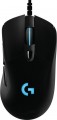 | 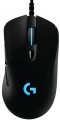 |
|---|---|---|
| Logitech G403 Hero | Logitech G403 Prodigy | |
| Compare prices 16 | Compare prices 2 | |
| User reviews | ||
| TOP sellers | ||
Branded sensor Hero. Weight adjustment. Adjustable RGB lighting. | Ultra-precise sensor. Weight adjustment. Adjustable RGB lighting. | |
| Product type | mouse | mouse |
| Connection | wired | wired |
| Sensor | optical | optical |
| Type | for game | for game |
Sensor and control | ||
| Sensor | Hero | PixArt 3366 |
| Sensor resolution | 100 – 25600 DPI | 12000 DPI |
| Max. acceleration | 40 G | 40 G |
| Max. speed | 400 ips | 400 ips |
| Number of buttons | 5 | 5 |
| Side buttons |  | |
| DPI-button | | |
| Scroll wheels | 1 | 1 |
Additional features | ||
| Optimal grip | palmar, finger | palmar, finger |
| Programmable buttons | | |
| Built-in memory | | |
| Lighting | RGB | RGB |
| Lighting effects | Logitech Lightsync | Logitech Lightsync |
| Feet material | teflon (PTFE) | |
Connection and power supply | ||
| Cable | USB-A braided | USB-A braided |
| Cable length | 2.1 m | 2.1 m |
General | ||
| Size (LxWxH) | 124x68x43 mm | 124x68x43 mm |
| Weight | 87 g | 87 g |
| Weight adjustment | | |
| Color | ||
| Added to E-Catalog | september 2019 | october 2016 |



Compare Logitech G403 Hero and G403 Prodigy
Comparing the mice Logitech G403 Hero and Logitech G403 Prodigy, it's noted that both models share similar features such as wired connectivity and an optical sensor. However, the G403 Hero is equipped with a more advanced Hero sensor with a resolution of up to 25600 DPI, while the G403 Prodigy uses a PixArt 3366 sensor with a maximum resolution of 12000 DPI. Users report that the G403 Hero offers higher precision and stability in games, whereas the G403 Prodigy may be less reliable in the long term. Both devices feature RGB lighting and programmable buttons, but the G403 Hero receives more positive reviews for its ergonomics and durability.
Price comparison
You may be interested in
Logitech G403 Hero often compared


Logitech G403 Prodigy often compared


Glossary
Sensor
The model of the sensor installed in the mouse. This information is indicated mainly for models equipped with high-end sensors, which are significantly superior in their capabilities to simpler solutions. Such characteristics are important primarily for gaming mice, so most of the devices for which the sensor model is specified belong to this category.
Knowing the name, you can find detailed data on the sensor and evaluate its capabilities. Note that one of the most popular brands nowadays, under which advanced sensors are produced, is PixArt ; on the market are often found, in particular, sensors PixArt 3212, PixArt 3325, PixArt 3327, PixArt 3335, PixArt 3360, PixArt 3389, PixArt 3395, PixArt 3950.
Knowing the name, you can find detailed data on the sensor and evaluate its capabilities. Note that one of the most popular brands nowadays, under which advanced sensors are produced, is PixArt ; on the market are often found, in particular, sensors PixArt 3212, PixArt 3325, PixArt 3327, PixArt 3335, PixArt 3360, PixArt 3389, PixArt 3395, PixArt 3950.
Sensor resolution
Resolution of the sensor responsible for tracking mouse movements on the work surface. Specified in DPI — dots per inch.
The physical meaning of DPI as a whole is as follows. The sensor of a modern mouse works on the same principle as the camera matrix, and consists of pixels. And DPI is the number of pixels that fall on 1 inch of the underlying surface (length or width), "visible" by the sensor.
It is believed that more DPI means a more advanced sensor and mouse in general; nowadays, models for 3500 – 5000 DPI, 12000 DPI, 16000 DPI even more are not uncommon. In a way, it is — high resolution contributes to accuracy. However, the only thing that is directly determined by this indicator is the speed at which the cursor moves across the screen: the higher the resolution of the sensor, the greater the number of pixels that the cursor will move when the mouse itself moves a certain distance. At the same time, it is worth recalling that too high a speed is even more undesirable than too low. So the real need for high DPI ( 1000 and above) arises mainly when working on large screens (4K resolution and more); for more modest displays (HD and Full HD), smaller values are often enough.
The physical meaning of DPI as a whole is as follows. The sensor of a modern mouse works on the same principle as the camera matrix, and consists of pixels. And DPI is the number of pixels that fall on 1 inch of the underlying surface (length or width), "visible" by the sensor.
It is believed that more DPI means a more advanced sensor and mouse in general; nowadays, models for 3500 – 5000 DPI, 12000 DPI, 16000 DPI even more are not uncommon. In a way, it is — high resolution contributes to accuracy. However, the only thing that is directly determined by this indicator is the speed at which the cursor moves across the screen: the higher the resolution of the sensor, the greater the number of pixels that the cursor will move when the mouse itself moves a certain distance. At the same time, it is worth recalling that too high a speed is even more undesirable than too low. So the real need for high DPI ( 1000 and above) arises mainly when working on large screens (4K resolution and more); for more modest displays (HD and Full HD), smaller values are often enough.
Feet material
- Teflon (PTFE). Polytetrafluoroethylene (PTFE) glides - also known as Teflon - are characterized by an extremely low coefficient of friction. As a result, mice with Teflon feet boast excellent glide and high cursor speed on any type of surface. The minimum level of friction allows you to easily control the movements of the mouse. Manipulators with Teflon gliders perform well in dynamic games and reduce wrist strain during prolonged work at the computer.
— Metal. When properly sanded, the metal feet provide excellent glide for the mouse, and they also have a long service life before abrasion. Note that manipulators with metal gliders are best used on plastic or other hard-wearing playing surfaces. Using a mouse without a mouse pad runs the risk of scratching the surface.
— Metal. When properly sanded, the metal feet provide excellent glide for the mouse, and they also have a long service life before abrasion. Note that manipulators with metal gliders are best used on plastic or other hard-wearing playing surfaces. Using a mouse without a mouse pad runs the risk of scratching the surface.