
Comparison JBL Stage 810 vs JBL CS-1214
Add to comparison |  | 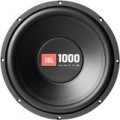 |
|---|---|---|
| JBL Stage 810 | JBL CS-1214 | |
| Compare prices 1 | from $66.67 up to $81.00 | |
| TOP sellers | ||
| Application area | car | car |
| Design | without body | without body |
| Type | passive | passive |
| Size | 8" (20 cm) | 12" (30 cm) |
Tech specs | ||
| Rated power | 200 W | 250 W |
| Max. power | 800 W | 1000 W |
| Frequency range | 38 – 200 Hz | 35 – 200 Hz |
| Sensitivity | 88 dB | 90 dB |
| Impedance | 4 ohm | 4 ohm |
| Resonant frequency | 41.6 Hz | |
General | ||
| Diffuser material | polypropylene | polypropylene |
| Woofer Diameter | 200 mm | 300 mm |
| Woofer depth | 95 mm | 153 mm |
| Added to E-Catalog | october 2017 | july 2012 |



Compare JBL Stage 810 and CS-1214
Price comparison
You may be interested in
My comparisons
JBL Stage 810 often compared


JBL CS-1214 often compared


Glossary
Size
The size (diameter) of the main subwoofer speaker. In all types of subwoofers, this parameter primarily affects the power and depth of sound: the larger the speaker, the louder it is and the deeper the bass it can provide (ceteris paribus). However with an increase in the size and dimensions, they increase accordingly, which determines the installation possibilities. The latter is especially true in Free Air subwoofers (see "Execution"): some cars are initially equipped with "seats" for a certain size, and it is difficult to install models with other dimensions there.
Now on the market there are subwoofers with such popular sizes: 5" (13 cm), 6" (15.25 cm), 6.3" (16 cm), 6.5" (16.5 cm), 6.75" (17 cm), 8" (20 cm ), 8.25"(21cm) , 9" (23cm ), 10" (25cm ), 11" (27cm), 12"(30cm) , 13" (33cm), 15"(38cm) , 16 " (40 cm), 18" (46 cm).
Now on the market there are subwoofers with such popular sizes: 5" (13 cm), 6" (15.25 cm), 6.3" (16 cm), 6.5" (16.5 cm), 6.75" (17 cm), 8" (20 cm ), 8.25"(21cm) , 9" (23cm ), 10" (25cm ), 11" (27cm), 12"(30cm) , 13" (33cm), 15"(38cm) , 16 " (40 cm), 18" (46 cm).
Rated power
The average (root mean square — RMS) power of the input signal, at which the subwoofer is able to work continuously without negative consequences (damage, failure) for at least an hour. The rated power of the subwoofer must be greater than the power of the amplifier connected to it — in order to avoid overloads.
Max. power
The maximum signal power that the subwoofer is able to withstand for a short time (up to several seconds) without any negative consequences. When selecting an amplifier-subwoofer pair, it is recommended to take a subwoofer with a maximum power of at least twice the maximum power of the amplifier. In general, the higher the maximum power, the more resistant the subwoofer is to overloads.
Frequency range
The range of audio frequencies reproduced by the subwoofer. It is believed that the human ear is capable of perceiving a frequency range of the order of 16 – 20,000 Hz, but in this case note that the subwoofer is designed to reproduce the lower frequency band (up to 200 Hz). Accordingly, in the case of the lower limit of the range, everything is simple: “the lower, the better”; the upper one should not be lower than the lower limit of the main car audio — otherwise there will be "gaps" in the frequencies, which will affect the sound quality.
Sensitivity
Sensitivity determines the loudness of the subwoofer when a signal of a certain power is connected to it: with equal signal power and impedance (see below), the subwoofer with the higher sensitivity will sound louder.
Resonant frequency
The natural frequency of the cone in the subwoofer speaker, namely the frequency with which the cone will oscillate if the speaker is suspended freely in the air and a single impulse is transmitted to the cone (for example, by clicking on it with your finger). In subwoofers, this parameter determines, in particular, the lower limit of the frequency range (see above): at frequencies below the resonant sound power drops sharply. Accordingly, for deep rich bass, the resonant frequency should be as low as possible. This parameter is also used to calculate the size of the enclosure for the subwoofer.
Woofer Diameter
Subwoofer main speaker size. The diameter of the woofer determines the size of the device (see above).
Woofer depth
The size of the main subwoofer speaker from the front (usually the frame protruding beyond the diffuser) to the rear edge (where the magnet is usually located). In practice, it matters when selecting enclosures for frameless models, as well as when installing Free Air (see "Design"): this is the depth to which the speaker will be "recessed" into the enclosure or trunk. And a flat subwoofer will not always produce less bass than its more voluminous counterpart.