
Comparison Organic Smart Osmo 5 vs Organic Master Osmo 5
Add to comparison | 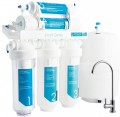 | 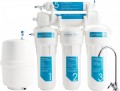 |
|---|---|---|
| Organic Smart Osmo 5 | Organic Master Osmo 5 | |
| Outdated Product | Outdated Product | |
| TOP sellers | ||
| Type | kitchen sink | kitchen sink |
| Reverse osmosis |  | |
| Purpose | for cold water | for cold water |
Cleaning specs | ||
| Stages of purification | 5 | 5 |
| Pollution clipping | 0.01 µm | 0.01 µm |
| Filtration speed | 0.2 L/min | 0.14 L/min |
| Types of filtration | mechanical impurities organic impurities softening (scale) chlorine ferrous heavy metals pesticides nitrates cadmium petroleum products | mechanical impurities organic impurities softening (scale) chlorine ferrous heavy metals pesticides nitrates cadmium petroleum products |
Connection and cartridges | ||
| Fitting size | ½" | ½" |
| Min. operating pressure | 2.8 atm | 3 atm |
| Max. operating pressure | 6 atm | 6 atm |
| Max operating temperature | 38 °C | 38 °C |
| Cartridge size | 10SL (10"x2.5") | 10SL (10"x2.5") |
More features | ||
| Tank | 8 L | 8 L |
| Tap | | |
| Added to E-Catalog | july 2017 | july 2017 |


Compare Organic Smart Osmo 5 and Master Osmo 5
You may be interested in
My comparisons
Organic Master Osmo 5 often compared


Glossary
Filtration speed
The amount of water that the filter is able to pass through itself per unit of time (of course, effectively purified in the process); usually stated in liters per minute. This parameter is largely related to the type (see above): for example, in jugs, the filtration rate usually does not exceed 0.5 L per minute, while for main devices that supply entire apartments, a throughput of tens or even hundreds of liters is required.
Note that it does not always make sense to pursue a high filtration rate. After all, other things being equal, finer cleaning takes more time; accordingly, the faster the filter works, the higher the chance that the quality of such cleaning will be relatively low. And devices that purify water efficiently and quickly usually have an appropriate price. Therefore, it is worth considering the purpose of the filter and, on the basis of this, determine the balance between the filtration speed and its quality when choosing. It is also worth keeping in mind the conditions of use: for example, if you need to filter low-quality tap water for drinking, it is better to sacrifice speed in favor of efficiency.
Note that it does not always make sense to pursue a high filtration rate. After all, other things being equal, finer cleaning takes more time; accordingly, the faster the filter works, the higher the chance that the quality of such cleaning will be relatively low. And devices that purify water efficiently and quickly usually have an appropriate price. Therefore, it is worth considering the purpose of the filter and, on the basis of this, determine the balance between the filtration speed and its quality when choosing. It is also worth keeping in mind the conditions of use: for example, if you need to filter low-quality tap water for drinking, it is better to sacrifice speed in favor of efficiency.
Min. operating pressure
The lowest inlet water pressure at which the filter is able to fully perform its functions. Indicated for models with a connection to the water supply — directly or through a tap (see "Connection").
The design of some filters requires a certain level of inlet pressure for normal operation; if the pressure is insufficient, both throughput and overall filter efficiency suffer, and some functions are not available at all. The latter is especially true for reverse osmosis (see above). Therefore, if the minimum operating pressure is directly indicated in the filter characteristics, you should make sure that your water supply system complies with this parameter before purchasing.
Note that for filters with a booster pump, this column indicates the lowest pressure at which the filter still does not require the use of a pump; see "Pump" for details.
The design of some filters requires a certain level of inlet pressure for normal operation; if the pressure is insufficient, both throughput and overall filter efficiency suffer, and some functions are not available at all. The latter is especially true for reverse osmosis (see above). Therefore, if the minimum operating pressure is directly indicated in the filter characteristics, you should make sure that your water supply system complies with this parameter before purchasing.
Note that for filters with a booster pump, this column indicates the lowest pressure at which the filter still does not require the use of a pump; see "Pump" for details.