
Comparison Defender Challenge Mini LE vs Genius TwinWheel
Add to comparison | 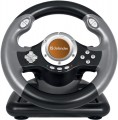 | 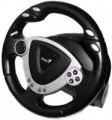 |
|---|---|---|
| Defender Challenge Mini LE | Genius TwinWheel | |
from $36.20 up to $39.96 | from $50.00 | |
| User reviews | ||
| TOP sellers | ||
Rubber coated steering wheel. Vibration response. Powered by USB port. | ||
| Device type (configuration) | steering wheel and pedals | steering wheel and pedals |
| Steering wheel size | 22.5 cm | |
| Compatibility | PC (Windows) | PC (Windows) |
| Connection | wired | wired |
| Cable | USB-A | USB-A |
Technical specifications | ||
| Total number of buttons | 11 | 12 |
| Feedback | vibration | vibration |
| D-pad controller |  | |
| Steering wheel turn | 180° | |
| Paddle shifters | 2 pcs | 2 pcs |
| Pedals | accelerator brake | accelerator brake |
General information | ||
| Mounting | clamps, suction cups | clamps, suction cups |
| Steering wheel cover | rubber | |
| Power source | USB port | |
| Color | ||
| Added to E-Catalog | november 2008 | november 2008 |


Compare Defender Challenge Mini LE and Genius TwinWheel
You may be interested in
My comparisons
Defender Challenge Mini LE often compared


Genius TwinWheel often compared
Glossary
Steering wheel size
The size of a gaming steering wheel usually refers to the diameter of the wheel in round and D-shaped forms and affects the realism of control, rotation speed, and grip comfort. Compact wheels, around 20 – 24 cm, are more common in simple models and are suitable for arcade racing but feel less realistic. A size of 27 – 30 cm is considered more versatile and closer to an actual car steering wheel, making it convenient for simulators, GT, rally, and everyday play. Larger wheels, 31 – 35 cm, are more often used in advanced setups, especially for trucking simulators, drifts, or the most realistic seating.
For formula wheels or steering wheels with a cut-off shape, the size is more often indicated by the maximum width between the outermost grip points.
For formula wheels or steering wheels with a cut-off shape, the size is more often indicated by the maximum width between the outermost grip points.
Total number of buttons
The total number of buttons provided in the manipulator's design.
The more buttons, the more additional functions can be "assigned" to the manipulator, reducing the likelihood of having to use other control devices (e.g., a PC keyboard) during gameplay. However, many gaming consoles (see "Platform Compatibility") require a certain minimum number of buttons for a compatible gamepad — having fewer buttons would simply not allow full use of all the console functions. For instance, the standard controller for the PlayStation 4 has 11 buttons.
Note that the D-Pad manipulator (see below) is not counted in this calculation: it is considered a specific control device, although it is based on buttons.
The more buttons, the more additional functions can be "assigned" to the manipulator, reducing the likelihood of having to use other control devices (e.g., a PC keyboard) during gameplay. However, many gaming consoles (see "Platform Compatibility") require a certain minimum number of buttons for a compatible gamepad — having fewer buttons would simply not allow full use of all the console functions. For instance, the standard controller for the PlayStation 4 has 11 buttons.
Note that the D-Pad manipulator (see below) is not counted in this calculation: it is considered a specific control device, although it is based on buttons.
Steering wheel turn
The steering wheel rotation angle in the control wheel (see "Device Type"). This parameter is measured by the total range — from one extreme point to the other; accordingly, the rotation angle from the mid position will be half of the total. For instance, an indicator of 180° means the wheel can turn both right and left by 90°.
This parameter directly affects both the overall level and the purpose of the wheel. Models with a rotation angle up to 270° are predominantly entry-level and are mainly intended for arcade racing enthusiasts without a significant emphasis on realism, as well as for children and beginner gamers. More advanced wheels have a rotation angle of 900°, or even 1080°. These figures are not arbitrary — they correspond to the steering wheel rotation ranges in most production cars (900°) and some racing supercars (1080°). Thus, such features make using the wheel as realistic as possible — on the other hand, they significantly impact the cost.
The range of steering wheel rotation can be adjusted by the steering angle adjustment function (if this feature is implemented in the game controller). The option is set either directly in the game or through the software that manages the wheel's operation.
This parameter directly affects both the overall level and the purpose of the wheel. Models with a rotation angle up to 270° are predominantly entry-level and are mainly intended for arcade racing enthusiasts without a significant emphasis on realism, as well as for children and beginner gamers. More advanced wheels have a rotation angle of 900°, or even 1080°. These figures are not arbitrary — they correspond to the steering wheel rotation ranges in most production cars (900°) and some racing supercars (1080°). Thus, such features make using the wheel as realistic as possible — on the other hand, they significantly impact the cost.
The range of steering wheel rotation can be adjusted by the steering angle adjustment function (if this feature is implemented in the game controller). The option is set either directly in the game or through the software that manages the wheel's operation.
Steering wheel cover
The steering wheel covering affects grip, tactile sensations, wear resistance, and comfort during long gameplay. The material determines whether the wheel is pleasant to the touch, won't slip in your hands, and how quickly the surface will lose its appearance with active use.
— Rubber. Practical, affordable, and well-suited for basic gaming wheels. This covering withstands frequent use, is easy to clean, and requires less maintenance, but usually feels simpler compared to leather or Alcantara.
— Alcantara. A pleasant-to-touch material that provides a firm grip, often found in more expensive and sporty steering wheels. It is great for simulators and active driving but gets dirty faster and requires gentle care, especially if playing without gloves.
— Leather. Usually represented by faux leather, making the wheel more akin to a car's and pleasant for everyday gaming. This covering is ideal for general use, GT, rally, and road simulators but may wear out over time in areas of active grip.
— Rubber. Practical, affordable, and well-suited for basic gaming wheels. This covering withstands frequent use, is easy to clean, and requires less maintenance, but usually feels simpler compared to leather or Alcantara.
— Alcantara. A pleasant-to-touch material that provides a firm grip, often found in more expensive and sporty steering wheels. It is great for simulators and active driving but gets dirty faster and requires gentle care, especially if playing without gloves.
— Leather. Usually represented by faux leather, making the wheel more akin to a car's and pleasant for everyday gaming. This covering is ideal for general use, GT, rally, and road simulators but may wear out over time in areas of active grip.
Power source
Power source used by a gaming controller.
This parameter directly depends on the type of connection (see "Connection"). For example, power from a USB port or network (power adapter) is mainly found in wired models, while devices with wireless connectivity (both purely wireless and combined) are almost guaranteed to use a battery or batteries. Here is a more detailed description of each of these options:
— USB port. Power from a USB port is usually the same one through which the controller directly interacts with the console, PC, or other gaming device. This type of connection allows avoiding extra wires. On the other hand, the power from USB is relatively low, making this option less suitable for controllers with powerful feedback systems (specifically, advanced wheels)—with such accessories, a separate power adapter (see below) is required. It is also worth noting that this power method is found in some wireless models—usually controllers for mobile devices that interact with a gadget via Bluetooth and receive power from this same gadget's USB port. This working format allows avoiding batteries in the controller itself; however, it additionally consumes the main device's charge.
— Network. Power from a standard electrical outlet using a separate power adapter (PA). This is mainly used in high-end wir...ed wheels (see "Device Type") that require high power for efficient operation of feedback systems. Theoretically, this option is not very convenient as it requires finding an additional socket; however, in practice, this usually poses no particular difficulties (in extreme cases, an extension cord can be used).
— Battery. Power from a built-in battery not related to standard sizes (unlike batteries), and often non-removable. This is the most popular power method for wireless controllers nowadays. Its main advantage over batteries is that it requires no extra expense or effort: the battery is included in the package, it doesn't need to be bought separately, and when the charge runs out, it's enough to recharge the controller. True, this procedure takes some time; however, the full charging time rarely exceeds a couple of hours, while the operating time can be measured in days (although there are more modest indicators). Moreover, many controllers can be used without disconnecting the charging device; this somewhat limits mobility, but this moment is usually not critical.
— Batteries (AA, AAA). Power from replaceable standard-sized elements—usually "finger" AA or "pinkie" AAA. The number of elements used may vary; however, the general features of such power are the same in all controllers. On the one hand, batteries allow for quick replacement, which enables playing with minimal interruptions: when the charge is depleted, it is enough to simply install fresh power elements instead of the dead ones. Meanwhile, the user has a choice: either regularly buy disposable batteries or invest in rechargeable batteries with an external charging device. If two sets of such batteries are purchased, one set can be kept on charge while the other is in use. On the other hand, using batteries inevitably involves additional costs: power elements are usually not included in the package and must be purchased separately before first use. As a result, this type of power is used noticeably less often than batteries, although it can be found in quite advanced and well-known devices—in particular, standard gamepads for Xbox 360, Xbox One, and even Xbox Series X|S.
This parameter directly depends on the type of connection (see "Connection"). For example, power from a USB port or network (power adapter) is mainly found in wired models, while devices with wireless connectivity (both purely wireless and combined) are almost guaranteed to use a battery or batteries. Here is a more detailed description of each of these options:
— USB port. Power from a USB port is usually the same one through which the controller directly interacts with the console, PC, or other gaming device. This type of connection allows avoiding extra wires. On the other hand, the power from USB is relatively low, making this option less suitable for controllers with powerful feedback systems (specifically, advanced wheels)—with such accessories, a separate power adapter (see below) is required. It is also worth noting that this power method is found in some wireless models—usually controllers for mobile devices that interact with a gadget via Bluetooth and receive power from this same gadget's USB port. This working format allows avoiding batteries in the controller itself; however, it additionally consumes the main device's charge.
— Network. Power from a standard electrical outlet using a separate power adapter (PA). This is mainly used in high-end wir...ed wheels (see "Device Type") that require high power for efficient operation of feedback systems. Theoretically, this option is not very convenient as it requires finding an additional socket; however, in practice, this usually poses no particular difficulties (in extreme cases, an extension cord can be used).
— Battery. Power from a built-in battery not related to standard sizes (unlike batteries), and often non-removable. This is the most popular power method for wireless controllers nowadays. Its main advantage over batteries is that it requires no extra expense or effort: the battery is included in the package, it doesn't need to be bought separately, and when the charge runs out, it's enough to recharge the controller. True, this procedure takes some time; however, the full charging time rarely exceeds a couple of hours, while the operating time can be measured in days (although there are more modest indicators). Moreover, many controllers can be used without disconnecting the charging device; this somewhat limits mobility, but this moment is usually not critical.
— Batteries (AA, AAA). Power from replaceable standard-sized elements—usually "finger" AA or "pinkie" AAA. The number of elements used may vary; however, the general features of such power are the same in all controllers. On the one hand, batteries allow for quick replacement, which enables playing with minimal interruptions: when the charge is depleted, it is enough to simply install fresh power elements instead of the dead ones. Meanwhile, the user has a choice: either regularly buy disposable batteries or invest in rechargeable batteries with an external charging device. If two sets of such batteries are purchased, one set can be kept on charge while the other is in use. On the other hand, using batteries inevitably involves additional costs: power elements are usually not included in the package and must be purchased separately before first use. As a result, this type of power is used noticeably less often than batteries, although it can be found in quite advanced and well-known devices—in particular, standard gamepads for Xbox 360, Xbox One, and even Xbox Series X|S.