
Comparison Asus Xonar U7 MKII vs Asus Xonar U7
Add to comparison | 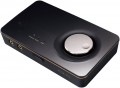 | 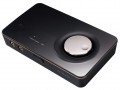 |
|---|---|---|
| Asus Xonar U7 MKII | Asus Xonar U7 | |
from $228.00 | from $109.59 up to $128.00 | |
| User reviews | ||
| TOP sellers | ||
Operation in 192 kHz/24 bit mode. 7.1 format support. Proprietary Sonic Studio software. Game utility Sonic Radar Pro. Support for Hyper Grounding technology. Support for high impedance headphones. | ||
| Type | gaming | on camera flashes |
Specs | ||
| Form factor | external | external |
| Interface | USB-B | USB-B |
| Channels | 7.1 | 7.1 |
| Audiochip | C-Media 6632AX | C-Media 6632A |
| Standards | Dolby Home Theater v4 | |
| ASIO |  | |
| Mac compatibility | | |
DAC | ||
| DAC resolution | 24 bit | 24 bit |
| Max. sampling rate | 192 kHz | 192 kHz |
| Dynamic Range | 110 dB | 110 dB |
| Signal-to-noise ratio | 114 dB | 114 dB |
ADC | ||
| ADC resolution | 24 bit | 24 bit |
| Max. sampling rate | 192 kHz | 192 kHz |
| Dynamic range | 110 dB | 110 dB |
| Signal-to-noise ratio | 110 dB | 110 dB |
| More features | headphones amplifier | headphones amplifier |
Inputs | ||
| mini-Jack (3.5 mm) | 1 | 1 |
Outputs | ||
| mini-Jack (3.5 mm) | 4 | 4 |
| RCA | 2 | 2 |
| Coaxial S/PDIF | 1 | 1 |
| Added to E-Catalog | march 2019 | december 2013 |


Compare Asus Xonar U7 MKII and Xonar U7
You may be interested in
My comparisons
Asus Xonar U7 MKII often compared


Asus Xonar U7 often compared


Glossary
Type
— Regular. This category includes all sound cards that do not have a clear specialization and do not belong to any of the types described below. Generally, they have a set of basic or mid-level characteristics and are intended for simple everyday tasks: listening to music and game sound through regular speakers or headphones, online communication via microphone, etc. Regular sound cards are equipped with both digital-to-analog and analog-to-digital converters and can be either internal or external.
— Audiophile (Hi-Fi). Sound cards designed for lovers of high-quality sound; they may also be useful for professionals engaged in professional audio processing who require the most accurate reproduction of the received signal. Accordingly, models of this type are distinguished by high build quality, advanced components, and additional equipment, a variety of interfaces, and extended configuration capabilities (both software and hardware, including even the possibility of replacing individual components of the circuit). However, such cards are priced accordingly.
— Gaming. Sound cards originally created as components for advanced gaming systems. Accordingly, the main purpose of such models is the high-quality transmission of game sound, including 3D and multi-channel sound. Usually, gaming sound cards are equipped with advanced DACs and support various special...standards (see below); furthermore, they may have additional equipment like external control modules (see below). The vast majority of models of this type are internal, but they often have rather original designs (which will be useful for modding enthusiasts using transparent cases).
— DAC. Abbreviation for "digital-to-analog converter." This term usually refers to a component of a sound card, but in this context, it refers to a separate type of sound card, whose distinctive feature is the lack of an analog-to-digital converter (ADC). Consequently, DACs can only transmit sound from the computer to headphones, speakers, etc., and cannot be used for sound digitization from a microphone or other external signal sources. Note that this category includes a variety of models — from basic "USB-headphone" adapters, the size of a flash drive, to advanced audiophile-class solutions.
— Audio Interface. A kind of opposite to the above-described DAC: audio interfaces are primarily intended for digitizing incoming sound (e.g., from a microphone or electric guitar). Consequently, they are not only necessarily equipped with analog-to-digital converters — generally, these ADCs have very advanced characteristics and extensive sound adjustment capabilities (and some models even provide hardware switches for this). At the same time, audio interfaces can also work in the mode of converting digital to analog sound (simply put — outputting sound to headphones/speakers). The cost of such devices is usually quite high, so it makes sense to purchase them only for those who plan to work a lot with sound recording.
— Audiophile (Hi-Fi). Sound cards designed for lovers of high-quality sound; they may also be useful for professionals engaged in professional audio processing who require the most accurate reproduction of the received signal. Accordingly, models of this type are distinguished by high build quality, advanced components, and additional equipment, a variety of interfaces, and extended configuration capabilities (both software and hardware, including even the possibility of replacing individual components of the circuit). However, such cards are priced accordingly.
— Gaming. Sound cards originally created as components for advanced gaming systems. Accordingly, the main purpose of such models is the high-quality transmission of game sound, including 3D and multi-channel sound. Usually, gaming sound cards are equipped with advanced DACs and support various special...standards (see below); furthermore, they may have additional equipment like external control modules (see below). The vast majority of models of this type are internal, but they often have rather original designs (which will be useful for modding enthusiasts using transparent cases).
— DAC. Abbreviation for "digital-to-analog converter." This term usually refers to a component of a sound card, but in this context, it refers to a separate type of sound card, whose distinctive feature is the lack of an analog-to-digital converter (ADC). Consequently, DACs can only transmit sound from the computer to headphones, speakers, etc., and cannot be used for sound digitization from a microphone or other external signal sources. Note that this category includes a variety of models — from basic "USB-headphone" adapters, the size of a flash drive, to advanced audiophile-class solutions.
— Audio Interface. A kind of opposite to the above-described DAC: audio interfaces are primarily intended for digitizing incoming sound (e.g., from a microphone or electric guitar). Consequently, they are not only necessarily equipped with analog-to-digital converters — generally, these ADCs have very advanced characteristics and extensive sound adjustment capabilities (and some models even provide hardware switches for this). At the same time, audio interfaces can also work in the mode of converting digital to analog sound (simply put — outputting sound to headphones/speakers). The cost of such devices is usually quite high, so it makes sense to purchase them only for those who plan to work a lot with sound recording.
Audiochip
Brand of the audio chip installed in the sound card.
The audio chip is one of the most important parts of a sound card, a kind of "heart" of the whole circuit, and it is on its characteristics that the sound quality and other capabilities of a particular model largely depend. Knowing the brand of the chip, you can easily find various information on it — official specifications, test results, reviews, etc. — and based on this, draw a conclusion to what extent this sound card is able to meet your requirements. Of course, for ordinary video cards (see "View") there is no need to delve into such details, but when choosing a gaming or audiophile model, they can be very useful.
The audio chip is one of the most important parts of a sound card, a kind of "heart" of the whole circuit, and it is on its characteristics that the sound quality and other capabilities of a particular model largely depend. Knowing the brand of the chip, you can easily find various information on it — official specifications, test results, reviews, etc. — and based on this, draw a conclusion to what extent this sound card is able to meet your requirements. Of course, for ordinary video cards (see "View") there is no need to delve into such details, but when choosing a gaming or audiophile model, they can be very useful.
Standards
Various standards and special digital audio technologies that the sound card is officially compatible with. For example, the Dolby and DTS standards in various variations are used primarily for multi-channel audio tracks in films, while DirectSound and EAX provide high-quality “surround” sound in games. In fact, the ability to work with one or another standard is largely determined by the software part of the system, and not by the characteristics of the sound card; however, official compatibility means at least the full compliance of the card with the requirements of the standard and the minimum risk of conflicts at the hardware level.