
Comparison Husqvarna ST 227P vs Husqvarna ST 224
Add to comparison | 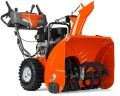 | 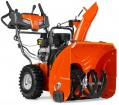 |
|---|---|---|
| Husqvarna ST 227P | Husqvarna ST 224 | |
from $2,089.56 up to $2,391.96 | from $1,464.40 up to $1,725.96 | |
| User reviews | ||
| TOP sellers | ||
Start from a network 230 V. Headlights. Powerful 7.5 hp engine Tyres X-trac with deep treads. Heated handles. Adjustment of handles on height. Control Panel. Differential unlock. | ||
| Motor type | petrol | petrol |
Snow removing | ||
| Working width | 68 cm | 61 cm |
| Snow height | 58 cm | 58 cm |
| Adjustable throw direction |  | |
| Throw distance adjustment | | |
| Working mechanism | steel auger | steel auger |
| Auger / brush diameter | 30.5 cm | 30.5 cm |
Design characteristics | ||
| Design | self-propelled lights heated handles | self-propelled lights heated handles |
| Movement | wheels | wheels |
| Number of gears | 6 forward / 1 back | 6 forward / 1 back |
| Selectable locking differential | | |
Motor | ||
| Motor type | LCT Storm Force 254 OHV | |
| Engine size | 254 cm³ | 208 cm³ |
| Motor power | 7.5 hp | 6.3 hp |
| Motor power | 5600 W | 4700 W |
| Fuel tank volume | 2.7 L | 2.6 L |
| Starter | electric starter (mains 230 V) | electric starter (mains 230 V) |
General | ||
| Wheels diameter | 38 cm | 38 cm |
| Noise level | 88 dB | 99 dB |
| Dimensions | 149.86x68.58x102.87 cm | 148.59x60.96x102.87 cm |
| Weight | 96 kg | 90 kg |
| Added to E-Catalog | october 2014 | october 2014 |


Compare Husqvarna ST 227P and ST 224
You may be interested in
My comparisons
Husqvarna ST 227P often compared


Husqvarna ST 224 often compared


Glossary
Working width
The width of the strip of snow that the snow blower can clear in one pass. The larger the capture width, the fewer passes will be required to process the site, which is especially important on large areas. On the other hand, for processing small spaces, clearing individual paths, etc. significant width is not required (moreover, a “narrow” snow blower will pass more easily in a hard-to-reach place). The larger the capture width, the more powerful the engine, usually, ceteris paribus.
The most compact modern snow blowers have a working width of less than 50 cm, these are mainly electric models of low power, although gasoline units are also found. A width of 50 – 60 cm can be called relatively small, 60 – 70 cm — medium, and in the largest models this figure exceeds 70 cm.
The most compact modern snow blowers have a working width of less than 50 cm, these are mainly electric models of low power, although gasoline units are also found. A width of 50 – 60 cm can be called relatively small, 60 – 70 cm — medium, and in the largest models this figure exceeds 70 cm.
Motor type
Model of the engine installed in the snow blower.
With this information, you can find detailed data on the engine — from official specifications to reviews, reviews and advice on specific nuances. In this way, you can evaluate how a snow blower with this particular engine will suit your needs.
With this information, you can find detailed data on the engine — from official specifications to reviews, reviews and advice on specific nuances. In this way, you can evaluate how a snow blower with this particular engine will suit your needs.
Engine size
The size of the engine installed in a gasoline or diesel (see "Engine type") snow blower. With the same type of internal combustion engine (see above), more displacement usually means more power and more fuel consumption.
Motor power
Snowblower motor power in horsepower.
The universal unit of power today is watts, but for petrol and diesel engines (see "Motor type"), the traditional designation in horsepower may also be given. 1 HP approximately equal to 735 watts.
The higher the motor power, the higher the performance of the snow blower, the better it handles with high dense snowdrifts and icy crust. However, more powerful engines consume more fuel, weigh more and cost more, and their use is not always justified. Detailed recommendations on choosing the optimal power for a specific situation can be found in special sources.
The universal unit of power today is watts, but for petrol and diesel engines (see "Motor type"), the traditional designation in horsepower may also be given. 1 HP approximately equal to 735 watts.
The higher the motor power, the higher the performance of the snow blower, the better it handles with high dense snowdrifts and icy crust. However, more powerful engines consume more fuel, weigh more and cost more, and their use is not always justified. Detailed recommendations on choosing the optimal power for a specific situation can be found in special sources.
Motor power
Snowblower motor power in watts. This designation is used for all electric models; for units with an internal combustion engine (see "Motor type"), the designation in horsepower may also be given (see above).
The higher the motor power, the higher the snowblower's flow rate, the better it copes with high dense snowdrifts and icy crust. However, more powerful engines consume more fuel, weigh more and cost more, and their use is not always justified. Detailed recommendations on choosing the optimal power for a specific situation can be found in special sources.
The higher the motor power, the higher the snowblower's flow rate, the better it copes with high dense snowdrifts and icy crust. However, more powerful engines consume more fuel, weigh more and cost more, and their use is not always justified. Detailed recommendations on choosing the optimal power for a specific situation can be found in special sources.
Fuel tank volume
The amount of fuel that the snow blower tank can hold at one time. Knowing this figure, as well as fuel consumption (see above), you can easily calculate the approximate operating time on one gas station. However, manufacturers usually choose the volume so that the operating time reaches at least 2 – 2.5 hours, so in most cases you can not pay much attention to this parameter.
Noise level
The average noise level produced by the snow blower during operation; the actual volume may differ slightly from this figure, but these deviations are usually negligible.
Note that snow blowers are quite loud equipment, plus the higher the power, the generally higher the noise level. This parameter is measured in decibels, this is a non-linear value, so the actual loudness is easiest to evaluate using comparative tables. So, the most "quiet" modern models give out about 55 – 60 dB — this can be compared with a conversation in slightly raised tones. 70 dB corresponds to a loud conversation, 80 dB to noise on a busy city street, 90 dB to a freight car at a distance of about 7 m, 100 dB to an industrial workshop, 110 dB to a tractor motor at a distance of 1 m.
The lower the noise level, the more comfortable this model will be to use. And according to sanitary standards, the maximum noise level considered safe for prolonged exposure (up to 8 hours) is 80 dB. So if the selected unit is noisier, and you plan to work often and for a long time, you should take care of protective headphones or earplugs.
Note that snow blowers are quite loud equipment, plus the higher the power, the generally higher the noise level. This parameter is measured in decibels, this is a non-linear value, so the actual loudness is easiest to evaluate using comparative tables. So, the most "quiet" modern models give out about 55 – 60 dB — this can be compared with a conversation in slightly raised tones. 70 dB corresponds to a loud conversation, 80 dB to noise on a busy city street, 90 dB to a freight car at a distance of about 7 m, 100 dB to an industrial workshop, 110 dB to a tractor motor at a distance of 1 m.
The lower the noise level, the more comfortable this model will be to use. And according to sanitary standards, the maximum noise level considered safe for prolonged exposure (up to 8 hours) is 80 dB. So if the selected unit is noisier, and you plan to work often and for a long time, you should take care of protective headphones or earplugs.