
Comparison NEO 84-115 vs Stanley 1-93-968
Add to comparison | 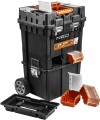 | 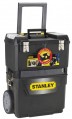 |
|---|---|---|
| NEO 84-115 | Stanley 1-93-968 | |
| Outdated Product | Compare prices 1 | |
| User reviews | ||
| TOP sellers | ||
| Type | set of boxes | set of boxes |
| Kit | 2 | 2 |
| Suitable for | tools and small items | tools and small items |
Specs | ||
| Size | 18.6" | |
| Сompartments | 3 | |
| Sections | drawlers | |
| Lid organizer |  | |
| Organizer slots | 13 | |
| Detachable tray | | |
| Recessed handle | | |
| Transportation wheels | | |
| Modular system | | |
General | ||
| Material | plastic | plastic |
| Lock material | metal | metal |
| Dimensions | 700x400x400 mm | 473x302x627 mm |
| Added to E-Catalog | june 2018 | april 2016 |



Compare NEO 84-115 and Stanley 1-93-968
Price comparison
You may be interested in
My comparisons
NEO 84-115 often compared


Stanley 1-93-968 often compared


Glossary
Size
The main size of the container for tools. Inches are traditionally used for this designation, and the length is usually indicated as the main size. This information allows you to evaluate the "weight category" of the product as a whole, as well as to determine whether it is suitable for a particular instrument of large sizes. At the same time, the characteristics usually indicate the overall dimensions on all three main sides (in millimetres), however, it is more convenient for many craftsmen to use the size designation in inches.
For kits (see below), this paragraph indicates the dimensions of all containers supplied in the kit.
For kits (see below), this paragraph indicates the dimensions of all containers supplied in the kit.
Сompartments
The number of compartments and/or pockets provided in the design of the tool container (with the exception of organizers, including those built into the lid — for them the number of cells is indicated separately, see below).
The more compartments or pockets, the easier it is to keep numerous items in the container at the same time. On the other hand, more compartments (for the same product size) usually means smaller individual compartments. The most modest models have up to 10 compartments / pockets, in the most capacious this number can exceed 30. Of course, when choosing by this parameter, you should take into account the type of container (see above). So, for traditional boxes, the maximum value is actually 20 compartments, and among backpacks there are models with 20 – 30 compartments.
The more compartments or pockets, the easier it is to keep numerous items in the container at the same time. On the other hand, more compartments (for the same product size) usually means smaller individual compartments. The most modest models have up to 10 compartments / pockets, in the most capacious this number can exceed 30. Of course, when choosing by this parameter, you should take into account the type of container (see above). So, for traditional boxes, the maximum value is actually 20 compartments, and among backpacks there are models with 20 – 30 compartments.
Sections
Design of movable sections mounted in a tool box or other container. A section is a separate movable unit, usually divided into several compartments (see above). The meaning of such blocks is to ensure the compactness of the container when folded and the convenience of access to the contents when unfolded. The types of sections can be as follows:
— Sliding. Sections located at the top of the container and also playing the role of a cover for its lower part. Typically, such sections are made in pairs or quadruples, 2 pairs each, and when opened, in accordance with the name, they diverge in different directions, allowing you to get to the space below them. This variety is found mainly in boxes (see "Type").
— Retractable. Sections that slide out of the inner volume of the container are like drawers in a desk or kitchen table. This design is used in organizers and trolleys(see "Type").
— Sliding. Sections located at the top of the container and also playing the role of a cover for its lower part. Typically, such sections are made in pairs or quadruples, 2 pairs each, and when opened, in accordance with the name, they diverge in different directions, allowing you to get to the space below them. This variety is found mainly in boxes (see "Type").
— Retractable. Sections that slide out of the inner volume of the container are like drawers in a desk or kitchen table. This design is used in organizers and trolleys(see "Type").
Organizer slots
The number of individual cells provided in the organizer. In this case, we can talk about an organizer as a separate device (see "Type"), or a set of cells built into the lid of the box (see "Lid with an organizer"). And for solutions with removable partitions, in which cells can be combined, the maximum number is indicated — with all installed partitions.
Organizers, by definition, are designed mainly for small things. Therefore, the more cells there are, the more varieties of small items can be stored in a container. For example, in 10 cells you can keep bolts of five different sizes and separately nuts for them. Such a number of compartments — up to 10 — is generally considered small, but in fact it is often quite enough. 11 – 20 cells can be called an average, and the most capacious organizers have up to 30 compartments. However it is worth considering that with the same dimensions of the container, an increase in the number of cells leads to a decrease in their volume.
Organizers, by definition, are designed mainly for small things. Therefore, the more cells there are, the more varieties of small items can be stored in a container. For example, in 10 cells you can keep bolts of five different sizes and separately nuts for them. Such a number of compartments — up to 10 — is generally considered small, but in fact it is often quite enough. 11 – 20 cells can be called an average, and the most capacious organizers have up to 30 compartments. However it is worth considering that with the same dimensions of the container, an increase in the number of cells leads to a decrease in their volume.