
Comparison Epson EcoTank L1110 vs Epson EcoTank L132
Add to comparison | 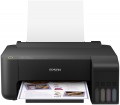 | 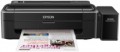 |
|---|---|---|
| Epson EcoTank L1110 | Epson EcoTank L132 | |
| Outdated Product | from $144.76 up to $165.24 | |
| User reviews | ||
| TOP sellers | ||
| Print formats | A4 | A4 |
| Print type | inkjet | inkjet |
| Output type | colour | colour |
| Number of colors | 4 | 4 |
Print | ||
| Max. resolution | 5760х1440 dpi | 5760х1440 dpi |
| Mono print | 33 ppm | 27 ppm |
| Colour print | 15 ppm | 15 ppm |
| Photo print | 69 s/p | 69 s/p |
Printing supplies | ||
| Mono cartridge resource | 4500 page | 4000 page |
| Colour cartridge resource | 7500 page | 5700 page |
| Built-in CISS |  | |
| Ink type | water soluble | water soluble |
Features | ||
| Data transfer | PC connection (USB-B) | PC connection (USB-B) |
| Screen | no display | no display |
Hardware | ||
| Grammage (min) | 64 g/m² | 64 g/m² |
| Grammage (max) | 256 g/m² | 255 g/m² |
General | ||
| Feed tray | 100 sheets | 100 sheets |
| Output tray | 30 sheets | |
| Power consumption | 12 W | 10 W |
| Dimensions (WxDxH) | 375x347x169 mm | 482x222x130 mm |
| Weight | 2.7 kg | 2.7 kg |
| Color | ||
| Added to E-Catalog | april 2019 | july 2015 |


Compare Epson EcoTank L1110 and L132
You may be interested in
My comparisons
Epson EcoTank L1110 often compared


Epson EcoTank L132 often compared


Glossary
Mono print
The black and white print speed provided by the printer. It should be noted that this parameter is often indicated for low quality when the device is running at maximum performance; at a higher quality (even at standard), the actual speed can be noticeably lower, so you should choose with a certain margin. Also note that high speed significantly affects the price, power consumption and noise level. Therefore, it does not always make sense to chase maximum performance — for simple applications (for example, at home or in a small office), a relatively slow and inexpensive device may be the best choice.
As for specific values, speeds up to 20 ppm are considered relatively low, 20 – 30 ppm — average, 31 – 40 ppm — decent, and the fastest models are capable of delivering more than 40 pages per minute.
As for specific values, speeds up to 20 ppm are considered relatively low, 20 – 30 ppm — average, 31 – 40 ppm — decent, and the fastest models are capable of delivering more than 40 pages per minute.
Mono cartridge resource
The maximum number of pages that the printer's ink (toner) can print. The value is rather conditional, in reality the deviations from the norm are very large (up or down). In inkjet printers, the cartridge life is relatively small and amounts to several hundred prints. In laser and LED devices, the bill is already in the thousands.
Colour cartridge resource
The maximum number of pages that the printer's ink (toner) can print. The value is rather conditional, in reality the deviations from the norm are very large (up or down). In inkjet printers, the cartridge life is relatively small and amounts to several hundred prints. In laser and LED devices, the bill is already in the thousands.
Grammage (max)
The maximum grammage on which the printer can produce normal print quality. For details about the weight, see "Paper Weight (Min)". An attempt to print on paper of a greater density than the maximum for this printer will, at best, end in nothing (the printer simply cannot capture the sheet), at worst, it can lead to a sheet jam in the printer, followed by the hassle of removing it.
Output tray
The number of sheets of paper that the output tray can hold — the tray where the finished media is delivered. Usually, this amount is specified for standard office paper with a density of 80 g/m²; if you use thicker sheets, the actual capacity of the tray will be less (conversely, thinner sheets may fit more).
Power consumption
The maximum power consumed by the printer during operation. The lower the power consumption, the less energy the printer consumes, the more economical it is. On the other hand, devices with lower power consumption are often less performant than their more high consumption counterparts. And for the same performance, a more economical printer is likely to cost more, but with heavy use, it can pay off in energy savings.