
Comparison Bosch MES25G0 vs Bosch MES4010
Add to comparison | 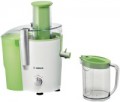 | 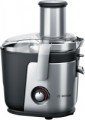 |
|---|---|---|
| Bosch MES25G0 | Bosch MES4010 | |
from $165.30 | from $482.00 | |
| TOP sellers | ||
Suction cups for better stability on the work surface. | The ceramic blade and sieve are electropolished for easy cleaning after use. Three speeds. Large loading opening. Easy disassembly. | |
| Type | centrifugal | centrifugal |
| Juice container | 1.25 L freestanding | 1.5 L freestanding |
| Pulp container | 2 L | 3 L |
Specs | ||
| Power | 700 W | 1200 W |
| Control | control knob | control knob |
| Number of speeds | 2 | 3 |
| Loading opening width | 73 mm | 84 mm |
| Functions | automatic release of pulp drop-stop system skimmer protection from accidental activation | automatic release of pulp drop-stop system skimmer protection from accidental activation |
General | ||
| Body material | plastic | steel |
| Round neck |  | |
| Suction cup feet | |  |
| Compartment for cord | | |
| Dimensions (HxWxD) | 31x31x18 cm | 51x30x40 cm |
| Weight | 4.4 kg | 6.9 kg |
| Color | ||
| Added to E-Catalog | january 2015 | july 2014 |


Compare Bosch MES25G0 and MES4010
You may be interested in
Bosch MES25G0 often compared


Bosch MES4010 often compared


Glossary
Juice container
Modern juicers can be equipped with either built-in or freestanding containers for juice. In the latter case, instead of the container included with the device, you can use any other one that fits in height: a glass, a jar, etc.
At the same time, the containers come in different volumes. Compact models may have a volume of around 0.3–0.6 liters, containers of 0.8–1.2 liters are convenient for everyday use, and options of 1.5 liters and more are suitable for making juice for a family or several servings at once.
At the same time, the containers come in different volumes. Compact models may have a volume of around 0.3–0.6 liters, containers of 0.8–1.2 liters are convenient for everyday use, and options of 1.5 liters and more are suitable for making juice for a family or several servings at once.
Pulp container
The volume of the tank for the oil cake (pressed pulp) installed in the juicer.
While most models with a pulp tank come equipped with an automatic pulp ejection function (see "Functions"), there are some exceptions. Nevertheless, the size of the tank directly affects the duration for which the juicer can be used without having to empty the oil cake residue. However, an increase in capacity significantly impacts the device's dimensions, weight, and cost.
Modern juicers are designed with oil cake containers ranging from 200-500 mL in the most compact models to 3 liters or more in larger ones. The specific capacity is usually chosen by designers based on the unit's total power and performance. However, models with similar performance characteristics may differ in their oil cake container volume. When selecting a juicer, it's important to consider the intended use of the device. For occasional home use, a smaller container may suffice, but for a cafe or bar where freshly squeezed juices are prepared regularly, a larger capacity juicer may be the better option.
While most models with a pulp tank come equipped with an automatic pulp ejection function (see "Functions"), there are some exceptions. Nevertheless, the size of the tank directly affects the duration for which the juicer can be used without having to empty the oil cake residue. However, an increase in capacity significantly impacts the device's dimensions, weight, and cost.
Modern juicers are designed with oil cake containers ranging from 200-500 mL in the most compact models to 3 liters or more in larger ones. The specific capacity is usually chosen by designers based on the unit's total power and performance. However, models with similar performance characteristics may differ in their oil cake container volume. When selecting a juicer, it's important to consider the intended use of the device. For occasional home use, a smaller container may suffice, but for a cafe or bar where freshly squeezed juices are prepared regularly, a larger capacity juicer may be the better option.
Power
The power of the juicer depends on its type. For example, the power of citrus juicers rarely exceeds 40 W, since the structure of citrus fruits is easily destroyed and does not require serious effort to extract juice. The power of centrifugal juicers can even exceed 1000 W. The centrifugal speed and spin features depend on the power of the centrifugal juicer (for more details, see Number of speeds)
Number of speeds
The number of speeds of the juicer. The optimal working speeds for different fruits are different: for example, soft fruits and vegetables need to be pressed at low speeds, solid ones (for example, carrots) — at maximum. In addition, the amount of pulp in the juice depends on the extraction speed: at high speeds it is more, at low speeds the juice is light.
The number of speeds provided by the design of the juicer can vary from 1 to 9. The more speeds, the easier it is to choose the optimal mode for each specific case.
The number of speeds provided by the design of the juicer can vary from 1 to 9. The more speeds, the easier it is to choose the optimal mode for each specific case.
Loading opening width
The width of the opening for loading products into the centrifugal juicer. You should pay attention to this parameter if you plan to get juice from large fruits such as apples or pears — if the opening is less than 70 mm wide, the fruits will most likely have to be cut into pieces.
Body material
The body of a modern juicer is most often made of plastic or steel. Plastic juicers tend to weigh less and cost less; in turn, metal ones are more durable and look “more respectably”. The body material usually does not affect the functionality of the device.
Suction cup feet
Suction cups reduce slippage of the body on the surface, minimize the risk of accidental displacement, and make using the juicer safer. Accordingly, when juicing carrots, apples, or beets, a device with such feet "wanders" less on the countertop. This is especially useful for powerful centrifugal models that may vibrate when juicing hard fruits and vegetables.