
Comparison Pioneer X-CM56 vs Pioneer X-CM35
Add to comparison | 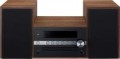 |  |
|---|---|---|
| Pioneer X-CM56 | Pioneer X-CM35 | |
from $373.33 up to $403.20 | from $342.22 up to $369.60 | |
| TOP sellers | ||
| Features | music center | music center |
| Number of channels | 2.0 | 2.0 |
Playback | ||
| Media | USB port CD | USB port CD |
Radio | ||
| Tuner bands | FM AM | FM AM |
| Radio Data System (RDS) |  | |
Tech specs | ||
| System power | 30 W | 30 W |
| Power per channel | 15 W | 15 W |
| Number of bands | 2 | 2 |
| Phase inverter | | |
| Equalizer | | |
| Bass Boost | | |
Interfaces and features | ||
| Interfaces | Bluetooth NFC | Bluetooth NFC |
| More features | time alarm | time alarm |
Connectors | ||
| Inputs | mini-Jack (3.5 mm) | RCA mini-Jack (3.5 mm) |
| Outputs | on headphones | on headphones |
General | ||
| LCD display | | |
| Remote control | | |
| USB for charging gadgets | | |
| Speaker dimensions (HxWxD) | 129x200x213 mm | 201x121x235 mm |
| Central unit dimensions (HxWxD) | 129x200x237 mm | 123x200x257 mm |
| Weight | 5.7 kg | 6 kg |
| Color | ||
| Added to E-Catalog | november 2016 | may 2016 |


Compare Pioneer X-CM56 and X-CM35
You may be interested in
My comparisons
Pioneer X-CM56 often compared


Pioneer X-CM35 often compared


Glossary
Inputs
— RCA. The RCA interface uses coaxial cables with characteristic tulip plugs and corresponding connectors. It can be used to transmit different types of data, but in this case it is meant to connect an audio signal from a preamplifier in analog format, one audio channel per connector. RCA is widely used in modern audio equipment, but its resistance to interference is very modest.
— Mini-Jack(3.5 mm). Standard connector for most modern portable audio equipment. In audio systems, it is mainly used to connect such equipment — primarily pocket media players. It uses analog signal transmission, but its resistance to interference, like that of RCA, is low, and the quality may be even lower due to the fact that both stereo sound channels are transmitted via one cable.
— Coaxial S/PDIF. An electrical variation of the S/PDIF standard that uses a coaxial cable with a tulip connector to transmit the signal. This interface should not be confused with the analog RCA described above — despite the identity of the connectors, these standards are fundamentally different: “coaxial” operates in digital format and allows for the transmission of even multi-channel sound over a single cable. Compared to optical S/PDIF, this interface is less resistant to interference, but more reliable, since the electrical cables are not as delicate.
— Optical. One of the varietie...s of the S/PDIF standard — along with the coaxial one described above. In this case, the signal is transmitted via a TOSLINK fiber-optic cable. The main advantage of this interface is its complete insensitivity to electrical interference, while its capabilities are sufficient even for working with multi-channel sound. Among the disadvantages, it is worth noting the high price of connecting cables, as well as the need for careful handling of them.
— For microphone. Input for connecting a microphone to an audio system; can use different types of connectors (3.5 mm mini-Jack, 6.35 mm Jack, etc.). This function is mandatory for models with karaoke (see "Additional"), but can also be used for other purposes.
— Instrumental. Connectors used to connect musical instruments (acoustic or bass guitars, keyboards, etc.). Most often, they are made in the form of 6.35 mm Jack sockets. The audio signal from the pickups has its own specifics, so the instrument input is usually characterized by a higher input signal level and special impedance matching to ensure optimal sound quality.
— Mini-Jack(3.5 mm). Standard connector for most modern portable audio equipment. In audio systems, it is mainly used to connect such equipment — primarily pocket media players. It uses analog signal transmission, but its resistance to interference, like that of RCA, is low, and the quality may be even lower due to the fact that both stereo sound channels are transmitted via one cable.
— Coaxial S/PDIF. An electrical variation of the S/PDIF standard that uses a coaxial cable with a tulip connector to transmit the signal. This interface should not be confused with the analog RCA described above — despite the identity of the connectors, these standards are fundamentally different: “coaxial” operates in digital format and allows for the transmission of even multi-channel sound over a single cable. Compared to optical S/PDIF, this interface is less resistant to interference, but more reliable, since the electrical cables are not as delicate.
— Optical. One of the varietie...s of the S/PDIF standard — along with the coaxial one described above. In this case, the signal is transmitted via a TOSLINK fiber-optic cable. The main advantage of this interface is its complete insensitivity to electrical interference, while its capabilities are sufficient even for working with multi-channel sound. Among the disadvantages, it is worth noting the high price of connecting cables, as well as the need for careful handling of them.
— For microphone. Input for connecting a microphone to an audio system; can use different types of connectors (3.5 mm mini-Jack, 6.35 mm Jack, etc.). This function is mandatory for models with karaoke (see "Additional"), but can also be used for other purposes.
— Instrumental. Connectors used to connect musical instruments (acoustic or bass guitars, keyboards, etc.). Most often, they are made in the form of 6.35 mm Jack sockets. The audio signal from the pickups has its own specifics, so the instrument input is usually characterized by a higher input signal level and special impedance matching to ensure optimal sound quality.