
Comparison Tronsmart W2TF vs Tronsmart W3PTA
Add to comparison | 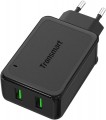 | 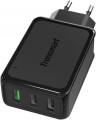 |
|---|---|---|
| Tronsmart W2TF | Tronsmart W3PTA | |
| Outdated Product | Outdated Product | |
| User reviews | ||
| TOP sellers | ||
Support Quick Charge 3.0/2.0 (5V/3A, 9V/2A, 12V/1.5A) | Support for Quick Charge 3.0/2.0 (5V/3A, 9V/2A, 12V/1.5A) fast charging. | |
| Type | mains charger | mains charger |
| USB-A ports | 2 pcs | 3 pcs |
| Max. power (USB) | 18 W | 18 W |
| Power (for all ports) | 36 W | 42 W |
| Fast charge | Quick Charge 3.0 | Quick Charge 3.0 |
| Features | work indicator | work indicator |
| Dimensions | 107x48x26 mm | 107x48x26 mm |
| Weight | 105 g | 102 g |
| Color | ||
| Added to E-Catalog | october 2019 | september 2019 |


Compare Tronsmart W2TF and W3PTA
You may be interested in
Tronsmart W2TF often compared

Tronsmart W3PTA often compared

Glossary
USB-A ports
The number of USB ports in the device design. Note that this refers only to classical, full-sized ports — the so-called USB-A; the number of USB-C ports, if available, is specified separately (see below).
The number of USB ports (of any type) corresponds to the number of gadgets that can be simultaneously connected to the charger using adapter cables or plugs for the corresponding port. At the same time, it should be noted that not all chargers are capable of providing full power to all charging outputs at once; for more details, see "Charging Current". As for the specific number of ports (USB-A and/or USB-C), nowadays relatively simple chargers with 1 port or 2 ports are the most popular. This is because individual chargers are usually purchased for one or two specific gadgets, and a larger number of charging outputs is comparatively rarely required. Nevertheless, you can easily find models with 3 ports and even more in the market.
The number of USB ports (of any type) corresponds to the number of gadgets that can be simultaneously connected to the charger using adapter cables or plugs for the corresponding port. At the same time, it should be noted that not all chargers are capable of providing full power to all charging outputs at once; for more details, see "Charging Current". As for the specific number of ports (USB-A and/or USB-C), nowadays relatively simple chargers with 1 port or 2 ports are the most popular. This is because individual chargers are usually purchased for one or two specific gadgets, and a larger number of charging outputs is comparatively rarely required. Nevertheless, you can easily find models with 3 ports and even more in the market.
Power (for all ports)
The total power provided by the device while simultaneously charging the maximum possible number of gadgets. This parameter is indicated only for models that can work with several gadgets; for a 1-socket charger or a wireless platform, the operating power is given in the “Power per 1 device” paragraph.
When evaluating this parameter, two points should be taken into account. First, when the charger is fully loaded, the power of each individual port and/or wireless platform may be lower than the maximum possible value. For example, some models with 2 USB ports for 2 A and 1 A (10 W and 5 W), with simultaneous operation of both ports, can output only 5 W each, that is, only 10 W in total (this is the number and indicated in this paragraph). Secondly, the distribution of power over individual connectors can be different — depending on the current on each port and supported fast charging technologies; these nuances are best specified in the official documentation.
When evaluating this parameter, two points should be taken into account. First, when the charger is fully loaded, the power of each individual port and/or wireless platform may be lower than the maximum possible value. For example, some models with 2 USB ports for 2 A and 1 A (10 W and 5 W), with simultaneous operation of both ports, can output only 5 W each, that is, only 10 W in total (this is the number and indicated in this paragraph). Secondly, the distribution of power over individual connectors can be different — depending on the current on each port and supported fast charging technologies; these nuances are best specified in the official documentation.