
Comparison DJI Osmo Mobile 2 vs DJI Osmo Mobile
Add to comparison | 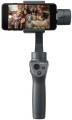 | 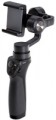 |
|---|---|---|
| DJI Osmo Mobile 2 | DJI Osmo Mobile | |
from $139.22 | Compare prices 2 | |
| TOP sellers | ||
Three diodes to indicate battery charge. Possibility to rotate the phone mount by 90°. Effective stabilization. Comfortable grip in the hand. Long battery life. Functional mobile application. USB port for smartphone charging. The difference from the Osmo Mobile model is the presence of a full-fledged USB port for recharging the phone, and not a connector similar to a 3.5 mm mini jack. | Effective three-axis stabilization of a smartphone mounted on a gimbal. Functional related application. Streaming video on social media or YouTube. tracking mode. Intuitive control. Long battery life. Not compatible with all smartphones. | |
| Type | for smartphone | for smartphone |
Gimbal specifications | ||
| Max. load | 0.24 kg | |
| Rotation angle | ±170° | ±165° |
| Tilt angle | ±170° | -140° +50° |
| Bank angle | -90° +70° | -50° +90° |
| Max. controlled speed | 120 °/sec | 120 °/sec |
| Max. phone diagonal | 6 " | 6 " |
| Max. phone width | 85 mm | 85 mm |
Battery | ||
| Battery model | 18650 | HB01-522365 |
| Capacity | 2600 mAh | 980 mAh |
| Battery life | 15 h | 4.5 h |
| Power bank function |  |  |
| Removable battery | | |
Shooting features | ||
| Camera control | joystick | joystick |
| Functions | camera position fixing axis lock | camera position fixing axis lock |
| Shooting modes | Time lapse selfie mode autopanorama tracking mode inversion mode | Time lapse selfie mode autopanorama tracking mode |
General | ||
| Connection | Bluetooth | Bluetooth |
| Dimensions (folded) | 295x113x72 mm | 161.5x61.8x48.2 mm |
| Weight | 485 g | 501 g |
| Added to E-Catalog | february 2018 | february 2017 |




Compare DJI Osmo Mobile 2 and Osmo Mobile
Price comparison
You may be interested in
My comparisons
DJI Osmo Mobile 2 often compared


DJI Osmo Mobile often compared


Glossary
Max. load
The maximum weight that the stabiliser is designed to carry.
This is the maximum weight of the camera with all accessories allowed for this model.
This is the maximum weight of the camera with all accessories allowed for this model.
Rotation angle
The range of rotation angles supported by the steadicam.
In this case, it means turning the camera to the right or left, without tilting back and forth.
In this case, it means turning the camera to the right or left, without tilting back and forth.
Tilt angle
The range of forward-backwards tilt angles relative to the vertical position supported by the stabiliser.
It can be written in different ways.
The simplest option is when one angle value is indicated in the characteristics. This may mean that the camera can deviate from the neutral position in both directions by the same angle, which is half the range.
Another option is used when the angles of tilt forward and backward are not the same. In such cases, the horizontal position of the camera on a vertical steadicam is taken as zero, the “-” sign indicates the maximum angle of camera deflection back, lens up, and the “+” sign — forward, lens down.
It can be written in different ways.
The simplest option is when one angle value is indicated in the characteristics. This may mean that the camera can deviate from the neutral position in both directions by the same angle, which is half the range.
Another option is used when the angles of tilt forward and backward are not the same. In such cases, the horizontal position of the camera on a vertical steadicam is taken as zero, the “-” sign indicates the maximum angle of camera deflection back, lens up, and the “+” sign — forward, lens down.
Bank angle
The range of roll angles (to the side) supported by the stabiliser.
Can be recorded in two ways (See "Tilt angle")
Can be recorded in two ways (See "Tilt angle")
Battery model
Model of the battery used in the stabiliser. This information is not very important when choosing: if you wish, knowing the battery model, you can find detailed information about it. However, the key characteristics of the battery are usually given in general information about the stabiliser. Nevertheless, model information can be useful if you plan to purchase an additional battery, or if you already have a battery and you need to evaluate its compatibility with the device.
Capacity
The capacity of the battery used in the stabiliser.
In theory, a higher capacity allows you to work longer without recharging, but the battery life of the stabiliser also depends on its power consumption. So, only models with similar performance characteristics can be compared with each other according to this indicator; and when choosing, it is better to focus not on the capacity, but on the directly claimed battery life.
In theory, a higher capacity allows you to work longer without recharging, but the battery life of the stabiliser also depends on its power consumption. So, only models with similar performance characteristics can be compared with each other according to this indicator; and when choosing, it is better to focus not on the capacity, but on the directly claimed battery life.
Battery life
The maximum length of time the device will work before it needs its battery to be recharged. It is worth considering that the manufacturer indicates the maximum time, which does not correspond to real indicators due to the conditions and intensity of use.
Power bank function
The ability of stabiliser to work steadicam in power bank mode — an external battery for various portable devices. It allows the device to share its energy with the phone, and the recording is not yet over.
Removable battery
The presence of a removable battery in the design of the stabiliser allows, if necessary, to replace the used one with a spare one and thus to record longer without interruption.