
Comparison SmartWay AllRoad Pro vs SmartYou SX10 Pro
Add to comparison | 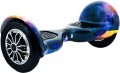 | 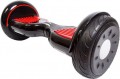 |
|---|---|---|
| SmartWay AllRoad Pro | SmartYou SX10 Pro | |
| Outdated Product | from $397.00 up to $399.96 | |
| TOP sellers | ||
| Product type | hoverboard | hoverboard |
| Max. load | 110 kg | 120 kg |
Driving performance | ||
| Range | 30 km | 22 km |
| Max. speed | 16 km/h | 22 km/h |
| Wheel size | 10 " | 10 " |
| Max. climb angle | 30 ° | 30 ° |
| Clearance | 90 mm | |
| Wheel material | rubber | rubber |
| More features | position lamps Bluetooth speakers remote control | position lamps Bluetooth speakers remote control |
Battery and motor | ||
| Battery capacity | 4400 mAh | 4400 mAh |
| Battery capacity | 158 W*h | 158 W*h |
| Voltage | 36 В | 36 В |
| Power | 1000 W | 1000 W |
| Number of motors | 2 | 2 |
| Full charge time | 120 min | 150 min |
General | ||
| Dustproof, waterproof | IP54 | IP54 |
| Dimensions | 660x275x275 mm | 262x262x546 mm |
| Weight | 12.5 kg | 11 kg |
| Color | ||
| Added to E-Catalog | august 2017 | february 2017 |


Compare SmartWay AllRoad Pro and SmartYou SX10 Pro
You may be interested in
My comparisons
SmartWay AllRoad Pro often compared


SmartYou SX10 Pro often compared


Glossary
Max. load
The maximum rider weight that the device can support (including the weight of a backpack, bag and other things carried on oneself; this is especially important to remember if the weight of the person himself is close to the maximum allowable). If the permissible load is exceeded, the transport not only loses efficiency but can also break down at any time. Therefore, it is impossible to ignore the prescriptions for weight anyway.
Range
The average distance that can be driven on a single battery charge. Usually, the range is indicated with some overestimation — based on a low (optimal from the point of view of energy consumption) speed, uniform movement on a flat surface, etc. Therefore, the actual battery life may be somewhat less. Nevertheless, this parameter is quite suitable for comparing different models with each other.
Thanks to the development of technology, the range in modern self-balancing vehicles can reach several tens of kilometers.
Thanks to the development of technology, the range in modern self-balancing vehicles can reach several tens of kilometers.
Max. speed
The maximum speed that the hoverboard is capable of reaching: on a flat surface, with a full battery charge and an average rider weight. The same parameter is also the maximum safe speed allowed when using this model; in theory, it is possible to accelerate even faster (for example, from a mountain), but this is fraught with breakdown, accident and injury, and therefore is not recommended at all.
Most modern models have a maximum speed of up to 20 km/h, and in “high-speed” vehicles this figure can exceed 30 km/h. Note that a fall from a hoverboard, even at a speed of 10 – 15 km/h, is fraught with serious injuries. Therefore, protective gear is highly recommended.
Most modern models have a maximum speed of up to 20 km/h, and in “high-speed” vehicles this figure can exceed 30 km/h. Note that a fall from a hoverboard, even at a speed of 10 – 15 km/h, is fraught with serious injuries. Therefore, protective gear is highly recommended.
Clearance
Clearance is the distance from the lowest point of the hull to the ground; in other words, this is the largest size of an obstacle on the road (in height), that the device can pass under itself. High clearance contributes to cross-country ability. However, it requires large-diameter wheels and, accordingly, an increase in motor power, which in turn affects the weight and price of the device. In addition, self-stabilizing transport is designed primarily for urban use, with driving on a flat surface. Therefore, even in most models, the clearance does not exceed 150 mm, and in some devices, it is only 30 mm.
Full charge time
The time required to fully charge the battery from zero to full capacity. This parameter allows you to estimate how long the breaks should be for a full replenishment of the energy supply. Reducing the charging time makes the use of the device more convenient, but it is achieved through special technologies, which, usually, are not cheap.