
Comparison Yamaha PSR-EW400 vs Yamaha PSR-E453
Add to comparison | 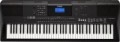 | 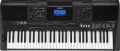 |
|---|---|---|
| Yamaha PSR-EW400 | Yamaha PSR-E453 | |
from $571.60 up to $636.36 | from $410.80 up to $469.08 | |
| User reviews | ||
| TOP sellers | ||
Autonomous food. Learning mode. Melody Suppressor. live control function. Pattern mode. 48-voice polyphony. There is no sampling function. | ||
| Type | synthesizer (rompler) | synthesizer (rompler) |
Keys | ||
| Number of keys | 76 | 61 |
| Size | full size | full size |
| Mechanics | active | active |
| Rigidity | semi-weighted | semi-weighted |
Specs | ||
| Polyphony | 48 voices | 48 voices |
| Built-in timbres | 758 шт | 758 шт |
| Auto accompaniment |  | |
| Accompaniment styles | 220 шт | 220 шт |
| Learning mode | | |
| Tempo change | 11 – 280 | 11 – 280 |
| Metronome | | |
| Sequencer (recording) | | |
| Built-in compositions | | |
Effects and control | ||
| Timbres layering | | |
| Keyboard split | | |
| Arpeggiator | | |
| Reverberation | | |
| Chorus | | |
| Transposition | | |
| Pitch controller | | |
| Fine tuning | | |
Connectors | ||
| Inputs | mini-Jack (3.5 mm) USB to device (type A) | mini-Jack (3.5 mm) USB to device (type A) |
| Connectable pedals | 1 шт | 1 шт |
| Outputs | USB to host (type B) headphones | USB to host (type B) headphones |
| Linear outputs | 2 | 1 |
In box | ||
| In box | music stand | music stand |
General | ||
| Built-in acoustics | 12 W | 12 W |
| Number of bands | 2 | 2 |
| Display | monochrome | monochrome |
| Power consumption | 8 W | 8 W |
| Autonomous power supply | aA batteries | aA batteries |
| Dimensions (WxHxD) | 1178x138x412 mm | 946x140x405 mm |
| Weight | 8.4 kg | 6.6 kg |
| Color | ||
| Added to E-Catalog | october 2016 | october 2016 |


Compare Yamaha PSR-EW400 and PSR-E453
You may be interested in
My comparisons
Yamaha PSR-EW400 often compared


Yamaha PSR-E453 often compared


Glossary
Number of keys
The greater the number of keys — the wider the range of the instrument, the lower and higher notes you can take on it right during the game, without resorting to tricks like octave shift (see below). By comparison, a full size piano keyboard has 88 keys. However, in synthesizers, such an amount is rare, because. the instrument would have turned out to be too bulky and expensive, and not every musician, even a professional one, needs such an extensive range. Thus, 88-key keyboards are used primarily in high-end workstations (see "Type"). For ordinary synthesizers, the standard is 49, 61 or 76 keys ( there are also options for 73 keys) — this is usually quite enough (while the "golden mean" option is considered to be 61 keys). And small children's models can have 32 keys.
Linear outputs
The number of line outputs provided in the design of the synthesizer.
The line output is used to transmit the sound produced by the synthesizer to external devices. At the same time, unlike the MIDI output, a “ready” sound is transmitted through such a connector — an analogue line-level audio signal that can be connected to another audio device — for example, to a power amplifier or active speakers for playback, to a computer or mixing console for recording, etc. Keep in mind that the line outputs can use different types of connectors — for example, 3.5 mm mini-Jack or 6.35 mm Jack; Specifically, these connectors are described in more detail in the “Inputs” section, but the matter is not limited to them.
Multiple analogue inputs make it possible to connect the synthesizer to several external audio devices at the same time — for example, to an amplifier for playback and a recorder for recording.
The line output is used to transmit the sound produced by the synthesizer to external devices. At the same time, unlike the MIDI output, a “ready” sound is transmitted through such a connector — an analogue line-level audio signal that can be connected to another audio device — for example, to a power amplifier or active speakers for playback, to a computer or mixing console for recording, etc. Keep in mind that the line outputs can use different types of connectors — for example, 3.5 mm mini-Jack or 6.35 mm Jack; Specifically, these connectors are described in more detail in the “Inputs” section, but the matter is not limited to them.
Multiple analogue inputs make it possible to connect the synthesizer to several external audio devices at the same time — for example, to an amplifier for playback and a recorder for recording.