
Comparison OMBRA OMT94S vs STELS 14106
Add to comparison | 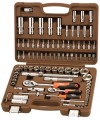 | 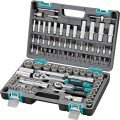 |
|---|---|---|
| OMBRA OMT94S | STELS 14106 | |
from $92.76 up to $118.88 | from $177.30 | |
| TOP sellers | ||
| Total number of items | 94 | 94 |
| Square drive size | 1/2, 1/4 " | 1/2, 1/4 " |
Heads and bits | ||
| Socket heads (6 points) | 43 | 43 |
| Socket heads sizes (6 points) | 4 — 32 mm | 4 — 32 mm |
| Spark plug sockets | 2 | 2 |
| Bits | 34 | 32 |
| Adapter | 1 | 1 |
| Ratchet wrench | 2 | 2 |
| Screwdriver handle | 1 | 1 |
| Tap wrench | 2 | 2 |
| Universal joint | 2 | 2 |
| Extension | hard | hard/flexible |
Wrenches | ||
| Hex wrenches | 3 | 3 |
| Hex wrenches size | 1.5 — 2.5 mm | 1.5 — 2.5 mm |
More features | ||
| Tool storage | plastic case | plastic case |
| Added to E-Catalog | february 2015 | february 2015 |


Compare OMBRA OMT94S and STELS 14106
You may be interested in
My comparisons
OMBRA OMT94S often compared


STELS 14106 often compared


Glossary
Bits
The number of bits supplied with the tool kit. A bat in this case is called a working nozzle, which plays the role of a screwdriver tip; in fact, they are most often used with screwdriver handles (see above).
Many types of splines (slots) are used in modern fasteners — starting with the well-known straight, cross-shaped ( Phillips and Pozidriv), Torx sprockets and ending with exotics like Torq-set (a cross with lines shifted from the centre), Pentalobe (with five ledges), etc. .P. In addition, the size of the slots can also vary, and in many cases, tool matching in size is very important. Accordingly, the more bits supplied with the set, the more versatile it is, the higher the probability that it will contain a nozzle of the desired type and size. However, the specific list of bits in the kit also does not hurt to clarify — in order to make sure that it has all the varieties you need. In the characteristics of individual sets, these data are given in the paragraph "Bit sizes" (see below).
Many types of splines (slots) are used in modern fasteners — starting with the well-known straight, cross-shaped ( Phillips and Pozidriv), Torx sprockets and ending with exotics like Torq-set (a cross with lines shifted from the centre), Pentalobe (with five ledges), etc. .P. In addition, the size of the slots can also vary, and in many cases, tool matching in size is very important. Accordingly, the more bits supplied with the set, the more versatile it is, the higher the probability that it will contain a nozzle of the desired type and size. However, the specific list of bits in the kit also does not hurt to clarify — in order to make sure that it has all the varieties you need. In the characteristics of individual sets, these data are given in the paragraph "Bit sizes" (see below).
Extension
The type of extension included with the tool kit.
Extensions refer to "intermediate" devices, if necessary, installed between the main tool (like a screwdriver handle, see above) and the working nozzle. As the name implies, they allow you to increase the length of the working part of the tool — for example, to get to hard-to-reach places. Here are the main options for such devices:
— Hard. Rigid rod extension. It does not give such freedom of action and the ability to get to hard-to-reach places as flexible (see below), but it is considered more reliable, allows you to develop great efforts (often the same as when working without an extension cord) and even allows the use as an improvised lever. Some rigid extensions may also have a crank function (see above).
— Flexible. An extension in the form of a flexible tube, usually made of a metal spiral. Such an extension, like a universal joint (see above), allows you to position the nozzle at an angle to the axis of rotation of the main tool — while the range of such angles is much wider (in some cases they can reach 180 °), and the long length and high mobility of the device are even more expands freedom of action. The disadvantage of flexible extensions is less suitability for work with greater efforts than the rigid ones described above.
— Rigid/flexible. This option is indicated for sets equipped with both types of...extensions described above. This makes it possible to choose an option depending on the specific situation.
If there are several extensions of the same type in the kit, they, usually, differ in the size of the attachment (see "Landing square").
Extensions refer to "intermediate" devices, if necessary, installed between the main tool (like a screwdriver handle, see above) and the working nozzle. As the name implies, they allow you to increase the length of the working part of the tool — for example, to get to hard-to-reach places. Here are the main options for such devices:
— Hard. Rigid rod extension. It does not give such freedom of action and the ability to get to hard-to-reach places as flexible (see below), but it is considered more reliable, allows you to develop great efforts (often the same as when working without an extension cord) and even allows the use as an improvised lever. Some rigid extensions may also have a crank function (see above).
— Flexible. An extension in the form of a flexible tube, usually made of a metal spiral. Such an extension, like a universal joint (see above), allows you to position the nozzle at an angle to the axis of rotation of the main tool — while the range of such angles is much wider (in some cases they can reach 180 °), and the long length and high mobility of the device are even more expands freedom of action. The disadvantage of flexible extensions is less suitability for work with greater efforts than the rigid ones described above.
— Rigid/flexible. This option is indicated for sets equipped with both types of...extensions described above. This makes it possible to choose an option depending on the specific situation.
If there are several extensions of the same type in the kit, they, usually, differ in the size of the attachment (see "Landing square").