
Comparison Peterhof PH-15259 vs Peterhof PH-15728
Add to comparison | 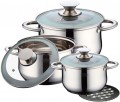 | 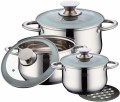 |
|---|---|---|
| Peterhof PH-15259 | Peterhof PH-15728 | |
| Outdated Product | from $26.32 | |
| TOP sellers | ||
| Type | set of dishes | set of dishes |
| Main items | 3 | 3 |
| In box | stand | stand |
Specs | ||
| Size | 18 cm 20 cm 22 cm | 16 cm 18 cm 20 cm |
| Volume | 2.9 L 3.9 L 5.1 L | 2.1 L 2.9 L 3.9 L |
| Non-stick coating | in absent | in absent |
More features | ||
| Features | induction compatible dishwasher compatible oven use steam hole layered bottom | induction compatible dishwasher compatible oven use steam hole layered bottom |
| Material | steel | steel |
| Lid material | glass | glass |
| Handles | metal | metal |
| Country of origin | Austria | Austria |
| Added to E-Catalog | june 2017 | march 2017 |


Compare Peterhof PH-15259 and PH-15728
You may be interested in
My comparisons
Peterhof PH-15728 often compared


Glossary
Size
The size of a pan is indicated by its diameter ( for round pans) or width ( for square pans). For sets containing objects of different sizes, values for all objects are given in this paragraph.
The volume of the pan directly depends on the size (see below). At the same time, it is also determined by depth; In fact, this means that dishes with the same capacity can vary in size. In such cases, when choosing, it is worth considering that a wider pan heats up faster and more evenly, but requires a larger burner. Actually, the size of the pan should not be less than the size of the burner; this is especially important if you plan to use the dishes on an electric stove.
The smallest pans, sold individually, are 16 cm or less in size, in the largest this figure can exceed 25 cm. As for sets, their sizes can be quite varied: in the smallest sets, the diameter of the largest pan is less than 20 cm(although other types of dishes can be larger), in the largest sets, the size is the same 20 cm(or even more) has the smallest pan.
The volume of the pan directly depends on the size (see below). At the same time, it is also determined by depth; In fact, this means that dishes with the same capacity can vary in size. In such cases, when choosing, it is worth considering that a wider pan heats up faster and more evenly, but requires a larger burner. Actually, the size of the pan should not be less than the size of the burner; this is especially important if you plan to use the dishes on an electric stove.
The smallest pans, sold individually, are 16 cm or less in size, in the largest this figure can exceed 25 cm. As for sets, their sizes can be quite varied: in the smallest sets, the diameter of the largest pan is less than 20 cm(although other types of dishes can be larger), in the largest sets, the size is the same 20 cm(or even more) has the smallest pan.
Volume
Working volume (capacity) of the pan. For sets (see "Type"), which include dishes of different sizes, values are given in this paragraph for all items.
A large volume allows you to cook a large amount of product at a time, but it affects the dimensions and weight of the pan. Therefore, the optimal capacity for different cases will also be different — depending on the amount of cooking and the type of dish. So, for classic pots, 3 – 4 L is considered a universal option: in such dishes it is convenient to cook soups and compotes for an average family. Models with a capacity of 2 – 3 liters are also popular — they are convenient for cooking side dishes, as well as small amounts of cooking (for 1 – 2 people). The smallest pans have a volume of less than 1 liter, they are suitable, in particular, for boiling eggs and heating milk. And the largest ones contain more than 10 liters, such dishes are designed mainly for catering and public events.
There are also more detailed recommendations on the choice of volume, including for other types of dishes — ladles, milk jugs, etc. (see "Type"); these recommendations can be found in special sources.
A large volume allows you to cook a large amount of product at a time, but it affects the dimensions and weight of the pan. Therefore, the optimal capacity for different cases will also be different — depending on the amount of cooking and the type of dish. So, for classic pots, 3 – 4 L is considered a universal option: in such dishes it is convenient to cook soups and compotes for an average family. Models with a capacity of 2 – 3 liters are also popular — they are convenient for cooking side dishes, as well as small amounts of cooking (for 1 – 2 people). The smallest pans have a volume of less than 1 liter, they are suitable, in particular, for boiling eggs and heating milk. And the largest ones contain more than 10 liters, such dishes are designed mainly for catering and public events.
There are also more detailed recommendations on the choice of volume, including for other types of dishes — ladles, milk jugs, etc. (see "Type"); these recommendations can be found in special sources.