
Comparison Waterpik Cordless Plus WP-450 vs Waterpik WP-100 E2 Ultra
Add to comparison | 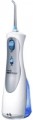 | 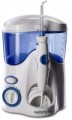 |
|---|---|---|
| Waterpik Cordless Plus WP-450 | Waterpik WP-100 E2 Ultra | |
| Compare prices 3 | Compare prices 1 | |
| User reviews | ||
| TOP sellers | ||
| Type | irrigator | irrigator |
| Nozzles | 4 no. standard (single jet) orthodontic (for braces) for implants | 6 no. standard (single jet) orthodontic (for braces) periodontological (pocket cleaning) for implants brush attachment 1 pc |
| Model of replaceable nozzle | JT-100E, OD-100E, PS-100E | JT-100E, PP-100E, OD-100E, PS-100E, TB-100E |
Specs | ||
| Intensity modes | 2 | 10 |
| Pulsation rate | 1.45 thousand/min | 1.4 thousand/min |
| Irrigator pressure | 30 – 75 PSI | 10 – 100 PSI |
| Water tank capacity | 210 ml | 650 ml |
Power supply | ||
| Power source | rechargeable battery | network |
General | ||
| Nozzle compartment |  |  |
| Dimensions | 210x100x70 mm | 210x145x125 mm |
| Weight | 675 g | |
| Color | ||
| Added to E-Catalog | august 2014 | august 2014 |




Compare Waterpik Cordless Plus WP-450 and WP-100 E2 Ultra
Price comparison
You may be interested in
My comparisons
Waterpik Cordless Plus WP-450 often compared


Waterpik WP-100 E2 Ultra often compared


Glossary
Nozzles
No translation necessary.
Model of replaceable nozzle
The model designation helps you find the right replacement tip without the risk of incompatibility with the irrigator handle. Unlike the tip type, which describes its purpose, the model indicates the specific series or item number of the product. This parameter is especially useful when purchasing additional standard, orthodontic, or periodontal tips.
Intensity modes
The number of intensity levels indicates how precisely the water pressure can be adjusted to match gum sensitivity and specific tasks. Low values are suitable for getting used to the irrigator and gentle treatment, while high values are for more intensive cleaning of food residues from between teeth. Intensity should not be confused with cleaning modes, which alter the nature of pulsations or the water delivery algorithm.
Pulsation rate
The number of pulsations per minute indicates the rhythm of the water jet's impact on teeth and gums. Frequent impulses sequentially loosen and wash away impurities, and the flow feels more continuous and gentle. However, for example, 1800 pulsations per minute are not necessarily more effective than 1200, as the result also depends on the water jet's strength, the nozzle, and the irrigator's design.
Irrigator pressure
The irrigator pressure determines the force of the water jet and directly affects cleaning intensity. Values around 20–40 PSI are suitable for getting used to the device and gentle care, while 70–100 PSI provides more powerful rinsing of hard-to-reach areas. A wide range allows you to select a comfortable flow strength for gums, implants, braces, and different nozzles.
Water tank capacity
The reservoir capacity directly affects the duration of irrigation without refilling. About 200 ml is usually sufficient for a short daily procedure, 300-400 ml for a more thorough cleaning of the entire oral cavity, and a capacity of 500 ml is convenient for braces, extended care, or use by multiple family members. The actual consumption also depends on the pressure, selected nozzle, and jet speed.
Power source
— Battery. A rechargeable power source provides portable operation without constant connection to a power outlet. This is the most convenient option for bathrooms and travel, but the device needs to be recharged periodically, and over time, the battery capacity may decrease.
— Mains. Power from the outlet is mainly characteristic of stationary irrigators with a separate reservoir. They can maintain a stable water pressure for a long time, but are not suitable for autonomous use and require safe placement near a power source.
— Batteries. Replaceable power elements make the irrigator independent of the charger and power grid. They are convenient to replace on the go, but with frequent use, this method becomes more expensive than a battery and creates additional consumables. Such models can be counted on the fingers of one hand.
— Mains. Power from the outlet is mainly characteristic of stationary irrigators with a separate reservoir. They can maintain a stable water pressure for a long time, but are not suitable for autonomous use and require safe placement near a power source.
— Batteries. Replaceable power elements make the irrigator independent of the charger and power grid. They are convenient to replace on the go, but with frequent use, this method becomes more expensive than a battery and creates additional consumables. Such models can be counted on the fingers of one hand.
Nozzle compartment
Attachment compartment is a built-in storage space for interchangeable water flosser tips. It helps keep them close to the device, protects them from dust, and reduces the risk of loss. Tips are stored more neatly in closed compartments; however, after use, it is advisable to rinse and dry them beforehand.