
Comparison Husqvarna 440 e 15 vs Husqvarna 445 e 15
Add to comparison | 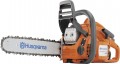 | 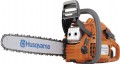 |
|---|---|---|
| Husqvarna 440 e 15 | Husqvarna 445 e 15 | |
from $30.95 | from $75.95 | |
| User reviews | ||
| TOP sellers | ||
| Product type | chainsaw | chainsaw |
| Type | portable | portable |
| Power source | petrol engine | petrol engine |
Motor | ||
| Engine size | 40.9 cm³ | 45.7 cm³ |
| Power | 1800 W | 2100 W |
| Power | 2.45 hp | 2.86 hp |
| Idle speed | 2900 rpm | 2500 rpm |
Cutting equipment | ||
| Bar/blade size | 380 mm | 380 mm |
| Chain pitch | 0.325 " | 0.325 " |
| Chain speed | 17 m/s | 17 m/s |
Protective functions | ||
| Chain brake |  | |
| Anti-vibration system | | |
Features | ||
| Features | keyless chain tension keyless blade replacement | keyless chain tension keyless blade replacement |
General | ||
| Noise level | 114 dB | 114 dB |
| Fuel tank volume | 0.37 L | 0.45 L |
| Oil tank volume | 0.25 L | 0.26 L |
| Weight | 4.4 kg | 5.1 kg |
| Added to E-Catalog | october 2017 | december 2009 |


Compare Husqvarna 440 e 15 and 445 e 15
Models Husqvarna 440 e 15 and Husqvarna 445 e 15 are gasoline chain saws with similar characteristics, yet they have key differences. The Husqvarna 440 e 15 has an engine displacement of 40.9 cm³ and a power output of 2.45 HP, while the Husqvarna 445 e 15 is equipped with a more powerful engine with a displacement of 45.7 cm³ and a power output of 2.86 HP. This makes the 445 e more suitable for heavier tasks. It is also worth noting that the fuel tank volume of the 445 e is 0.45 L, which is slightly larger than the 440 e with 0.37 L. Both devices have the same bar size of 380 mm and a chain speed of 17 m/s, as well as features such as a chain brake and an anti-vibration system. The weight of the 440 e is 4.4 kg, whereas the 445 e weighs 5.1 kg, which should also be considered when making a choice.
You may be interested in
My comparisons
Husqvarna 440 e 15 often compared


Glossary
Engine size
The volume of the engine of a gasoline saw (see "Power source"). On the one hand, the power and performance of the tool depend on this indicator, on the other hand, its weight, price and fuel consumption. Accordingly, it is necessary to choose a model taking into account the specifics of the planned work, and it does not always make sense to chase large volumes. In particular, for simple household tasks, an engine capacity of about 40 – 50 cm3 is considered quite sufficient, and in professional models this figure can exceed 100 cm3. More detailed selection recommendations can be found in special sources.
Power
Saw motor power in watts. For petrol tools (see "Power Source"), horsepower is additionally indicated, see below for details.
The higher the power, the better the tool is suitable for voluminous work and hard materials, the greater the depth of cut it can provide and the easier it can cope with significant loads. In addition, for different types of saws and different types of materials, the actual power values \u200b\u200bcan also be different. For example, a power of 2.5 – 3 kW is actually the limit for chain saws, but in chain saws this is an average figure, among such tools there are models of 3 – 4 kW and even more. Detailed selection recommendations for various cases can be found in special sources.
The higher the power, the better the tool is suitable for voluminous work and hard materials, the greater the depth of cut it can provide and the easier it can cope with significant loads. In addition, for different types of saws and different types of materials, the actual power values \u200b\u200bcan also be different. For example, a power of 2.5 – 3 kW is actually the limit for chain saws, but in chain saws this is an average figure, among such tools there are models of 3 – 4 kW and even more. Detailed selection recommendations for various cases can be found in special sources.
Power
The power of the saw engine expressed in horsepower (hp). This designation is traditionally used in gasoline models (see "Power Source") along with watts; 1 HP ≈ 735 W.
For more information about power, see the paragraph of the same name above.
For more information about power, see the paragraph of the same name above.
Idle speed
The speed of rotation of the engine in a saw with an internal combustion engine (see "Power") with no load on the blade and with the speed controller fully released (set to minimum). Theoretically, the lower the idle speed, the lower the fuel consumption without load (ceteris paribus); however, the difference between modern chainsaws is usually so insignificant that this parameter is more of a reference than a real practical value.
Fuel tank volume
The volume of the fuel tank in saws with a petrol engine (see "Power source"). A volume tank, on the one hand, allows the device to work for a long time without refueling, on the other hand, it seriously affects the weight and dimensions. The latter is not critical for stationary units (see "Type"), but it is very important for portable equipment — and the vast majority of chainsaws and power cutters are made portable. And taking into account the fact that refueling usually does not cause any particular difficulties, it does not make sense to equip hand tools with capacious tanks, therefore this volume is small in such saws.
Oil tank volume
The volume of the oil tank provided in the tool.
In this case, we mean a tank from which oil is supplied to the saw chain (see "Device") to lubricate it during operation. In general, this is a reference parameter that allows you to estimate how much oil is needed for one refueling of the tool.
In this case, we mean a tank from which oil is supplied to the saw chain (see "Device") to lubricate it during operation. In general, this is a reference parameter that allows you to estimate how much oil is needed for one refueling of the tool.
Weight
The total weight of the tool. For petrol models (see "Power Source"), usually, dry weight is indicated, excluding fuel.
In general, it makes sense to pay attention to this parameter primarily when choosing a hand tool. At the same time, note that higher power, a more capacious battery or a capacious tank will inevitably affect weight. However, tools with similar characteristics can and do differ markedly in weight. And here it is worth considering that a lighter model will be more comfortable to work with, but weight reduction may affect reliability and/or cost. In addition, a more massive tool is more stable, it is not so prone to jerks under uneven loads. If we talk about specific numbers, then a weight of 3 kg or less is considered very light, 3–5 kg is relatively small, 5–7 kg is medium, 7–10 kg is significant, and some powerful tools (mainly gasoline) weigh and over 10 kg.
As for stationary saws, weight is of secondary importance for them — it mainly affects the ease of transportation.
In general, it makes sense to pay attention to this parameter primarily when choosing a hand tool. At the same time, note that higher power, a more capacious battery or a capacious tank will inevitably affect weight. However, tools with similar characteristics can and do differ markedly in weight. And here it is worth considering that a lighter model will be more comfortable to work with, but weight reduction may affect reliability and/or cost. In addition, a more massive tool is more stable, it is not so prone to jerks under uneven loads. If we talk about specific numbers, then a weight of 3 kg or less is considered very light, 3–5 kg is relatively small, 5–7 kg is medium, 7–10 kg is significant, and some powerful tools (mainly gasoline) weigh and over 10 kg.
As for stationary saws, weight is of secondary importance for them — it mainly affects the ease of transportation.