
Comparison Daewoo DACS5218 vs Daewoo DACS5820XT
Add to comparison | 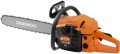 | 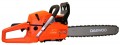 |
|---|---|---|
| Daewoo DACS5218 | Daewoo DACS5820XT | |
from $147.60 up to $167.80 | from $191.00 up to $259.60 | |
| User reviews | ||
| TOP sellers | ||
| Product type | chainsaw | chainsaw |
| Type | portable | portable |
| Power source | petrol engine | petrol engine |
Motor | ||
| Engine size | 52 cm³ | 58 cm³ |
| Power | 2600 W | 3300 W |
| Power | 3.53 hp | 4.5 hp |
| No load speed | 10800 rpm | 10600 rpm |
Cutting equipment | ||
| Bar/blade size | 450 mm | 500 mm |
| Chain pitch | 0.325 " | 0.325 " |
Protective functions | ||
| Chain brake |  | |
| Anti-vibration system | | |
General | ||
| Fuel tank volume | 0.55 L | 0.55 L |
| Oil tank volume | 0.31 L | 0.26 L |
| Size | 535x300x285 mm | |
| Weight | 6.3 kg | 7.5 kg |
| Added to E-Catalog | november 2015 | february 2015 |


Compare Daewoo DACS5218 and DACS5820XT
You may be interested in
My comparisons
Daewoo DACS5218 often compared

Glossary
Engine size
The volume of the engine of a gasoline saw (see "Power source"). On the one hand, the power and performance of the tool depend on this indicator, on the other hand, its weight, price and fuel consumption. Accordingly, it is necessary to choose a model taking into account the specifics of the planned work, and it does not always make sense to chase large volumes. In particular, for simple household tasks, an engine capacity of about 40 – 50 cm3 is considered quite sufficient, and in professional models this figure can exceed 100 cm3. More detailed selection recommendations can be found in special sources.
Power
Saw motor power in watts. For petrol tools (see "Power Source"), horsepower is additionally indicated, see below for details.
The higher the power, the better the tool is suitable for voluminous work and hard materials, the greater the depth of cut it can provide and the easier it can cope with significant loads. In addition, for different types of saws and different types of materials, the actual power values \u200b\u200bcan also be different. For example, a power of 2.5 – 3 kW is actually the limit for chain saws, but in chain saws this is an average figure, among such tools there are models of 3 – 4 kW and even more. Detailed selection recommendations for various cases can be found in special sources.
The higher the power, the better the tool is suitable for voluminous work and hard materials, the greater the depth of cut it can provide and the easier it can cope with significant loads. In addition, for different types of saws and different types of materials, the actual power values \u200b\u200bcan also be different. For example, a power of 2.5 – 3 kW is actually the limit for chain saws, but in chain saws this is an average figure, among such tools there are models of 3 – 4 kW and even more. Detailed selection recommendations for various cases can be found in special sources.
Power
The power of the saw engine expressed in horsepower (hp). This designation is traditionally used in gasoline models (see "Power Source") along with watts; 1 HP ≈ 735 W.
For more information about power, see the paragraph of the same name above.
For more information about power, see the paragraph of the same name above.
No load speed
The highest speed that the saw engine is capable of delivering in normal operation.
We emphasize that this parameter should not be confused with the maximum disk speed (see below) — here we are talking exclusively about the speed of rotation of the motor shaft. It can be specified for all types of saws, not only for models using discs. However, in general, engine speed is more of a reference than really significant information. In fact, it is needed mainly for some specific tool maintenance tasks; when choosing, it is better to focus on indicators that are more “close to life” — engine power, cutting depth, chain / tape speed or disk speed, etc.
We emphasize that this parameter should not be confused with the maximum disk speed (see below) — here we are talking exclusively about the speed of rotation of the motor shaft. It can be specified for all types of saws, not only for models using discs. However, in general, engine speed is more of a reference than really significant information. In fact, it is needed mainly for some specific tool maintenance tasks; when choosing, it is better to focus on indicators that are more “close to life” — engine power, cutting depth, chain / tape speed or disk speed, etc.
Bar/blade size
The largest tyre size (in chain saws) or disc (in circular saws and some others, see "Device") that is allowed for this tool. Tyres are sized by working length, rims by diameter.
A larger bar/wheel allows for deeper cuts but requires more powerful motors. Therefore, this parameter cannot be exceeded — this can lead to an overload of the engine with all the corresponding troubles. However, in many models with a disc it is physically impossible to install a nozzle with a diameter larger than the maximum allowable.
Also note that saws with similar bar/blade sizes may differ in maximum depth of cut (mostly due to differences in design or power). As for the specific dimensions, they depend on the type of saw (see "Device"). For example, large discs of 450 – 500 mm are found exclusively in stationary chain saws, the maximum figure for cutting models is 400 – 450 mm, for trimming — 300 – 350 mm, and sizes of 500 – 550 mm or more clearly indicate that speech It's about a chainsaw chainsaw bar. Detailed recommendations regarding the choice of a tool for a given size can be found in special sources.
A larger bar/wheel allows for deeper cuts but requires more powerful motors. Therefore, this parameter cannot be exceeded — this can lead to an overload of the engine with all the corresponding troubles. However, in many models with a disc it is physically impossible to install a nozzle with a diameter larger than the maximum allowable.
Also note that saws with similar bar/blade sizes may differ in maximum depth of cut (mostly due to differences in design or power). As for the specific dimensions, they depend on the type of saw (see "Device"). For example, large discs of 450 – 500 mm are found exclusively in stationary chain saws, the maximum figure for cutting models is 400 – 450 mm, for trimming — 300 – 350 mm, and sizes of 500 – 550 mm or more clearly indicate that speech It's about a chainsaw chainsaw bar. Detailed recommendations regarding the choice of a tool for a given size can be found in special sources.
Oil tank volume
The volume of the oil tank provided in the tool.
In this case, we mean a tank from which oil is supplied to the saw chain (see "Device") to lubricate it during operation. In general, this is a reference parameter that allows you to estimate how much oil is needed for one refueling of the tool.
In this case, we mean a tank from which oil is supplied to the saw chain (see "Device") to lubricate it during operation. In general, this is a reference parameter that allows you to estimate how much oil is needed for one refueling of the tool.
Size
General dimensions of the saw. For a stationary tool (see "Type"), this parameter determines primarily the amount of space that will be required for installation; problems with this can only arise in very tight spaces, so in most cases the dimensions of a stationary saw do not need to be given special attention. In the case of hand-held models, the small size makes it easier to work in hard-to-reach places and improves overall usability. On the other hand, a compact tool inevitably turns out to be low-power; and some jobs by definition require large, heavy saws, with large bar lengths or blade diameters.
Weight
The total weight of the tool. For petrol models (see "Power Source"), usually, dry weight is indicated, excluding fuel.
In general, it makes sense to pay attention to this parameter primarily when choosing a hand tool. At the same time, note that higher power, a more capacious battery or a capacious tank will inevitably affect weight. However, tools with similar characteristics can and do differ markedly in weight. And here it is worth considering that a lighter model will be more comfortable to work with, but weight reduction may affect reliability and/or cost. In addition, a more massive tool is more stable, it is not so prone to jerks under uneven loads. If we talk about specific numbers, then a weight of 3 kg or less is considered very light, 3–5 kg is relatively small, 5–7 kg is medium, 7–10 kg is significant, and some powerful tools (mainly gasoline) weigh and over 10 kg.
As for stationary saws, weight is of secondary importance for them — it mainly affects the ease of transportation.
In general, it makes sense to pay attention to this parameter primarily when choosing a hand tool. At the same time, note that higher power, a more capacious battery or a capacious tank will inevitably affect weight. However, tools with similar characteristics can and do differ markedly in weight. And here it is worth considering that a lighter model will be more comfortable to work with, but weight reduction may affect reliability and/or cost. In addition, a more massive tool is more stable, it is not so prone to jerks under uneven loads. If we talk about specific numbers, then a weight of 3 kg or less is considered very light, 3–5 kg is relatively small, 5–7 kg is medium, 7–10 kg is significant, and some powerful tools (mainly gasoline) weigh and over 10 kg.
As for stationary saws, weight is of secondary importance for them — it mainly affects the ease of transportation.