
Comparison MOBICOOL G26 AC/DC vs Ezetil E 32
Add to comparison | 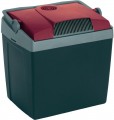 |  |
|---|---|---|
| MOBICOOL G26 AC/DC | Ezetil E 32 | |
| Outdated Product | from $104.80 up to $123.84 | |
| TOP sellers | ||
| Type | cooling box | cooling box |
| Principle of operation | thermoelectric | thermoelectric |
| Volume | 26 L | 32 L |
| Operation mode | cooling | cooling |
Specs | ||
| Max. cooling at | 20 °C | 20 °C |
| Min. cooling temperature | 5 °C | 5 °C |
| Сooling energy consumption | 48 W | |
| Features | built-in fan | built-in fan |
General specs | ||
| Supply voltage | 12/230 В | 12 В |
| Size (HxWxD) | 40x40x30 cm | 44x38x27 cm |
| Weight | 4 kg | 4.5 kg |
| Added to E-Catalog | may 2013 | july 2011 |


Compare MOBICOOL G26 AC/DC and Ezetil E 32
You may be interested in
MOBICOOL G26 AC/DC often compared


Ezetil E 32 often compared


Glossary
Volume
The volume of the working chamber of the car refrigerator. The larger the volume, the more products can be loaded into the unit at a time. When choosing according to this parameter, it makes sense to select a model with a margin, because it is not recommended to load products too tightly — this adversely affects the quality of the device. On the other hand, note that the volumetric container and dimensions will have the appropriate ones.
Сooling energy consumption
The power consumed by the refrigerator when operating in cooling mode. The greater this power, the more performant the refrigerator is, usually, and the less time it takes to cool the product. On the other hand, note that more power means more power consumption — which can be critical, for example, during long-term operation from a car battery (that is, when the car engine is turned off).
Supply voltage
The supply voltage for which the car refrigerator is designed. There are several standard options:
— 12 V Standard voltage of the on-board mains of passenger cars, as well as many minibuses and light trucks. Supported by most modern car refrigerators.
— 24 V Standard voltage of the on-board mains of buses, heavy trucks and other large equipment; also found in some SUVs. Car refrigerators "only for 24 V" are almost never produced; as a rule, this option is provided in addition to 12 V.
— 230 V Powered by a standard household outlet. Usually a backup option, in case the refrigerator needs to be turned on outside the car for a while — for example, to pre-cool before a trip. In addition, units with such power can be used as an improvised replacement for a stationary refrigerator — for example, when going to the country, where there is no permanent refrigerator.
— 12 V Standard voltage of the on-board mains of passenger cars, as well as many minibuses and light trucks. Supported by most modern car refrigerators.
— 24 V Standard voltage of the on-board mains of buses, heavy trucks and other large equipment; also found in some SUVs. Car refrigerators "only for 24 V" are almost never produced; as a rule, this option is provided in addition to 12 V.
— 230 V Powered by a standard household outlet. Usually a backup option, in case the refrigerator needs to be turned on outside the car for a while — for example, to pre-cool before a trip. In addition, units with such power can be used as an improvised replacement for a stationary refrigerator — for example, when going to the country, where there is no permanent refrigerator.