
Comparison AKG P5 S vs AKG P3 S
Add to comparison | 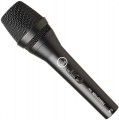 | 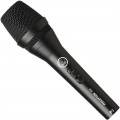 |
|---|---|---|
| AKG P5 S | AKG P3 S | |
| Compare prices 1 | Compare prices 3 | |
| TOP sellers | ||
| Microphone | vocal | vocal |
| Operating principle | dynamic | dynamic |
Specs | ||
| Microphone directivity | unidirectional | unidirectional |
| Directional pattern | supercardioid | cardioid |
| Rated resistance | 580 Ohm | |
| Frequency range | 40 – 20000 Hz | 40 – 20000 Hz |
| Sensitivity | -52 dB | -52 dB |
| Sound pressure | 144 dB | 144 dB |
Functions and connectors | ||
| Features | mute button | mute button |
| Connection | XLR | XLR |
General | ||
| Material | metal | metal |
| Size | 190x51x51 mm | 190x51x51 mm |
| Weight | 320 g | 320 g |
| In box | rack holder case | rack holder case |
| Color | ||
| Added to E-Catalog | march 2015 | march 2015 |



Compare AKG P5 S and P3 S
Microphones AKG P5 S and AKG P3 S have similar characteristics such as a frequency range from 40 to 20000 Hz, unidirectional design, and metal casing. However, the P5 S has a supercardioid polar pattern, providing better sound isolation, while the P3 S uses a cardioid pattern. Both microphones have an XLR connector and a mute function, but the P5 S may be preferred for professional use due to its directivity.
You may be interested in
My comparisons
AKG P5 S often compared


AKG P3 S often compared

Glossary
Directional pattern
The polar pattern of a unidirectional microphone (see above). There are models with DN switching.
By itself, such a diagram is a graph of sensitivity versus direction, built in the so-called polar coordinate system. For unidirectional models, there are three main options for the shape of the line on such a chart:
— Cardioid. A chart shaped like an inverted heart symbol (hence the name). Microphones with these characteristics cover a fairly large area in front, which makes it difficult to filter out extraneous sound sources that are close to the main source. At the same time, they are completely insensitive to sound coming from the rear.
— Supercardioid. These mics have a narrower front coverage than "classic" cardioid mics, making it easier to pick up directional sound. The downside of this is some (albeit rather low) sensitivity to sound coming directly from behind.
— Hypercardioid. The hypercardioid pattern further narrows the microphone's sensitivity zone in the front (compared to the supercardioid pattern), but widens this zone in the back.
By itself, such a diagram is a graph of sensitivity versus direction, built in the so-called polar coordinate system. For unidirectional models, there are three main options for the shape of the line on such a chart:
— Cardioid. A chart shaped like an inverted heart symbol (hence the name). Microphones with these characteristics cover a fairly large area in front, which makes it difficult to filter out extraneous sound sources that are close to the main source. At the same time, they are completely insensitive to sound coming from the rear.
— Supercardioid. These mics have a narrower front coverage than "classic" cardioid mics, making it easier to pick up directional sound. The downside of this is some (albeit rather low) sensitivity to sound coming directly from behind.
— Hypercardioid. The hypercardioid pattern further narrows the microphone's sensitivity zone in the front (compared to the supercardioid pattern), but widens this zone in the back.
Rated resistance
Microphone AC impedance; this parameter is also called "impedance". This is one of the most important characteristics that determines compatibility with the amplifier or other device to which the microphone is connected: if the impedance is not optimal, there may be a loss in signal power. It has its own characteristics, depending on the purpose of a particular model (see above). So, for microphones used with computers, laptops, voice recorders and phones / tablets, the impedance may not be indicated at all — the characteristics of such models are selected in such a way as to ensure normal compatibility with the corresponding devices. But in professional audio equipment, special rules are used for selection; more details can be found in special sources.