
Comparison Fosi Audio DAC-Q5 vs Fosi Audio DAC-Q4
Add to comparison |  | 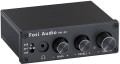 |
|---|---|---|
| Fosi Audio DAC-Q5 | Fosi Audio DAC-Q4 | |
| Outdated Product | Compare prices 3 | |
| TOP sellers | ||
| Type | DAC | DAC |
| DAC | ESS9018K2M | |
| Number of channels | 2 шт | 2 шт |
Specs | ||
| DAC sampling frequency | 192 kHz | 192 kHz |
| DAC bit depth | 24 bit | 24 bit |
| Frequency range | 10 – 20000 Hz | 20 – 20000 Hz |
| Signal to noise ratio | 110 dB | 105 dB |
| Coef. harmonic distortion | 0.002 % | 0.01 % |
Features | ||
| Functions | level adjustment | bass control treble adjustment level adjustment |
| More features | Mac | Mac |
Connectors | ||
| Inputs | coaxial S/PDIF optical USB-B | coaxial S/PDIF optical USB-B |
| Outputs | RCA | RCA |
| Headphone outputs | 1x mini-Jack (3.5 mm) 1x Jack (6.35 mm) | 1x mini-Jack (3.5 mm) |
General | ||
| Power supply | power through mount | power through mount |
| Dimensions (WxDxH) | 98x165x35 mm | 98x73x33 mm |
| Weight | 400 g | |
| Added to E-Catalog | november 2024 | november 2024 |





Compare Fosi Audio DAC-Q5 and DAC-Q4
Price comparison
You may be interested in
My comparisons
Fosi Audio DAC-Q5 often compared

Fosi Audio DAC-Q4 often compared
Glossary
DAC
Model of the digital-to-analogue converter installed in the device.
DAC in this case means the “heart” of the device, the main circuit that directly provides the conversion of digital audio to analogue. The name of the DAC model is given mainly for advertising purposes — as an illustration of the fact that high-quality components are used in the device. In addition, knowing the model, you can find detailed information about a particular DAC; although in fact such a need does not arise often, it may still arise in some specific cases.
DAC in this case means the “heart” of the device, the main circuit that directly provides the conversion of digital audio to analogue. The name of the DAC model is given mainly for advertising purposes — as an illustration of the fact that high-quality components are used in the device. In addition, knowing the model, you can find detailed information about a particular DAC; although in fact such a need does not arise often, it may still arise in some specific cases.
Frequency range
The audio frequency range supported by the device. Most often, we are talking about the frequency range that the device can output in an analogue audio signal at the output.
In general, the wider the frequency range — the fuller the sound, the lower the likelihood that the transducer will “cut off” the upper or lower frequencies. However, note that the human ear is able to hear sounds at frequencies from 16 to 22,000 Hz, and the upper limit decreases with age. So from a practical point of view, it does not make sense to provide a wider range in audio technology. And the impressive numbers found in high-end devices (for example, 1 – 50,000 Hz) are more of a "side effect" of advanced electronic circuits and are given in the characteristics mainly for the purpose of advertising. Also recall that the overall sound quality is affected by many other factors, in addition to the frequency range.
In general, the wider the frequency range — the fuller the sound, the lower the likelihood that the transducer will “cut off” the upper or lower frequencies. However, note that the human ear is able to hear sounds at frequencies from 16 to 22,000 Hz, and the upper limit decreases with age. So from a practical point of view, it does not make sense to provide a wider range in audio technology. And the impressive numbers found in high-end devices (for example, 1 – 50,000 Hz) are more of a "side effect" of advanced electronic circuits and are given in the characteristics mainly for the purpose of advertising. Also recall that the overall sound quality is affected by many other factors, in addition to the frequency range.
Signal to noise ratio
The signal-to-noise ratio provided by the converter.
This parameter describes the ratio of the volume of the pure sound produced by the device to the volume of its own noise (which is inevitably created by any electronic device). Thus, the higher the signal-to-noise ratio, the clearer the sound, the less the DAC's own noise affects the audio signal. Indicators up to 80 dB can be considered acceptable, up to 100 dB — not bad, 100 – 120 dB — good, more than 120 dB — excellent. However, it is worth remembering that the overall sound quality is affected not only by this parameter, but also by many others.
Note that the signal-to-noise ratio is often associated with such a characteristic as the dynamic range (see above). They are similar in general meaning, both describe the difference between an extraneous background and a useful signal. However, the noise level in the calculations is taken differently: for the signal-to-noise ratio, the background of the converter “at idle” is taken into account, and for the dynamic range, the noise that occurs when a low-level signal is output. This is the reason for the difference in numbers.
This parameter describes the ratio of the volume of the pure sound produced by the device to the volume of its own noise (which is inevitably created by any electronic device). Thus, the higher the signal-to-noise ratio, the clearer the sound, the less the DAC's own noise affects the audio signal. Indicators up to 80 dB can be considered acceptable, up to 100 dB — not bad, 100 – 120 dB — good, more than 120 dB — excellent. However, it is worth remembering that the overall sound quality is affected not only by this parameter, but also by many others.
Note that the signal-to-noise ratio is often associated with such a characteristic as the dynamic range (see above). They are similar in general meaning, both describe the difference between an extraneous background and a useful signal. However, the noise level in the calculations is taken differently: for the signal-to-noise ratio, the background of the converter “at idle” is taken into account, and for the dynamic range, the noise that occurs when a low-level signal is output. This is the reason for the difference in numbers.
Coef. harmonic distortion
The coefficient of harmonic distortion produced by the converter during operation.
The lower this indicator, the clearer the sound produced by the device is, the less distortion is introduced into the audio signal. It is impossible to completely avoid such distortions, but it is possible to reduce them to a level that is not perceived by a person. It is believed that the human ear does not hear harmonics, the level of which is 0.5% and below. However, in high-end audio applications, distortion rates can be much lower — 0.005%, 0.001% or even less. This makes quite a practical sense: the distortions from the individual components of the system are summed up, and the lower the harmonic coefficient of each component, the less distortion there will be in the audible sound as a result.
The lower this indicator, the clearer the sound produced by the device is, the less distortion is introduced into the audio signal. It is impossible to completely avoid such distortions, but it is possible to reduce them to a level that is not perceived by a person. It is believed that the human ear does not hear harmonics, the level of which is 0.5% and below. However, in high-end audio applications, distortion rates can be much lower — 0.005%, 0.001% or even less. This makes quite a practical sense: the distortions from the individual components of the system are summed up, and the lower the harmonic coefficient of each component, the less distortion there will be in the audible sound as a result.
Functions
Adjustments provided directly in the device.
— Bass adjustment. Separate bass level control; usually combined with treble control (see below). This function allows you to change the sound image by adjusting the volume of the bass sound relative to the rest of the frequency range.
— Treble adjustment. Separate treble control. Like the bass adjustment described above, it allows you to adjust the sound picture — in this case, by changing the volume of high frequencies relative to the rest of the range.
— Balance adjustment. Adjusts the sound balance between two stereo channels by increasing the volume for one channel and decreasing the volume for the other. Due to this, in the perception of the listener, the sound "shifts" towards greater volume. This function is mainly used for correction purposes — for example, if the speakers are at different distances from the listener, shifting the balance towards the far speaker allows you to compensate for the difference in audible volume.
— Level adjustment. Adjusting the overall signal level at the output, in other words, adjusting the volume. Adjusting the volume using the DAC's own control is sometimes more convenient than accessing the settings of other components of the audio system.
— Headphone level adjustment.... Headphone sound volume adjustment. This control is provided mainly for user comfort, it allows you to set the sound level in the "ears" to your own preferences. This possibility is especially relevant in light of the fact that headphones are rarely equipped with their own volume controls (and usually these are inexpensive models with relatively low sound quality).
— Sensitivity adjustment. Adjustment of input sensitivity of the converter. This function is found mainly in models with analogue inputs: it allows you to amplify the incoming signal, if necessary, even before it is processed by the converter, if the initial signal level is too low.
— Bass adjustment. Separate bass level control; usually combined with treble control (see below). This function allows you to change the sound image by adjusting the volume of the bass sound relative to the rest of the frequency range.
— Treble adjustment. Separate treble control. Like the bass adjustment described above, it allows you to adjust the sound picture — in this case, by changing the volume of high frequencies relative to the rest of the range.
— Balance adjustment. Adjusts the sound balance between two stereo channels by increasing the volume for one channel and decreasing the volume for the other. Due to this, in the perception of the listener, the sound "shifts" towards greater volume. This function is mainly used for correction purposes — for example, if the speakers are at different distances from the listener, shifting the balance towards the far speaker allows you to compensate for the difference in audible volume.
— Level adjustment. Adjusting the overall signal level at the output, in other words, adjusting the volume. Adjusting the volume using the DAC's own control is sometimes more convenient than accessing the settings of other components of the audio system.
— Headphone level adjustment.... Headphone sound volume adjustment. This control is provided mainly for user comfort, it allows you to set the sound level in the "ears" to your own preferences. This possibility is especially relevant in light of the fact that headphones are rarely equipped with their own volume controls (and usually these are inexpensive models with relatively low sound quality).
— Sensitivity adjustment. Adjustment of input sensitivity of the converter. This function is found mainly in models with analogue inputs: it allows you to amplify the incoming signal, if necessary, even before it is processed by the converter, if the initial signal level is too low.
Headphone outputs
The total number of headphone outputs provided in the DAC design.
Most models are designed for individual use, but there are exceptions - you can find models with 2 or more outputs on sale. The general idea of such a design is obvious: it allows you to connect several headphones at once and use the DAC for several listeners at once.
However, not all connectors can be of the same type. Among them are the classic mini-Jack (3.5 mm) and Jack (6.35 mm), as well as the less popular XLR and 4.4 mm Pentaconn.
— mini-Jack (3.5 mm). The most popular plug format among modern wired headphones. It is found in models of all price categories; and even high-end solutions that allow use with a more advanced 6.35 mm Jack most often have not a built-in Jack format connector, but a 3.5 mm plug and a complete adapter to 6.35 mm. On the other hand, in terms of acoustic properties, the mini-Jack is somewhat inferior to its "big brother".
— 6.35 mm (Jack). The plug format is designed mainly for fairly advanced equipment, mainly stationary. The large size of the connector makes it somewhat difficult to use in compact devices; on the other hand, due to this feature, the quality of the connection, reliability and noise immunity are significantly higher than with a more miniature 3.5 mm mini-Jack. And you can connect headphon...es with a mini-Jack plug to a Jack-type socket using a simple adapter; often such an adapter is even supplied with the "ears".
— XLR. This is a connector for mainly professional use, with a characteristic round shape, pin-shaped contacts, and often a lock on the rim for additional reliability in connection. This connector is used for the so-called balanced connection of headphones, which has a positive effect on the purity of the sound and allows you to use even long wires without additional risk of distortion. On the other hand, in the case of headphones, the need for such a connection arises relatively rarely, and there are not many “ears” with an XLR plug - these are mainly high-end professional models. So in amplifiers, outputs of this type are mainly used in premium-level stationary devices. Most often, a four-pin connector is used as such an output, often without a lock and / or of reduced size. In general, this type of connector is less common in audio equipment than the three-pin type, but it is the standard option in headphones, especially since 4 pins allow both stereo channels to be output through one jack (while three-pin jacks operate in the “one channel per jack” format). However, there are models where the role of a balanced headphone output is played by a pair of three-pin XLRs. At the same time, such connectors can be physically combined with 6.35 mm Jack outputs — in other words, the 6.35 mm jack is built right into the center of the XLR connector. This makes the design more compact, but does not allow both types of connectors to be used simultaneously.
— Pentaconn 4.4. A connection implemented by a 5-pin connector with a diameter of 4.4 mm. This is a relatively new balanced connection standard developed by Sony. Most often used as a linear output for digital-to-analog converters and amplifiers. Additionally, this connector can be found in multimedia players and even console consoles. The main advantage of the Pentaconn 4.4 standard is the ability to output an audio signal to fairly powerful high-impedance headphones. This standard is an alternative to the not very practical Jack and XLR connections.
Most models are designed for individual use, but there are exceptions - you can find models with 2 or more outputs on sale. The general idea of such a design is obvious: it allows you to connect several headphones at once and use the DAC for several listeners at once.
However, not all connectors can be of the same type. Among them are the classic mini-Jack (3.5 mm) and Jack (6.35 mm), as well as the less popular XLR and 4.4 mm Pentaconn.
— mini-Jack (3.5 mm). The most popular plug format among modern wired headphones. It is found in models of all price categories; and even high-end solutions that allow use with a more advanced 6.35 mm Jack most often have not a built-in Jack format connector, but a 3.5 mm plug and a complete adapter to 6.35 mm. On the other hand, in terms of acoustic properties, the mini-Jack is somewhat inferior to its "big brother".
— 6.35 mm (Jack). The plug format is designed mainly for fairly advanced equipment, mainly stationary. The large size of the connector makes it somewhat difficult to use in compact devices; on the other hand, due to this feature, the quality of the connection, reliability and noise immunity are significantly higher than with a more miniature 3.5 mm mini-Jack. And you can connect headphon...es with a mini-Jack plug to a Jack-type socket using a simple adapter; often such an adapter is even supplied with the "ears".
— XLR. This is a connector for mainly professional use, with a characteristic round shape, pin-shaped contacts, and often a lock on the rim for additional reliability in connection. This connector is used for the so-called balanced connection of headphones, which has a positive effect on the purity of the sound and allows you to use even long wires without additional risk of distortion. On the other hand, in the case of headphones, the need for such a connection arises relatively rarely, and there are not many “ears” with an XLR plug - these are mainly high-end professional models. So in amplifiers, outputs of this type are mainly used in premium-level stationary devices. Most often, a four-pin connector is used as such an output, often without a lock and / or of reduced size. In general, this type of connector is less common in audio equipment than the three-pin type, but it is the standard option in headphones, especially since 4 pins allow both stereo channels to be output through one jack (while three-pin jacks operate in the “one channel per jack” format). However, there are models where the role of a balanced headphone output is played by a pair of three-pin XLRs. At the same time, such connectors can be physically combined with 6.35 mm Jack outputs — in other words, the 6.35 mm jack is built right into the center of the XLR connector. This makes the design more compact, but does not allow both types of connectors to be used simultaneously.
— Pentaconn 4.4. A connection implemented by a 5-pin connector with a diameter of 4.4 mm. This is a relatively new balanced connection standard developed by Sony. Most often used as a linear output for digital-to-analog converters and amplifiers. Additionally, this connector can be found in multimedia players and even console consoles. The main advantage of the Pentaconn 4.4 standard is the ability to output an audio signal to fairly powerful high-impedance headphones. This standard is an alternative to the not very practical Jack and XLR connections.