
Comparison UNI-T UT306C vs UNI-T UT300S
Add to comparison |  | 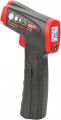 |
|---|---|---|
| UNI-T UT306C | UNI-T UT300S | |
| Compare prices 1 | Outdated Product | |
| TOP sellers | ||
| Design | gun | gun |
| Target designator | circular | single point |
Specs | ||
| Surface t measurements | -50 – 500 °C | -32 – 400 °C |
| Distance to spot ratio | 12 | 12 |
| Response time | 250 ms | 500 ms |
| Measurement accuracy | 2 °C | 2 °C |
| Measurement accuracy | 2 % | 2 % |
| Operating temperature | 0 – 50 °C | 0 – 40 °C |
| Functions | emissivity adjustment | emissivity adjustment |
General | ||
| Power source | 2xAAA | PP3 |
| Dimensions | 146x78x45 mm | 153x108x40 mm |
| Weight | 162 g | 185 g |
| Added to E-Catalog | july 2024 | december 2019 |



Compare UNI-T UT306C and UT300S
Price comparison
You may be interested in
My comparisons
UNI-T UT300S often compared

Glossary
Target designator
The type of laser designator provided in the design of the pyrometer.
The laser pointer allows you to see exactly where the device is directed and the temperature of which particular area it measures. The options could be:
— Single point. Target designator in the form of a single beam pointing to the centre of the measurement area. The simplest and cheapest option, however, not very accurate — in the sense that the user cannot accurately assess which area on the measured surface falls into the field of view of the pyrometer.
— Two-point. Target designator in the form of two beams pointing to points along the edges of the measurement area. The location of the points can be horizontal (left and right) or vertical (top and bottom). Anyway, such a target designator already allows you to determine the size of the area that falls into the field of view of the device. However, it costs a little more than a single-point one, and therefore is less common.
— Multi-point circular. Target designator in the form of several rays forming a circle of dots on the measured surface. This is the most complex and expensive, but also the most accurate option: the circle clearly shows the location and size of the measurement area.
— Missing. The complete absence of any target designat...or in the design; it is necessary to direct such a device "by eye". This option is found exclusively in individual models of the most compact devices, which, in principle, are not designed for measurements at long distances.
The laser pointer allows you to see exactly where the device is directed and the temperature of which particular area it measures. The options could be:
— Single point. Target designator in the form of a single beam pointing to the centre of the measurement area. The simplest and cheapest option, however, not very accurate — in the sense that the user cannot accurately assess which area on the measured surface falls into the field of view of the pyrometer.
— Two-point. Target designator in the form of two beams pointing to points along the edges of the measurement area. The location of the points can be horizontal (left and right) or vertical (top and bottom). Anyway, such a target designator already allows you to determine the size of the area that falls into the field of view of the device. However, it costs a little more than a single-point one, and therefore is less common.
— Multi-point circular. Target designator in the form of several rays forming a circle of dots on the measured surface. This is the most complex and expensive, but also the most accurate option: the circle clearly shows the location and size of the measurement area.
— Missing. The complete absence of any target designat...or in the design; it is necessary to direct such a device "by eye". This option is found exclusively in individual models of the most compact devices, which, in principle, are not designed for measurements at long distances.
Surface t measurements
The range of surface temperatures that the instrument can effectively measure.
In general, the meaning of this parameter is quite obvious. We only note that an extensive operating range is not always an advantage. First, it affects the cost of the device; secondly, when the range is extended, the measurement accuracy may deteriorate. So when choosing, you should not chase the maximum temperature range, but take into account real needs: for example, it hardly makes sense to choose a pyrometer with an upper limit of 500 °C for measuring the quality of thermal insulation and determining heat leaks in residential premises. It is conditionally possible to divide pyrometers into those that are for measuring low temperatures, and, accordingly, for high ones.
In general, the meaning of this parameter is quite obvious. We only note that an extensive operating range is not always an advantage. First, it affects the cost of the device; secondly, when the range is extended, the measurement accuracy may deteriorate. So when choosing, you should not chase the maximum temperature range, but take into account real needs: for example, it hardly makes sense to choose a pyrometer with an upper limit of 500 °C for measuring the quality of thermal insulation and determining heat leaks in residential premises. It is conditionally possible to divide pyrometers into those that are for measuring low temperatures, and, accordingly, for high ones.
Response time
Approximate response time of the device, namely the time that elapses from pressing the measurement button until the results are shown on the display (or from a change in temperature to a change in the readings on the display, if we are talking about continuous measurement mode). In most cases, this parameter does not play a special role: even in the "slowest" devices, it does not exceed 1000 ms (1 s), which does not lead to any inconvenience. It is worth paying attention to the response time only if the device is planned to be used to measure the temperature of fast moving objects: the faster the reaction, the less time you have to keep the measured object in the field of view of the pyrometer, the lower the likelihood that this object can “jump out” from the field of view until the end of measurements.
Operating temperature
The range of ambient air temperatures over which the instrument can perform its functions normally.
All modern pyrometers are guaranteed to work at room temperature. At the same time, they usually allow deviations from it within 15 – 20 °C — for example, in many models, the operating temperature range is claimed within 0 ... 40 °C. So you should pay attention to this indicator if the device is planned to be used at temperatures below zero, or vice versa, in hot conditions — not every model is able to work normally with one or another “extreme”.
Note that going beyond the range of permissible temperatures does not necessarily lead to a breakdown of the device. However, one should not deviate from these recommendations, at least in the light of the fact that under abnormal conditions the device begins to give too high an error, and there is no need to talk about any measurement accuracy.
All modern pyrometers are guaranteed to work at room temperature. At the same time, they usually allow deviations from it within 15 – 20 °C — for example, in many models, the operating temperature range is claimed within 0 ... 40 °C. So you should pay attention to this indicator if the device is planned to be used at temperatures below zero, or vice versa, in hot conditions — not every model is able to work normally with one or another “extreme”.
Note that going beyond the range of permissible temperatures does not necessarily lead to a breakdown of the device. However, one should not deviate from these recommendations, at least in the light of the fact that under abnormal conditions the device begins to give too high an error, and there is no need to talk about any measurement accuracy.
Power source
- "6LR61". A standard 9-volt Krona battery is rectangular in shape, with a pair of contacts at one end. Quite a popular option: for a number of reasons, 9 V voltage is very convenient for use in pyrometers.
—AA. A popular standard size of replaceable cells is known as “pen-cell batteries”. Similar elements are also available in the form of rechargeable batteries. In pyrometers, such power supply is less common than “Kronas” - in particular, because several AA batteries are usually required for effective operation. However, this is also a fairly popular option.
- AAA. Another common standard size of replaceable elements is “pinky batteries”. Similar to the AA described above in everything, with the exception of a smaller size and, accordingly, lower capacity. They are used mainly in compact devices, for which even AA batteries are too bulky.
— Branded battery. Powered by its own battery of the original standard, which can also be made non-removable. On the one hand, such power has a number of advantages over replaceable batteries. Thus, the battery is initially included in the kit, it does not need to be purchased separately; and when the charge is exhausted, there is no need to spend money on fresh batteries - just leave the device to charge. On the other hand, charging requi...res a power source and takes quite a long time, while batteries, if there are spare ones, can be changed in a matter of seconds. Therefore, this option was not particularly widespread.
- CR2032. Quite miniature “tablet” batteries with a diameter of 32 mm and a thickness of 2 mm. Due to their low capacity, they are used extremely rarely - exclusively in miniature devices designed for maximum compactness and, as a rule, intended for short distances (up to 1 m).
There are also models with combined power supply that can operate from one or another source.
— “Krona” / external power supply. Models capable of operating both from the Krona battery described above and from the supplied AC power supply. The advantage of this option is that if there is an outlet, the device can be connected to it, saving battery power (or even charging it if a battery in the “Krona” form factor is used for power).
— AA / branded battery. Devices that can operate both from replaceable AA batteries and from a branded battery. To do this, the package usually includes an adapter that allows you to install a set of batteries instead of the battery. Note that the battery itself is not necessarily supplied with the pyrometer - on the contrary, batteries may be included in the package, but the battery must be purchased separately (or removed from another instrument of the same brand - some manufacturers use universal interchangeable batteries for their devices). See above for more details on each type of power supply, and their combination gives the user a choice and, in theory, allows them to mutually compensate for deficiencies. On the other hand, in most cases it is easier to buy replacement elements in the form of batteries than to mess with a branded battery, so this option is not particularly widespread.
—AA. A popular standard size of replaceable cells is known as “pen-cell batteries”. Similar elements are also available in the form of rechargeable batteries. In pyrometers, such power supply is less common than “Kronas” - in particular, because several AA batteries are usually required for effective operation. However, this is also a fairly popular option.
- AAA. Another common standard size of replaceable elements is “pinky batteries”. Similar to the AA described above in everything, with the exception of a smaller size and, accordingly, lower capacity. They are used mainly in compact devices, for which even AA batteries are too bulky.
— Branded battery. Powered by its own battery of the original standard, which can also be made non-removable. On the one hand, such power has a number of advantages over replaceable batteries. Thus, the battery is initially included in the kit, it does not need to be purchased separately; and when the charge is exhausted, there is no need to spend money on fresh batteries - just leave the device to charge. On the other hand, charging requi...res a power source and takes quite a long time, while batteries, if there are spare ones, can be changed in a matter of seconds. Therefore, this option was not particularly widespread.
- CR2032. Quite miniature “tablet” batteries with a diameter of 32 mm and a thickness of 2 mm. Due to their low capacity, they are used extremely rarely - exclusively in miniature devices designed for maximum compactness and, as a rule, intended for short distances (up to 1 m).
There are also models with combined power supply that can operate from one or another source.
— “Krona” / external power supply. Models capable of operating both from the Krona battery described above and from the supplied AC power supply. The advantage of this option is that if there is an outlet, the device can be connected to it, saving battery power (or even charging it if a battery in the “Krona” form factor is used for power).
— AA / branded battery. Devices that can operate both from replaceable AA batteries and from a branded battery. To do this, the package usually includes an adapter that allows you to install a set of batteries instead of the battery. Note that the battery itself is not necessarily supplied with the pyrometer - on the contrary, batteries may be included in the package, but the battery must be purchased separately (or removed from another instrument of the same brand - some manufacturers use universal interchangeable batteries for their devices). See above for more details on each type of power supply, and their combination gives the user a choice and, in theory, allows them to mutually compensate for deficiencies. On the other hand, in most cases it is easier to buy replacement elements in the form of batteries than to mess with a branded battery, so this option is not particularly widespread.