
Comparison DJI Neo 2 vs DJI Neo
Add to comparison |  | 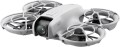 |
|---|---|---|
| DJI Neo 2 | DJI Neo | |
| Compare prices 3 | Compare prices 7 | |
| User reviews | ||
| TOP sellers | ||
Maximum takeoff height — 2 km. Built-in memory 49 GB. Course LIDAR for obstacle detection. Expandable DJI Neo 2 (O4) video transmission module. Wi-Fi 6 (up to 500 m) and Bluetooth 5.2. Voice control via Bluetooth headset. Compared to the DJI Neo, the 4K shooting has been improved, omnidirectional obstacle avoidance, gesture and voice control have been added, and the speed of following, internal memory, and video transmission range (via Wi-Fi) have been increased. | ||
| Features | mini drone | mini drone |
Flight specs | ||
| Range of flight | 7 km | 7 km |
| Maximum flight time | 19 min | 18 min |
| Horizontal speed | 43 km/h | 57 km/h |
| Ascent / descent speed | 18 km/h | 7 km/h |
| Wind impedance | 11 m/s | 8 m/s |
Camera | ||
| Camera type | built-in | built-in |
| Matrix size | 1/2" | 1/2" |
| Aperture | f/2.2 | f/2.8 |
| Number of megapixels | 12 MP | 12 MP |
| Photo resolution | 4000x3000 px | 4000x3000 px |
| Full HD filming (1080p) | 1920x1080 px 60 fps | 1920x1080 px 60 fps |
| Ultra HD (4K) | 3840x2880 pixels, 60 fps | 3840x2160 px 30 fps |
| Viewing angles | 119.8° | 117.6° |
| Camera stabilization |  | |
| Mechanical stabilizer suspension | | |
| Camera with control | | |
| Live video streaming | | |
Flight modes and sensors | ||
| Flight modes | return "home" Follow me (tracking) Dronie (distance) Rocket (distance up) Orbit mode (flying in a circle) Helix (spiral flight) | return "home" Follow me (tracking) Dronie (distance) Rocket (distance up) Orbit mode (flying in a circle) Helix (spiral flight) |
| Sensors | GPS module heights optic gyroscope | GPS module heights gyroscope |
| Obstacle sensors | bottom top on the sides front back | |
Control and transmitter | ||
| Control | remote control and smartphone | remote control only |
| Gesture control | |  |
| Range | 10000 m | |
| Control frequency | 2.4 and 5.8 GHz | 2.4 and 5.8 GHz |
| Video transmission frequency | 2.4 and 5.8 GHz (Wi-Fi) | 2.4 and 5.8 GHz (Wi-Fi) |
Motor and chassis | ||
| Number of screws | 4 pcs | 4 pcs |
Battery | ||
| Battery capacity | 1.61 Ah | 1.44 Ah |
| Voltage | 7.16 В | 7.3 В |
| Batteries in the set | 1 pcs | 1 pcs |
| USB charging | | |
General | ||
| Protected case | | |
| Material | plastic | plastic |
| Dimensions | 171x167x54 mm | 130x157x49 mm |
| Dimensions (folded) | 171x147x41 mm | |
| Weight | 151 g | |
| Color | ||
| Added to E-Catalog | november 2025 | september 2024 |


Compare DJI Neo 2 and Neo
You may be interested in
My comparisons
DJI Neo 2 often compared


DJI Neo often compared


Glossary
Maximum flight time
Maximum flight time of a quadcopter on one full battery charge. This indicator is quite approximate, since it is most often indicated for ideal conditions - in real use, the flight time may be less than stated. However, by this indicator it is quite possible to evaluate the general capabilities of the copter and compare it with other models - a longer declared flight time in practice usually means higher autonomy.
Note that for modern copters, a flight time of 20 minutes or more is considered a good indicator, and in the most “long-lasting” models it can exceed 40 minutes.
Note that for modern copters, a flight time of 20 minutes or more is considered a good indicator, and in the most “long-lasting” models it can exceed 40 minutes.
Horizontal speed
The highest speed that a quadcopter can achieve in horizontal flight. It is worth considering that in most cases this parameter is indicated for optimal operating conditions: a fully charged battery, low air temperature, minimum weight, etc. However, it is quite possible to rely on it both when choosing and when comparing different models of copters with each other.
Note that quadcopters were originally designed as stable and maneuverable aerial platforms, and not as high-speed vehicles. Therefore, you should specifically look for a fast quadcopter only in cases where the ability to quickly move from place to place is critical (for example, when the device is supposed to be used for video recording of fast-moving objects over large areas).
Note that quadcopters were originally designed as stable and maneuverable aerial platforms, and not as high-speed vehicles. Therefore, you should specifically look for a fast quadcopter only in cases where the ability to quickly move from place to place is critical (for example, when the device is supposed to be used for video recording of fast-moving objects over large areas).
Ascent / descent speed
The speed at which the quadcopter rises up in the air or descends to the ground. Recreational, photo and video models tend to have more moderate climb/descent speeds, while professional or racing drones can rise and fall much faster. This indicator can be used to evaluate how quickly the copter can rise to a height for filming or, if necessary, avoid obstacles, and a high descent rate will be useful if the drone needs to be returned to the ground quickly and safely.
Wind impedance
The ability of a quadcopter to maintain and maintain stable flight parameters in windy weather. In this column, it is customary to indicate the wind force in meters per second, which ensures trouble-free takeoff and landing of the drone within the permissible wind speed. Directly in flight, copters can overcome the resistance of even faster winds. But takeoffs and landings with wind strength above the designated level are fraught with unpredictable movements of the drone, loss of control and an increased risk of emergency situations.
Aperture
Aperture - a characteristic that determines how much the camera lens attenuates the light flux passing through it. It depends on two main characteristics - the diameter of the active aperture of the lens and the focal length - and in the classical form is written as the ratio of the first to the second, while the diameter of the effective aperture is taken as a unit: for example, 1 / 2.8. Often, when recording the characteristics of a lens, the unit is generally omitted, such a record looks, for example, like this: f / 1.8. At the same time, the larger the number in the denominator, the smaller the aperture value: f / 4.0 lenses will produce a darker image than models with f / 1.4 aperture.
Ultra HD (4K)
Maximum resolution and frame rate supported by the aircraft camera (built-in or bundled) when shooting in Ultra HD (4K)
UHD is a much more advanced video standard than Quad HD and even more so Full HD. Such a frame is approximately 2 times larger than a FullHD frame on each side and, accordingly, 4 times larger in terms of the total number of pixels. In this case, specific resolutions may be different; in copters, 3840x2160 and 4096x2160 are the most popular. Thus, shooting in this standard gives excellent detail; on the other hand, it puts forward rather high demands on the hardware of the camera and the amount of memory. Therefore, 4K support is an unmistakable sign of a high-end built-in camera. At the same time, we note that in modern drones you can also find more solid resolutions — see “Shooting above 4K”.
As for the actual frame rate, the higher it is, the smoother the video turns out, the less motion is blurred in the frame. On the other hand, the shooting speed directly affects the requirements for the power of the hardware and the volume of the finished files. In general, values up to 24 fps can be called minimal, from 24 to 30 fps — average, from 30 to 60 fps — above average, and a speed of 60 fps already allows us to talk about high-speed shooting UltraHD. However for full-fledged high-speed shooting, which allows you to create slow-motion videos, an even higher frame rate...is desirable, which is not yet found in copter cameras; however, modern technologies are developing rapidly, and the situation may change in the near future.
UHD is a much more advanced video standard than Quad HD and even more so Full HD. Such a frame is approximately 2 times larger than a FullHD frame on each side and, accordingly, 4 times larger in terms of the total number of pixels. In this case, specific resolutions may be different; in copters, 3840x2160 and 4096x2160 are the most popular. Thus, shooting in this standard gives excellent detail; on the other hand, it puts forward rather high demands on the hardware of the camera and the amount of memory. Therefore, 4K support is an unmistakable sign of a high-end built-in camera. At the same time, we note that in modern drones you can also find more solid resolutions — see “Shooting above 4K”.
As for the actual frame rate, the higher it is, the smoother the video turns out, the less motion is blurred in the frame. On the other hand, the shooting speed directly affects the requirements for the power of the hardware and the volume of the finished files. In general, values up to 24 fps can be called minimal, from 24 to 30 fps — average, from 30 to 60 fps — above average, and a speed of 60 fps already allows us to talk about high-speed shooting UltraHD. However for full-fledged high-speed shooting, which allows you to create slow-motion videos, an even higher frame rate...is desirable, which is not yet found in copter cameras; however, modern technologies are developing rapidly, and the situation may change in the near future.
Viewing angles
The viewing angle provided by the standard quadcopter camera; for optics with adjustable zoom, usually, the maximum value is taken into account.
The viewing angle is the angle between the lines connecting the centre of the lens to the two opposite extreme points of the visible image. Usually measured along the diagonal of the frame, but there may be exceptions. As for the specific values of this parameter, in modern copters they can range from 55 – 60 ° to 180 ° and even more. At the same time, a wider angle (ceteris paribus) allows you to simultaneously fit more space into the frame; and a narrower one covers a smaller space, however, the objects that are in the frame look larger, it is easier to see individual small details on them. So when choosing by this parameter, you should consider what is more important for you: wide coverage or an additional zoom effect.
The viewing angle is the angle between the lines connecting the centre of the lens to the two opposite extreme points of the visible image. Usually measured along the diagonal of the frame, but there may be exceptions. As for the specific values of this parameter, in modern copters they can range from 55 – 60 ° to 180 ° and even more. At the same time, a wider angle (ceteris paribus) allows you to simultaneously fit more space into the frame; and a narrower one covers a smaller space, however, the objects that are in the frame look larger, it is easier to see individual small details on them. So when choosing by this parameter, you should consider what is more important for you: wide coverage or an additional zoom effect.
Sensors
Additional sensors provided in the design of the quadcopter.
— Heights. A sensor that determines the flight altitude of the machine. Such sensors can use the barometric or ultrasonic principle of operation. In the first case, the height is measured by the difference in atmospheric pressure between the current point and the starting point (that is, the sensor determines the height relative to the initial level); in the second, the sensor acts similarly to sonar, sending a signal to the ground and measuring the time it takes to return. Barometric sensors are not very accurate, but they work well at high altitudes — tens and hundreds of metres; ultrasonic — on the contrary, they allow you to accurately manoeuvre at low level flight, but lose effectiveness as you climb. However, in some advanced models, both options may be provided at once. Data from the height sensor can either be used by the quadcopter “independently” (for example, when hovering or automatically returning), or transmitted to the operator to the remote control or smartphone.
— Optical. A sensor that allows the quadcopter to "see" the environment in certain directions. One of the simplest variants of such a sensor is a downward-facing camera that allows the device to “copy” the surface under which it flies. Due to this, the machine, for example, can navigate indoors, where the signal from GPS satellites does not reach. In...addition to such a chamber, "eyes" can also be provided from different sides of the machine. Note that optical sensors have certain limitations in their use — for example, they lose their effectiveness on dark, shiny or uniform (without noticeable details) surfaces, as well as at high speeds.
— GPS module. A sensor that receives signals from navigation satellites (GPS, in some models also GLONASS) and determines the current geographical coordinates of the machine. Specific ways of using position data can be different: returning home, flying by waypoints (see below), recording a flight route, etc.
— Gyroscope. A sensor that determines the direction, angle and speed of the machine's rotation along a specific axis. Modern technologies make it possible to create full-fledged three-axis gyroscopes of very compact dimensions, and it is with such modules that quadcopters are usually equipped. On the basis of gyroscopes, automatic stabilization systems usually work, returning the car to a horizontal position after a gust of wind, collision with an obstacle, etc. At the same time, such equipment affects the cost of the device, and in some cases (for example, during piloting), automatic stabilization is more of a hindrance than a useful feature. Therefore, some low-cost, as well as advanced aerobatic quadcopters, are not equipped with gyroscopes.
— Heights. A sensor that determines the flight altitude of the machine. Such sensors can use the barometric or ultrasonic principle of operation. In the first case, the height is measured by the difference in atmospheric pressure between the current point and the starting point (that is, the sensor determines the height relative to the initial level); in the second, the sensor acts similarly to sonar, sending a signal to the ground and measuring the time it takes to return. Barometric sensors are not very accurate, but they work well at high altitudes — tens and hundreds of metres; ultrasonic — on the contrary, they allow you to accurately manoeuvre at low level flight, but lose effectiveness as you climb. However, in some advanced models, both options may be provided at once. Data from the height sensor can either be used by the quadcopter “independently” (for example, when hovering or automatically returning), or transmitted to the operator to the remote control or smartphone.
— Optical. A sensor that allows the quadcopter to "see" the environment in certain directions. One of the simplest variants of such a sensor is a downward-facing camera that allows the device to “copy” the surface under which it flies. Due to this, the machine, for example, can navigate indoors, where the signal from GPS satellites does not reach. In...addition to such a chamber, "eyes" can also be provided from different sides of the machine. Note that optical sensors have certain limitations in their use — for example, they lose their effectiveness on dark, shiny or uniform (without noticeable details) surfaces, as well as at high speeds.
— GPS module. A sensor that receives signals from navigation satellites (GPS, in some models also GLONASS) and determines the current geographical coordinates of the machine. Specific ways of using position data can be different: returning home, flying by waypoints (see below), recording a flight route, etc.
— Gyroscope. A sensor that determines the direction, angle and speed of the machine's rotation along a specific axis. Modern technologies make it possible to create full-fledged three-axis gyroscopes of very compact dimensions, and it is with such modules that quadcopters are usually equipped. On the basis of gyroscopes, automatic stabilization systems usually work, returning the car to a horizontal position after a gust of wind, collision with an obstacle, etc. At the same time, such equipment affects the cost of the device, and in some cases (for example, during piloting), automatic stabilization is more of a hindrance than a useful feature. Therefore, some low-cost, as well as advanced aerobatic quadcopters, are not equipped with gyroscopes.
Obstacle sensors
The location of the obstacle sensors that the quadcopter is equipped with.
Such sensors allow the drone to recognize foreign objects in the immediate vicinity in advance and avoid collisions with them; however, many models even provide the possibility of automatic avoidance of obstacles. Such equipment will definitely be useful when flying in a confined space, but it can also come in handy in open areas — they reduce the risk of bumping into wires, flying into tree branches, etc.
In terms of location, the most advanced option is full coverage, in which sensors are installed on all sides: front, rear, sides, top and bottom. However, more modest options are not uncommon. At the same time, we note that the front sensor can be provided even in models equipped with a camera and having the ability to live broadcast (see above): such a sensor usually covers the dead zone of the camera, providing, again, additional insurance against collisions.
Such sensors allow the drone to recognize foreign objects in the immediate vicinity in advance and avoid collisions with them; however, many models even provide the possibility of automatic avoidance of obstacles. Such equipment will definitely be useful when flying in a confined space, but it can also come in handy in open areas — they reduce the risk of bumping into wires, flying into tree branches, etc.
In terms of location, the most advanced option is full coverage, in which sensors are installed on all sides: front, rear, sides, top and bottom. However, more modest options are not uncommon. At the same time, we note that the front sensor can be provided even in models equipped with a camera and having the ability to live broadcast (see above): such a sensor usually covers the dead zone of the camera, providing, again, additional insurance against collisions.