
Comparison Ultradesk Highlander vs Cougar E-Star 140
Add to comparison | 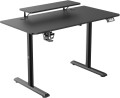 |  |
|---|---|---|
| Ultradesk Highlander | Cougar E-Star 140 | |
| Outdated Product | Compare prices 1 | |
| User reviews | ||
| TOP sellers | ||
Size of the shelf for the monitor: width - 70 cm, depth - 22 cm, height - 10 cm. | ||
| Form factor | gaming | office |
Design | ||
| Dimensions | 1200x600x720 mm | 1400x600x720 mm |
| Max. height | 1170 mm | 1170 mm |
| Height adjustment | electric motor | electric motor |
| Table top shape | rectangular | rectangular |
| Leg design | T-shaped | T-shaped |
| Monitor stand |  | |
| Cable management | | |
| Cable hole | |  |
Features | ||
| Number of motors | 1 pcs | 1 pcs |
| Cup holder | | |
| Headphone holder | | |
| Mouse Pad | | |
| Max. load | 60 kg | |
| Weight | 24.5 kg | 24 kg |
| Added to E-Catalog | november 2024 | july 2024 |



Compare Ultradesk Highlander and Cougar E-Star 140
Price comparison
You may be interested in
My comparisons
Ultradesk Highlander often compared

Cougar E-Star 140 often compared


Glossary
Form factor
— Office. This classification includes neat, intelligent desks suitable for both office or home work, as well as for use as a study desk for children. It should be noted that classic wooden desks with pedestals and drawers do not fall into this category. Instead, it comprises more technological solutions with adjustable height desktops.
— Gaming (Gamer). Specialized furniture designed for convenience and maximum immersion in the gaming process. Unlike regular office models, they have a reinforced structure with optimal height for long sessions, a wide working surface for multiple monitors and peripherals, as well as an ergonomic design with cuts or curves for comfortable seating. Often, these tables come equipped with holders for headphones and beverages, cable management, RGB lighting, or even spots for mounting a system unit. Thanks to this, a gaming desk not only looks impressive but also provides convenient organization of the workspace for e-sports and streaming.
— Gaming (Gamer). Specialized furniture designed for convenience and maximum immersion in the gaming process. Unlike regular office models, they have a reinforced structure with optimal height for long sessions, a wide working surface for multiple monitors and peripherals, as well as an ergonomic design with cuts or curves for comfortable seating. Often, these tables come equipped with holders for headphones and beverages, cable management, RGB lighting, or even spots for mounting a system unit. Thanks to this, a gaming desk not only looks impressive but also provides convenient organization of the workspace for e-sports and streaming.
Dimensions
The size of an office desk directly affects how comfortable it is to work: a depth of 60–80 cm is considered optimal so there’s enough space for a laptop, a monitor, and stationery, while the width is chosen between 100 and 160 cm depending on how much equipment and how many accessories you have. For gaming desks, the standard is wider—70–80 cm and 120–180 cm respectively—since you need to fit multiple monitors, a PC tower, peripherals, and still have free space to move. Unlike compact office models, gaming versions often have a rounded front edge or a corner design, which boosts ergonomics. In reality, office options are more common in minimalist interiors for working with documents or a laptop, whereas gaming ones are used in setups with more devices, LED lighting, and accessories.
Cable hole
Standard Cable Grommet in the Desktop, usually 60–80 mm in diameter with a cover and rubber gasket or brush, through which power and low-voltage cables can be neatly routed to the PC, monitors, and docking station. This solution frees up the desk edge, reduces the risk of bending and snagging with feet, simplifies cleaning, and makes the setup visually cleaner; compared to desks without holes, there are fewer loops and less strain on ports. In gaming models, two grommets are often installed at the edges for multi-monitor configurations, while in office models, one central grommet with an outlet to the under-desk tray is common. This is practical for scenarios like "two monitors + microphone + gamepad charger": thick cables run downward through the grommet, only short tails remain on top, and rearranging equipment takes minutes — exactly what ergonomic guides recommend.
Cup holder
An easy way to remove a mug, can, or shaker from the work surface without risking spilling a drink on the keyboard and mouse. Most often, the cup holder is detachable and mounted under the edge of the tabletop on a bracket, less frequently it is built into a cutout on the tabletop itself; the first option wins in terms of safety and space-saving, while the second is convenient for quick access. A metal mesh "bowl" or sturdy plastic holds standard bottles and thermos mugs, and some models have a notch for a handle and drainage holes for condensation. In practice, this is convenient for long gaming sessions, streaming, and studying: the coffee goes under the table, the surface is free for an XL mat, and hot drinks are kept away from electronics.
Mouse Pad
An oversized desk mat in XL format that covers a significant portion of the tabletop, creating a smooth, predictable surface for sensor and mouse foot gliding. The top is made of woven microfiber for "speed" or "control", and the bottom is non-slip rubber with a thickness of 3–5 mm, with stitched edges and water-repellent treatment. There are versions tailored to specific table models or with cutouts for cup holders/mounts. This mat dampens vibrations, protects the table surface, and ensures stable tracking at low DPI, which is critical for shooters and broad "flick movements". Compared to a small mat, there is room for the keyboard and even friction throughout the area, and compared to a bare textured tabletop, there is less wear on the feet and higher movement repeatability. In everyday use, it's convenient for daily work, streams, and games: the mouse and keyboard are on the same level, the cable does not catch on edges, and maintenance is reduced to dry cleaning or hand washing.
Max. load
The weight capacity that the tabletop and frame can safely support without bending or becoming unstable. Manufacturers typically specify the static (evenly distributed) and less often the dynamic load when adjusting the height. The strongest influence in practice is the frame design, presence of a crossbar, thickness and material of the tabletop, as well as the overhang of supports: fixed desks usually have a higher margin, while adjustable ones have a lower margin at higher positions due to leverage. It is important to understand that monitor brackets, racing wheel clamps, and placing a computer at the edge create point loads and high moments, so identical "80 kg" ratings on paper may be safe in one scenario but lead to vibrations in another. A sensible guideline is to distribute weight closer to the center and supports, avoid sitting on the edge, and for setups with two 27–32″ monitors on mounts, speakers, and a printer, choose a desk with a sturdy steel frame and reserve in static load capacity to have a buffer during everyday use.