
Comparison Microlife NEB 210 vs ProMedica Briz
Add to comparison | 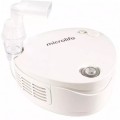 |  |
|---|---|---|
| Microlife NEB 210 | ProMedica Briz | |
| Outdated Product | Outdated Product | |
| TOP sellers | ||
| Type | compressor | compressor |
| Purpose | stationary | stationary |
Specs | ||
| Medicine container | 6 ml | 6 ml |
| Compressor power | 160 W | |
| Max air flow | 8 L/min | 8 L/min |
| Nebulization rate | 0.4 ml/min | 0.18 ml/min |
| Particle size | 0.5 – 5 µm | |
| Medium particle size (MMAD) | 2.08 µm | 3 µm |
| Particle size changing |  |  |
| Noise level | 58 dB | |
| Nozzles | adult mask children's mask nozzle for nose nozzle for mouth | adult mask children's mask nozzle for nose nozzle for mouth |
General | ||
| Power source | mains | mains |
| Cable length | 1.5 m | |
| Dimensions | 160x161x90 mm | 145x142x90 mm |
| Weight | 1200 g | 1 g |
| Added to E-Catalog | august 2023 | march 2021 |


Compare Microlife NEB 210 and ProMedica Briz
You may be interested in
My comparisons
Microlife NEB 210 often compared


ProMedica Briz often compared
Glossary
Compressor power
The power consumed by the compressor of the nebuliser during operation; in this case, it means not only the corresponding element of compressor models (see "Type"), but also the nebulizer in ultrasonic devices.
The performance and power consumption of the nebuliser depend on this parameter. The more powerful the compressor, the higher the possible air flow rate and, accordingly, nebulization. At the same time, powerful devices consume more power (which is especially important when powered offline, see below) and can generate quite a lot of noise.
The performance and power consumption of the nebuliser depend on this parameter. The more powerful the compressor, the higher the possible air flow rate and, accordingly, nebulization. At the same time, powerful devices consume more power (which is especially important when powered offline, see below) and can generate quite a lot of noise.
Nebulization rate
The nebuliser's nebulization capacity per minute.
The ideal nebulization rate can differ based on factors such as the patient's health condition, the type of disease, and the composition of the inhaled medication, as outlined in medical guidelines. This rate is crucial in assessing the inhaler's effectiveness for specific situations and also influences how long the device operates on a single medication refill.
Some models have a nebulization speed control — in such cases, the maximum value is usually indicated in the characteristics.
The ideal nebulization rate can differ based on factors such as the patient's health condition, the type of disease, and the composition of the inhaled medication, as outlined in medical guidelines. This rate is crucial in assessing the inhaler's effectiveness for specific situations and also influences how long the device operates on a single medication refill.
Some models have a nebulization speed control — in such cases, the maximum value is usually indicated in the characteristics.
Particle size
The aerosol generated by a nebuliser contains droplets of varying sizes. Smaller droplets have an easier time reaching the narrow passages of the bronchi, delivering the medicinal substance deeper into the respiratory system. For optimal therapeutic effects, it is recommended that droplet sizes do not surpass 5 microns. It's worth noting that during the atomization process, particles may vary in size, and their values are often expressed as a range.
Medium particle size (MMAD)
Since not all particles have the same size, this paragraph indicates exactly the average, most common particle size when splitting in this inhaler. Accordingly, lower values allow easier and deeper penetration into the bronchi.
Particle size changing
Possibility to change the size of the particles created during the nebulization of the medicinal product. See above for size value. Here we note that high penetrating power is not always required: for some diseases (for example, inflammation in the larynx or trachea), it is not necessary to deliver the medicine deep into the bronchi. Accordingly, by changing the particle size, it is possible to control the delivery distance.
Noise level
The nebuliser's maximum noise level during normal operation is a crucial factor for user comfort, especially in situations where loud sounds are undesirable, such as when treating children or during nighttime use. It's important to note that the relationship between decibel levels and actual perceived noise is not linear. For instance, a 3 dB increase corresponds to a doubling of noise, and a 20 dB increase equals a 100 — fold increase in noise. Comparative tables are often used to assess the actual loudness of inhalers, and here are some relevant values for modern devices:
30 dB — comparable to a whisper, the maximum permissible noise level in residential premises at night according to sanitary standards;
35 dB — talking in an undertone;
40 dB — normal speech at a distance of about 10 m;
45 dB — conversation in a normal voice;
50 dB — a conversation is slightly louder than usual, it is considered the maximum noise level that does not cause noticeable inconvenience;
55 dB — car engine;
60 dB — TV at medium volume;
65 dB — loud conversations at a distance of up to 1 m.
30 dB — comparable to a whisper, the maximum permissible noise level in residential premises at night according to sanitary standards;
35 dB — talking in an undertone;
40 dB — normal speech at a distance of about 10 m;
45 dB — conversation in a normal voice;
50 dB — a conversation is slightly louder than usual, it is considered the maximum noise level that does not cause noticeable inconvenience;
55 dB — car engine;
60 dB — TV at medium volume;
65 dB — loud conversations at a distance of up to 1 m.