
Comparison Yamaha PSR-EW320 vs Yamaha PSR-E373
Add to comparison |  | 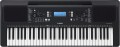 |
|---|---|---|
| Yamaha PSR-EW320 | Yamaha PSR-E373 | |
from $134.00 | from $274.99 | |
| TOP sellers | ||
| Type | synthesizer (rompler) | synthesizer (rompler) |
Keys | ||
| Number of keys | 76 | 61 |
| Size | full size | full size |
| Mechanics | active | active |
| Rigidity | semi-weighted | semi-weighted |
Specs | ||
| Polyphony | 48 voices | 48 voices |
| Built-in timbres | 650 шт | 622 шт |
| Auto accompaniment |  | |
| Accompaniment styles | 260 шт | 205 шт |
| Learning mode | | |
| Tempo change | 11 – 280 | 11 – 280 |
| Metronome | | |
| Sequencer (recording) | | |
| Built-in compositions | | |
Effects and control | ||
| Timbres layering | | |
| Keyboard split | | |
| Arpeggiator | | |
| Reverberation | | |
| Chorus | | |
| Transposition | | |
| Pitch controller | |  |
| Fine tuning | | |
Connectors | ||
| Inputs | mini-Jack (3.5 mm) | mini-Jack (3.5 mm) |
| Connectable pedals | 1 шт | 1 шт |
| Outputs | USB to host (type B) headphones | USB to host (type B) headphones |
| Linear outputs | 1 | 1 |
In box | ||
| In box | music stand | |
General | ||
| Built-in acoustics | 5 W | 5 W |
| Number of bands | 1 | 1 |
| Display | monochrome | monochrome |
| Power consumption | 5 W | 6 W |
| Autonomous power supply | aA batteries | aA batteries |
| Dimensions (WxHxD) | 1148x105x317 mm | 945x118x369 mm |
| Weight | 5.2 kg | 4.6 kg |
| Color | ||
| Added to E-Catalog | september 2024 | march 2021 |


Compare Yamaha PSR-EW320 and PSR-E373
You may be interested in
My comparisons
Yamaha PSR-EW320 often compared


Yamaha PSR-E373 often compared


Glossary
Number of keys
The greater the number of keys — the wider the range of the instrument, the lower and higher notes you can take on it right during the game, without resorting to tricks like octave shift (see below). By comparison, a full size piano keyboard has 88 keys. However, in synthesizers, such an amount is rare, because. the instrument would have turned out to be too bulky and expensive, and not every musician, even a professional one, needs such an extensive range. Thus, 88-key keyboards are used primarily in high-end workstations (see "Type"). For ordinary synthesizers, the standard is 49, 61 or 76 keys ( there are also options for 73 keys) — this is usually quite enough (while the "golden mean" option is considered to be 61 keys). And small children's models can have 32 keys.
Built-in timbres
The number of built-in sounds provided in the synthesizer.
The number of timbres is often described as the number of instruments that a given model can imitate. However, this is not entirely true — rather, this parameter can be called "the number of instruments and sound effects." For example, the same instrument — an electric guitar — with different "gadgets" (distortion, overdrive) will sound differently, and in the synthesizer each such gadget will be considered a separate timbre. The “drums” timbre usually combines different types of drums and other percussion instruments — in other words, it allows you to portray both the “bass drum” and the cymbals without switching settings, just by pressing the desired keys. And some timbres may not have analogues among real instruments at all.
The more built-in timbres, the more extensive the possibilities of the synthesizer, the more diverse the sounds that can be extracted from it. At the same time, in high-end models like workstations (see "Type"), this number can reach 1000 or even more.
The number of timbres is often described as the number of instruments that a given model can imitate. However, this is not entirely true — rather, this parameter can be called "the number of instruments and sound effects." For example, the same instrument — an electric guitar — with different "gadgets" (distortion, overdrive) will sound differently, and in the synthesizer each such gadget will be considered a separate timbre. The “drums” timbre usually combines different types of drums and other percussion instruments — in other words, it allows you to portray both the “bass drum” and the cymbals without switching settings, just by pressing the desired keys. And some timbres may not have analogues among real instruments at all.
The more built-in timbres, the more extensive the possibilities of the synthesizer, the more diverse the sounds that can be extracted from it. At the same time, in high-end models like workstations (see "Type"), this number can reach 1000 or even more.
Accompaniment styles
The number of auto accompaniment styles (see above) originally provided in the synthesizer, in other words, the number of accompaniment options available to the user.
The more extensive this set, the higher the probability of finding among these melodies suitable options for a particular case. At the same time, the abundance of styles in itself is not yet a 100% guarantee that among them there will be a suitable one, especially since different synthesizer models can differ markedly in a specific set of melodies. So the list does not hurt to clarify before buying. Also note that the situation can be corrected by user styles (see below) — many synthesizers with auto accompaniment support them.
The more extensive this set, the higher the probability of finding among these melodies suitable options for a particular case. At the same time, the abundance of styles in itself is not yet a 100% guarantee that among them there will be a suitable one, especially since different synthesizer models can differ markedly in a specific set of melodies. So the list does not hurt to clarify before buying. Also note that the situation can be corrected by user styles (see below) — many synthesizers with auto accompaniment support them.
Pitch controller
The presence of a pitch controller(Pitch Bend) in the design of the synthesizer.
This function allows you to smoothly change the pitch by a small amount. In this way, specific playing techniques on some instruments are imitated — for example, tightening the strings on a guitar, which gives a characteristic, “floating” sound in frequency. The pitch control usually has the form of a wheel or lever.
This function allows you to smoothly change the pitch by a small amount. In this way, specific playing techniques on some instruments are imitated — for example, tightening the strings on a guitar, which gives a characteristic, “floating” sound in frequency. The pitch control usually has the form of a wheel or lever.
In box
Additional items supplied with the synthesizer in addition to the instrument itself.
— Music stand. A stand for musical notations, installed in such a way that the materials on it are constantly in front of the musician's eyes. In modern synthesizers, the music stand can be built-in or removable.
— Pedal. An additional control in the form of a pedal, which can be responsible for a wide variety of functions, depending on the model of the synthesizer. For more information about this, see "Connected pedals", here we note that the presence of a pedal in the kit eliminates the need to look for and select it separately.
— Power Supply. Power supply for connecting the synthesizer to the network. The very possibility of working from the outlet is important for most modern synthesizers. Therefore, the absence of a power supply in the kit means either that it is made internal, or that we have a simple and inexpensive model (usually for children, see "Type"), designed mainly for battery operation and not equipped with a PSU or not providing for it at all connections. An external power supply unit is convenient because it can be disconnected when working from autonomous power sources, saving the tool from unnecessary wires.
— Disk. Optical disk (CD or DVD) with various additional materials on the synthesizer. These can be instructions and other documentation, drivers for connecting to a computer, specialized software for editing music on a PC,...etc.
— Rack. Own stand for installing the synthesizer on the floor — usually folding, in the unfolded state resembling the letter X in shape. With such a stand, the musician does not have to look for a free table, window sill or other similar place to place the instrument — there is enough free space on the floor. Racks for synthesizers are also sold separately, but it is often more convenient or even cheaper to buy such a device along with an instrument.
— Microphone. The microphone can be used both for singing and for creating samples based on external sounds. However it is worth noting that usually relatively inexpensive synthesizers for beginner musicians are equipped with microphones — it is more convenient for a professional to independently choose additional equipment (including a microphone) to suit their own needs and preferences, without relying on the choice of the manufacturer. Accordingly, the complete microphones themselves usually have rather modest characteristics.
— Music stand. A stand for musical notations, installed in such a way that the materials on it are constantly in front of the musician's eyes. In modern synthesizers, the music stand can be built-in or removable.
— Pedal. An additional control in the form of a pedal, which can be responsible for a wide variety of functions, depending on the model of the synthesizer. For more information about this, see "Connected pedals", here we note that the presence of a pedal in the kit eliminates the need to look for and select it separately.
— Power Supply. Power supply for connecting the synthesizer to the network. The very possibility of working from the outlet is important for most modern synthesizers. Therefore, the absence of a power supply in the kit means either that it is made internal, or that we have a simple and inexpensive model (usually for children, see "Type"), designed mainly for battery operation and not equipped with a PSU or not providing for it at all connections. An external power supply unit is convenient because it can be disconnected when working from autonomous power sources, saving the tool from unnecessary wires.
— Disk. Optical disk (CD or DVD) with various additional materials on the synthesizer. These can be instructions and other documentation, drivers for connecting to a computer, specialized software for editing music on a PC,...etc.
— Rack. Own stand for installing the synthesizer on the floor — usually folding, in the unfolded state resembling the letter X in shape. With such a stand, the musician does not have to look for a free table, window sill or other similar place to place the instrument — there is enough free space on the floor. Racks for synthesizers are also sold separately, but it is often more convenient or even cheaper to buy such a device along with an instrument.
— Microphone. The microphone can be used both for singing and for creating samples based on external sounds. However it is worth noting that usually relatively inexpensive synthesizers for beginner musicians are equipped with microphones — it is more convenient for a professional to independently choose additional equipment (including a microphone) to suit their own needs and preferences, without relying on the choice of the manufacturer. Accordingly, the complete microphones themselves usually have rather modest characteristics.
Power consumption
Rated power consumed by the tool during operation. Modern synthesizers, even the most powerful and advanced ones like workstations (see "Type"), consume very little energy — up to 100 W, and often noticeably less. Therefore, it is rarely necessary to pay attention to this parameter in fact, mainly in rather specific situations — for example, when working from an autonomous generator, when you need to take into account the entire load connected to such a power supply.