
Comparison STIHL SR 430 vs STIHL SR 420
Add to comparison |  | 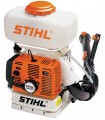 |
|---|---|---|
| STIHL SR 430 | STIHL SR 420 | |
from $510.36 | from $461.96 | |
| TOP sellers | ||
| Type | petrol | petrol |
| Design | backpack | backpack |
Specs | ||
| Volume | 14 L | 13 L |
| Productivity (liquid) | 2.64 L/min | 1.81 L/min |
| Max. spraying distance | 14.5 m | 12 m |
| Wand type | wide | wide |
| Wand material | plastic | plastic |
Motor | ||
| ICE type | 2-stroke | 2-stroke |
| Cylinder volume | 63.3 cm3 | 56.6 cm3 |
| Power | 3.9 hp | 3.5 hp |
| Power | 2.9 kW | 2.6 kW |
| Fuel tank capacity | 1.7 L | 1.5 L |
| Startup type | by hand | by hand |
General | ||
| Spray lock |  | |
| Measuring scale | |  |
| Replaceable nozzles | | |
| Noise level | 97 dB | 101 dB |
| Weight | 12.2 kg | 11.1 kg |
| Added to E-Catalog | february 2016 | february 2016 |


Compare STIHL SR 430 and SR 420
You may be interested in
My comparisons
STIHL SR 420 often compared


Glossary
Volume
The nominal volume of the sprayer tank. Usually, in this case, the working volume is indicated, and not the full capacity (“for the cork”).
The more capacious the sprayer is, the more work can be done with it without refueling. On the other hand, a large volume accordingly affects the price, dimensions, and most importantly, the weight of the unit (and not only in a filled, but also in a “dry” state). Therefore, even with large volumes of work, it is sometimes more rational to use a relatively small unit, refueling it several times.
Detailed recommendations on the optimal volume of the tank for a particular situation can be found in special sources. With regard to specific values, in the most compact manual sprayers (see above), the capacity does not exceed 2 liters. Tanks for 2.1 – 5 liters can be found both in hand-held devices, and in pump-action and battery models (see "Type") with a shoulder carry. Sprayers for 5.1 – 10 liters are almost all made shoulder-mounted, the capacity of gasoline units actually starts from 10 liters, and the most capacious modern sprayers have tanks of more than 15 liters.
The more capacious the sprayer is, the more work can be done with it without refueling. On the other hand, a large volume accordingly affects the price, dimensions, and most importantly, the weight of the unit (and not only in a filled, but also in a “dry” state). Therefore, even with large volumes of work, it is sometimes more rational to use a relatively small unit, refueling it several times.
Detailed recommendations on the optimal volume of the tank for a particular situation can be found in special sources. With regard to specific values, in the most compact manual sprayers (see above), the capacity does not exceed 2 liters. Tanks for 2.1 – 5 liters can be found both in hand-held devices, and in pump-action and battery models (see "Type") with a shoulder carry. Sprayers for 5.1 – 10 liters are almost all made shoulder-mounted, the capacity of gasoline units actually starts from 10 liters, and the most capacious modern sprayers have tanks of more than 15 liters.
Productivity (liquid)
Maximum performance of the sprayer when working with liquid; Please note that in pump (see "Type of pumping") and battery (see "Type") models, the actual performance may decrease as the air supply or battery charge is exhausted.
High performance allows you to quickly process large areas; moreover, it is often combined with a good spraying distance (see below). On the other hand, such models require fairly large tanks — or they often have to be refilled; neither one nor the other contributes to the convenience of work. In addition, over-capacity is even more undesirable than under-capacity: a low-capacity sprayer will just take longer to process, and a too-capacity sprayer can ruin the job by “overdosing” the chemical. Therefore, it makes sense to use high-performance devices only for specific tasks.
Detailed data on optimal performance values for different situations can be found in special sources.
High performance allows you to quickly process large areas; moreover, it is often combined with a good spraying distance (see below). On the other hand, such models require fairly large tanks — or they often have to be refilled; neither one nor the other contributes to the convenience of work. In addition, over-capacity is even more undesirable than under-capacity: a low-capacity sprayer will just take longer to process, and a too-capacity sprayer can ruin the job by “overdosing” the chemical. Therefore, it makes sense to use high-performance devices only for specific tasks.
Detailed data on optimal performance values for different situations can be found in special sources.
Max. spraying distance
The longest distance a sprayer can effectively spray a liquid or powder. Usually, the horizontal range is implied, however, for “long-range” models, values bare also given for vertical spraying — in such units, the difference between horizontal and vertical ranges can be very noticeable.
A “long-range” sprayer (for 10–15 m or more) is convenient in that it allows you to process a large area without moving, and also to reach high branches without using ladders. On the other hand, a long range requires appropriate power, which affects the price, weight and dimensions of the unit — despite the fact that such capabilities are not always required: for example, for a cramped greenhouse, an atomizer with a short range ( 5 – 10 m, and often and less) So it is worth choosing according to this indicator, taking into account the features of the planned work.
A “long-range” sprayer (for 10–15 m or more) is convenient in that it allows you to process a large area without moving, and also to reach high branches without using ladders. On the other hand, a long range requires appropriate power, which affects the price, weight and dimensions of the unit — despite the fact that such capabilities are not always required: for example, for a cramped greenhouse, an atomizer with a short range ( 5 – 10 m, and often and less) So it is worth choosing according to this indicator, taking into account the features of the planned work.
Cylinder volume
The volume of one cylinder in an internal combustion engine installed in a sprayer. In fact, we are talking about the working volume of the entire engine, because. in this technique, only single-cylinder internal combustion engines are used.
In general, a large cylinder volume allows you to achieve high power, but power also depends on some engine characteristics (primarily the type of internal combustion engine, see above). And the performance characteristics of the sprayers themselves with the same engine power can also be different. But what directly depends on the volume of the engine is fuel consumption: a larger volume, usually, requires more fuel.
In general, a large cylinder volume allows you to achieve high power, but power also depends on some engine characteristics (primarily the type of internal combustion engine, see above). And the performance characteristics of the sprayers themselves with the same engine power can also be different. But what directly depends on the volume of the engine is fuel consumption: a larger volume, usually, requires more fuel.
Power
Engine power of the gasoline sprayer (see "Type") in horsepower.
Power directly affects the spraying range and the performance of the unit, according to this indicator, it is quite possible to assess the overall level of the device. However note that manufacturers can indicate this characteristic in different ways: some give the rated power (when the engine is running in normal mode), others give the maximum power (at peak load). Therefore, when choosing and comparing, it is worth considering not only this indicator, but also other basic characteristics.
As for horsepower, this unit is traditionally used to assess the power of an internal combustion engine. 1 HP approximately equal to 735 watts.
Power directly affects the spraying range and the performance of the unit, according to this indicator, it is quite possible to assess the overall level of the device. However note that manufacturers can indicate this characteristic in different ways: some give the rated power (when the engine is running in normal mode), others give the maximum power (at peak load). Therefore, when choosing and comparing, it is worth considering not only this indicator, but also other basic characteristics.
As for horsepower, this unit is traditionally used to assess the power of an internal combustion engine. 1 HP approximately equal to 735 watts.
Power
Sprayer engine power in kilowatts. Watt (kilowatt) is a universal unit used for all types of engines, but in fact this parameter is indicated mainly for gasoline units (see "Type"). This is due to the fact that electric sprayers — even the most powerful and heavy ones — consume less than 1 kW, which does not create any problems with connecting to a conventional outlet; so for such units there is no need to specify engine power.
Power directly affects the spraying range and the performance of the unit, according to this indicator, it is quite possible to assess the overall level of the device. However note that manufacturers can indicate this characteristic in different ways: some give the rated power (when the engine is running in normal mode), others — the maximum (at peak load). Therefore, when choosing and comparing, it is worth considering not only this indicator, but also other basic characteristics.
As for specific figures, in the most modest models this figure does not exceed 1 kW ; 1.1 – 2 kW can be called the average value; and many gasoline sprayers are equipped with motors and more than 2 kW.
Power directly affects the spraying range and the performance of the unit, according to this indicator, it is quite possible to assess the overall level of the device. However note that manufacturers can indicate this characteristic in different ways: some give the rated power (when the engine is running in normal mode), others — the maximum (at peak load). Therefore, when choosing and comparing, it is worth considering not only this indicator, but also other basic characteristics.
As for specific figures, in the most modest models this figure does not exceed 1 kW ; 1.1 – 2 kW can be called the average value; and many gasoline sprayers are equipped with motors and more than 2 kW.
Fuel tank capacity
The volume of the fuel tank in the petrol sprayer (see "Type").
Knowing the fuel consumption (see below), the volume of the tank can be used to estimate the time of continuous operation without refueling. In general, a larger tank, on the one hand, allows you to work longer between refueling, on the other hand, it affects the dimensions and weight of the entire unit. In addition, the power of the internal combustion engine in the sprayers is relatively low and they require little fuel, and you still have to fill the main tank every few minutes. In light of all this, manufacturers usually install tanks in sprayers with a volume of 0.5 to 2 liters — this is quite enough for at least half an hour of work (often more).
Knowing the fuel consumption (see below), the volume of the tank can be used to estimate the time of continuous operation without refueling. In general, a larger tank, on the one hand, allows you to work longer between refueling, on the other hand, it affects the dimensions and weight of the entire unit. In addition, the power of the internal combustion engine in the sprayers is relatively low and they require little fuel, and you still have to fill the main tank every few minutes. In light of all this, manufacturers usually install tanks in sprayers with a volume of 0.5 to 2 liters — this is quite enough for at least half an hour of work (often more).
Measuring scale
The presence of a measuring scale in the design of the sprayer.
Usually, such a scale is applied directly to the tank wall, and the tank itself is made transparent or translucent. Other design options are also possible — for example, a water metre tube with a scale built into the opaque wall of the tank. Anyway, the measuring scale allows you to determine with a fairly high accuracy how much chemicals are left in the sprayer, and without having to open the tank.
Usually, such a scale is applied directly to the tank wall, and the tank itself is made transparent or translucent. Other design options are also possible — for example, a water metre tube with a scale built into the opaque wall of the tank. Anyway, the measuring scale allows you to determine with a fairly high accuracy how much chemicals are left in the sprayer, and without having to open the tank.
Noise level
The average noise level produced by the sprayer during normal operation.
The “loudness” of operation largely depends on the type of sprayer (see above): for example, battery units are generally much quieter than gasoline ones. Anyway, the lower this indicator, the more comfortable the use of the unit, especially during long-term work. Note that the decibel is a non-linear quantity, and therefore it is best to evaluate the noise level using special comparative tables.
The most "quiet" models are manual: the noise level in them is so low that it is often not indicated at all in the characteristics. Yes, and low-power battery models can work with a volume of 30 – 35 dB, which can be compared with a muffled conversation. In more advanced versions, the noise can reach 70 dB — this is already comparable to a loud conversation. For gasoline models, the same 70 dB is, in fact, the minimum indicator, while the maximum value exceeds 100 dB (the noise of an industrial workshop or a tractor engine).
The “loudness” of operation largely depends on the type of sprayer (see above): for example, battery units are generally much quieter than gasoline ones. Anyway, the lower this indicator, the more comfortable the use of the unit, especially during long-term work. Note that the decibel is a non-linear quantity, and therefore it is best to evaluate the noise level using special comparative tables.
The most "quiet" models are manual: the noise level in them is so low that it is often not indicated at all in the characteristics. Yes, and low-power battery models can work with a volume of 30 – 35 dB, which can be compared with a muffled conversation. In more advanced versions, the noise can reach 70 dB — this is already comparable to a loud conversation. For gasoline models, the same 70 dB is, in fact, the minimum indicator, while the maximum value exceeds 100 dB (the noise of an industrial workshop or a tractor engine).