
Comparison Donic Appelgren Level 500 vs Atemi 700 Progress
Add to comparison | 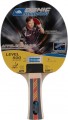 |  |
|---|---|---|
| Donic Appelgren Level 500 | Atemi 700 Progress | |
from $11.92 up to $23.20 | from $13.00 | |
| TOP sellers | ||
| In box | 1 racket | 1 racket |
| Class | intermediate (3*) | advanced (4*) |
Specs | ||
| Playing style | universal | universal |
| Handle shape | flared | flared |
| Speed | 90 | 70 |
| Spin | 80 | 80 |
| Control | 90 | 80 |
| Base material | wood | wood |
| Number of base layers | 5 | 5 |
| Sponge thickness | 1.8 mm | 1.8 mm |
General | ||
| ITTF certificate |  | |
| Added to E-Catalog | march 2015 | march 2015 |


Compare Donic Appelgren Level 500 and Atemi 700 Progress
You may be interested in
My comparisons
Donic Appelgren Level 500 often compared


Atemi 700 Progress often compared


Glossary
Class
The class of a racket describes the general purpose of the product and its ability to perform various table tennis techniques. The general purpose is clear from the name of the class: for example, for those who have not yet held rackets in their hands, 1* models are best suited, players with some experience who play regularly can pay attention to 2*, etc. As for techniques, the more stars, the wider the available range: for example, on “one-star” models only simulations of cutting and top spin are available, while “two-star” models allow you to perform these techniques with average strength, and powerful cutting and top spins are available starting from 3*.
It is worth noting that the term “professional” in this case is somewhat conditional: the class is indicated for the racket (see “Product type”), while professional athletes prefer to assemble equipment, choosing the base and pads themselves. Therefore, the 5* marking corresponds to the most advanced class among ready-made rackets. However, this class is more often designed for experienced amateurs than for representatives of “big sports”.
It is worth noting that the term “professional” in this case is somewhat conditional: the class is indicated for the racket (see “Product type”), while professional athletes prefer to assemble equipment, choosing the base and pads themselves. Therefore, the 5* marking corresponds to the most advanced class among ready-made rackets. However, this class is more often designed for experienced amateurs than for representatives of “big sports”.
Speed
Table tennis rackets have 3 main practical characteristics: speed, spin and control. The general class of the product, the style of play (see above), the available techniques, the requirements for the player's skills, etc. depend on their values and ratio. One of the most popular designation options is on a hundred-point scale; This scale is also used in our catalogue.
The speed indicator describes how fast the ball will move after contact with the racket. High-speed values are very important for an attacking style of play.
The speed indicator describes how fast the ball will move after contact with the racket. High-speed values are very important for an attacking style of play.
Control
Table tennis rackets have 3 main practical characteristics: speed, spin and control. The general class of the product, the style of play (see above), available techniques, requirements for player skills, etc. depend on their values and ratio. One of the most popular designation options is on a hundred-point scale; This scale is also used in our catalogue.
Control describes the overall handling of a racket. Roughly speaking, this is a parameter of how easily it can be used to give the tennis ball exactly the speed, direction of flight and rotation that the athlete wants to provide. High values on the control scale will be comfortable regardless of the level of the player and the style of play; however, increasing the speed/rotation hurts control, as a “faster” or “spinning” racket is usually more demanding on the accuracy of movements. Therefore, many models for professionals and experienced amateurs, usually, are distinguished by a low degree of controllability, and “beginner” rackets, on the contrary, have high control parameters and low speed/spin.
Control describes the overall handling of a racket. Roughly speaking, this is a parameter of how easily it can be used to give the tennis ball exactly the speed, direction of flight and rotation that the athlete wants to provide. High values on the control scale will be comfortable regardless of the level of the player and the style of play; however, increasing the speed/rotation hurts control, as a “faster” or “spinning” racket is usually more demanding on the accuracy of movements. Therefore, many models for professionals and experienced amateurs, usually, are distinguished by a low degree of controllability, and “beginner” rackets, on the contrary, have high control parameters and low speed/spin.