
Comparison Grand PG-1 vs Intertool GS-0001
Add to comparison |  | 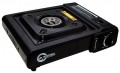 |
|---|---|---|
| Grand PG-1 | Intertool GS-0001 | |
| Outdated Product | Outdated Product | |
| User reviews | ||
| TOP sellers | ||
| Type | cooker | cooker |
| Fuel | gas | gas |
| Balloon mount | collet | collet |
Specs | ||
| Power | 2900 W | 2000 W |
| Fuel consumption | 220 g/h | 145 g/h |
| Power regulator |  | |
| Piezo ignition | | |
General | ||
| Case included | | |
| Material | metal | |
| Dimensions | 330x270x90 mm | 342x275x113 mm |
| Weight | 1300 g | 2333 g |
| Added to E-Catalog | march 2025 | february 2019 |


Compare Grand PG-1 and Intertool GS-0001
You may be interested in
My comparisons
Intertool GS-0001 often compared


Glossary
Power
The rated power of the burner is the amount of heat generated by it during operation. For models with power control, the value is indicated at the maximum mode.
The nuances of choosing this parameter depend on the type of device. So, the general rule for burners and stoves (see "Type") states that at least 1 kW of power is needed to efficiently heat 1 liter of liquid. And the volumes that you have to deal with depend on the number of tourists and the expected conditions: in a warm climate, 600-700 mL per person is enough for 1 cooking, in a cool one — 1 liter, and it is better to clarify recommendations for different types of extreme tourism in special sources. Thus, the minimum indicator for burners is actually 1 kW, for stoves — 1.5 kW, and the most powerful ones can provide 3 kW or more. Note that more powerful burner models have the appropriate dimensions and weight, and you can heat a large amount of food several times; so for long hikes with luggage carried on you, a relatively low-powered device may be more suitable.
In the case of heaters, it can be assumed that a power of 1 – 1.5 kW is enough for 5 – 7 m2 of area — this is quite enough to heat a tent or tent, higher power is rarely required in fact. And for lamps, the main indicator of efficiency is not power, but luminous flux (see below).
The nuances of choosing this parameter depend on the type of device. So, the general rule for burners and stoves (see "Type") states that at least 1 kW of power is needed to efficiently heat 1 liter of liquid. And the volumes that you have to deal with depend on the number of tourists and the expected conditions: in a warm climate, 600-700 mL per person is enough for 1 cooking, in a cool one — 1 liter, and it is better to clarify recommendations for different types of extreme tourism in special sources. Thus, the minimum indicator for burners is actually 1 kW, for stoves — 1.5 kW, and the most powerful ones can provide 3 kW or more. Note that more powerful burner models have the appropriate dimensions and weight, and you can heat a large amount of food several times; so for long hikes with luggage carried on you, a relatively low-powered device may be more suitable.
In the case of heaters, it can be assumed that a power of 1 – 1.5 kW is enough for 5 – 7 m2 of area — this is quite enough to heat a tent or tent, higher power is rarely required in fact. And for lamps, the main indicator of efficiency is not power, but luminous flux (see below).
Fuel consumption
The amount of fuel required for the normal operation of the burner for a certain time; usually stated in grams per hour. Different manufacturers may calculate fuel consumption differently, but most often it is indicated for normal operation, when the burner produces the power indicated in the documentation (see "Power"). Knowing the fuel consumption and the capacity of the cylinder used (see "Replaceable cylinders") or the built-in tank (see "Filling volume"), you can easily calculate the time of continuous operation of the burner.
Material
— Titan. Durable, wear-resistant and light weight material, characterized by high resistance to corrosion and resistance to high temperatures. Burners in a titanium alloy body make ammunition as light as possible in comparison with models made of other metals, which is extremely important when hiking.
— Steel. The stainless steel body guarantees a long service life of the burner due to its high resistance to corrosion. Steel also tolerates high temperatures well.
— Steel. The stainless steel body guarantees a long service life of the burner due to its high resistance to corrosion. Steel also tolerates high temperatures well.
Weight
The total weight of the device. Usually, the specifications indicate "dry" weight — excluding fuel.
Lightness is important on long hikes where you have to carry your gear; on the other hand, ceteris paribus, less weight means either low strength and reliability, or greater cost. The lightest classic type burners and lamps (see "Type") weigh up to 200 g, in the working position, most of the mass of such a device falls on fuel. However, there are also more massive models. For plates, in turn, lightness is not critical, and most of these models are quite heavy — 1 kg or more. In heaters, the weight can be different — from 60 – 70 g in pocket hand warmers to 1.5 kg (or even more) in powerful outdoor appliances.
Lightness is important on long hikes where you have to carry your gear; on the other hand, ceteris paribus, less weight means either low strength and reliability, or greater cost. The lightest classic type burners and lamps (see "Type") weigh up to 200 g, in the working position, most of the mass of such a device falls on fuel. However, there are also more massive models. For plates, in turn, lightness is not critical, and most of these models are quite heavy — 1 kg or more. In heaters, the weight can be different — from 60 – 70 g in pocket hand warmers to 1.5 kg (or even more) in powerful outdoor appliances.